Disclaimer: Information found on CryptoreNews is those of writers quoted. It does not represent the opinions of CryptoreNews on whether to sell, buy or hold any investments. You are advised to conduct your own research before making any investment decisions. Use provided information at your own risk.
CryptoreNews covers fintech, blockchain and Bitcoin bringing you the latest crypto news and analyses on the future of money.


Key Takeaways:
- Donald Trump has recently appointed Paul Atkins to succeed Gary Gensler as SEC Chair.
- The experienced attorney is anticipated to establish a definitive framework for regulating crypto assets.
- Experts also foresee Atkins emphasizing investor protection.
Donald Trump has officially selected Paul Atkins as the forthcoming Chairman of the U.S. Securities and Exchange Commission (SEC), fulfilling his pre-election commitment to dismiss current Chair Gary Gensler on his first day in office.
However, Trump will not need to dismiss Gensler. The 67-year-old, who has aggressively targeted the crypto sector since assuming the SEC Chair position in 2021, announced his intention to resign on Jan. 20, coinciding with Joe Biden’s departure from office.
Atkins, a seasoned lawyer and businessman with previous SEC experience, faces significant challenges. He is taking over from a figure who has become one of the most prominent adversaries of the crypto industry.
Many anticipate that he will “rectify the issues” created by Gensler, who is accused of attempting to undermine the industry through “regulation by enforcement.”
Hester Peirce, a current SEC commissioner known as “Crypto Mom” for her supportive stance on crypto, stated that Atkins is the ideal candidate for the role.
“We have a lot of work to do at the SEC to advance free markets, capital formation, investor choice, and innovation,” she expressed on X. “I’m pleased that Paul Atkins will be returning to lead the effort.”
We have a lot of work to do at the SEC to advance free markets, capital formation, investor choice, and innovation. I’m delighted that Paul Atkins will be returning to lead the effort. Having worked for him during his last stint at the agency, I cannot think of a better person…
— Hester Peirce (@HesterPeirce) December 4, 2024
How Gensler Became ‘Crypto Enemy Number One’
To provide context, Gensler embodies the ambiguity of U.S. law regarding crypto. With the legal framework being unclear, the SEC has the authority to determine which tokens qualify as investment contracts. It has notoriously targeted tokens and NFTs that have practical applications beyond mere speculation.
During Gensler’s leadership, the regulator has initiated a record number of enforcement actions against crypto firms. In 2023, the Commission launched 53% more actions against the sector compared to the previous year.
Moreover, throughout his three-year tenure, Gensler has been responsible for 50% of the SEC’s enforcement actions against the crypto industry since 2015, as reported by crypto venture firm Paradigm.
The $238 million invested by the crypto lobby in support of pro-industry candidates during the November election is still overshadowed by the $429 million lost by the 100-member Blockchain Association in its battle against the SEC.
The takeaway is that regulating cryptocurrency under the existing laws involves as much philosophical consideration as it does legal interpretation.
By nominating Atkins, who is viewed as pro-Bitcoin, Trump is clearly acknowledging the backing of the crypto community. The President-elect is confident in his choice for the position.
“Paul is a proven leader for common sense regulations,” Trump stated when announcing the nomination earlier this December. “He believes in the promise of robust, innovative capital markets that are responsive to the needs of investors…”
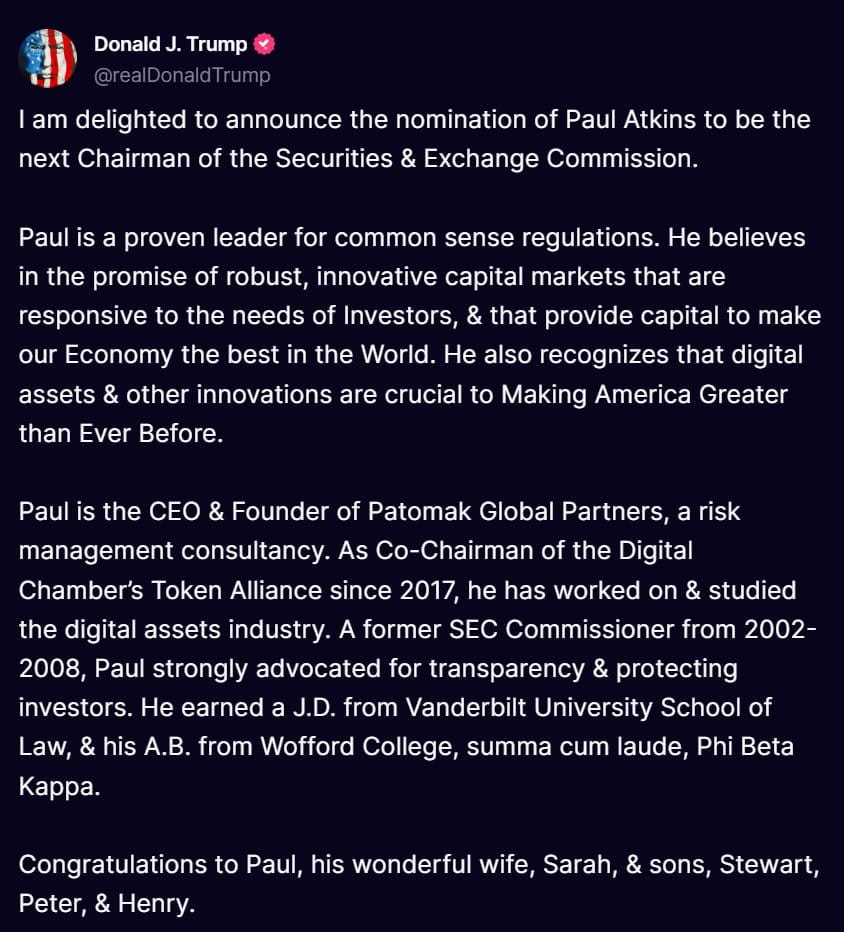 Screenshot of Donald Trump’s announcement regarding Paul Atkins
‘Solid Pick’
Atkins is a former SEC commissioner from the George Bush administration and possesses the progressive background that Trump could leverage at the regulatory agency. Since leaving at the end of Bush’s term, Atkins has articulated strong opposition to Dodd-Frank, a set of regulations implemented after the 2008 financial crisis aimed at enacting significant changes to the U.S. financial regulatory framework.
Atkins’ tenure at the SEC also positions him as a suitable candidate in the Trump administration, according to prior reports. The former commissioner has opposed substantial fines for companies breaching securities laws. Recently, he has engaged in crypto advocacy through the lobby group, Token Alliance.
Mason Jappa, CEO of U.S.-based Bitcoin mining firm Blockware, characterized Trump’s nomination of Atkins as “a solid pick.”
“What cryptocurrency needs from the regulators to flourish in America is transparency and consistency – Atkins is recognized for both,” Jappa informed Cryptonews, adding:
Related Posts
“At the very least, crypto will thrive in a neutral regulatory environment, and Atkins, as a Libertarian, can provide that even if he does not end up being radically pro-crypto.”
Jappa expressed his expectation that Atkins will establish “a clear set of rules for large capital allocators to start taking the industry more seriously.”
He noted that the SEC’s approval of spot Bitcoin and Ethereum exchange-traded funds (ETFs) was “a significant step in that direction.”
Regulatory Clarity
Some critics seem to worry about potential deregulation during Atkins’ leadership. However, George Georgiades, general counsel at stablecoin payments network Borderless.xyz, stated that the crypto industry has consistently called for regulatory clarity, not deregulation. It seeks a structured rule-making process, he asserted.
Speaking to Cryptonews, Georgiades remarked that Atkins is joining the SEC at a “critical time [for] our industry.” He anticipates that the 66-year-old will implement changes that will position America as a leader in cryptocurrency adoption.
When asked about the modifications Atkins could introduce to support the crypto sector, Georgiades stated:
“It starts with returning to our traditional rule-making process and meaningful engagement between the SEC and market participants. [This is] to ensure there is regulatory clarity on how digital assets are characterized, defining the extent of the SEC’s jurisdiction versus other U.S. regulators and balancing consumer protection with the need to embrace innovation.”
Georgiades, a technology lawyer with expertise in regulatory compliance, mentioned that there are “complex legal issues” concerning the classification of certain crypto assets that require reform. This includes the design of staking products, stablecoin frameworks, and tokenized Real World Assets (RWA).
He indicated that such matters necessitate clarity “regarding whether oversight falls within the SEC’s jurisdiction. If so, how to integrate these products with our registration process or exemptions.”
Georgiades emphasized:
“The SEC’s mission is to protect investors; maintain fair, orderly, and efficient markets; and facilitate capital formation. Regulation by enforcement and ambiguity will not achieve those goals.”
Courage Kimber, an American crypto analyst and digital nomad, believes Atkins is Donald Trump’s “least controversial” choice due to his previous experience as SEC commissioner.
“Given that he [Atkins] works as a lobbyist for crypto firms and has connections to the Chamber of Digital Commerce, there’s a strong likelihood he will establish a clear regulatory framework for the industry to adhere to,” Kimber told Cryptonews via LinkedIn.
Could Paul Atkins Go for Deregulation?
According to Slava Demchuk, CEO of the compliance and blockchain forensics firm AMLBot, Atkins “could lean towards deregulation, potentially easing the compliance burden for crypto firms.”
Demchuk points out the various regulatory bodies and agencies currently overseeing the crypto sector, including the SEC, the Commodity Futures Trading Commission (CFTC), FinCEN, and the IRS.
He stated, “Without a unified regulatory framework or a clear understanding of each agency’s scope of authority, it becomes challenging for companies to navigate compliance requirements and operate effectively.”
Demchuk informed Cryptonews that he anticipates Atkins “to enhance support for crypto services within national banks, simplifying integration with traditional financial infrastructure.” He added:
“The administration might advocate for the use of regulatory sandboxes, allowing banks to safely explore blockchain and digital asset innovations without the constraints of heavy regulatory burdens. He would likely support minimal government intervention…”
Sid Powell, CEO and co-founder of the crypto lending platform Maple, remarked that Trump’s selection of Atkins “signals that the new administration is not only seeking proponents of crypto but also those who have invested time in building relationships within the industry.”
“U.S. innovators and startups in crypto/blockchain are likely to be more satisfied under an Atkins administration,” Powell told Cryptonews. “There’s going to be a stronger push for innovative laws and for regulators and key crypto players to collaborate rather than face regulatory challenges.”
However, all the expected reforms hinge on whether Atkins accepts the position. The former commissioner is hesitant to leave his consulting firm, Patomak Global Partners, due to the extensive work required to revamp the SEC, as reported by Coindesk, citing sources close to the situation. Atkins believes Gensler “mismanaged” the agency, according to these sources.
The post What Reforms Can We Expect from Paul Atkins at the SEC? appeared first on Cryptonews.
