Disclaimer: Information found on CryptoreNews is those of writers quoted. It does not represent the opinions of CryptoreNews on whether to sell, buy or hold any investments. You are advised to conduct your own research before making any investment decisions. Use provided information at your own risk.
CryptoreNews covers fintech, blockchain and Bitcoin bringing you the latest crypto news and analyses on the future of money.


It appears that each time Massachusetts Senator Elizabeth Warren is unsuccessful in passing an anti-crypto bill, she presents a new version. She has perfected the technique of introducing messaging bills—legislation aimed more at garnering media attention and fundraising than at actual enactment.
Warren’s most recent proposal, the Digital Asset Anti-Money Laundering Act, poses a threat to the fundamental principles of freedom and personal sovereignty inherent in crypto. While she contends that her legislation is essential for addressing illicit activities, a deeper examination indicates its potential to hinder innovation, compromise user privacy, and benefit large financial institutions.
The bill, co-sponsored by Kansas Senator Roger Marshall, is founded on the assertion that digital assets are increasingly utilized for criminal endeavors such as money laundering, ransomware incidents, and financing terrorism. Although some malicious actors misuse digital assets, the bill’s strategy of categorizing all developers and wallet providers as potential offenders is not only impractical but also perilous.
Related: The SEC is facing another defeat in its recycled lawsuit against Kraken
The most concerning aspect of the bill is the stipulation that digital asset developers adhere to Bank Secrecy Act (BSA) obligations and Know-Your-Customer (KYC) regulations. This effectively shifts the responsibility of law enforcement onto software developers, akin to holding car manufacturers accountable for the manner in which their vehicles are operated on public roads.
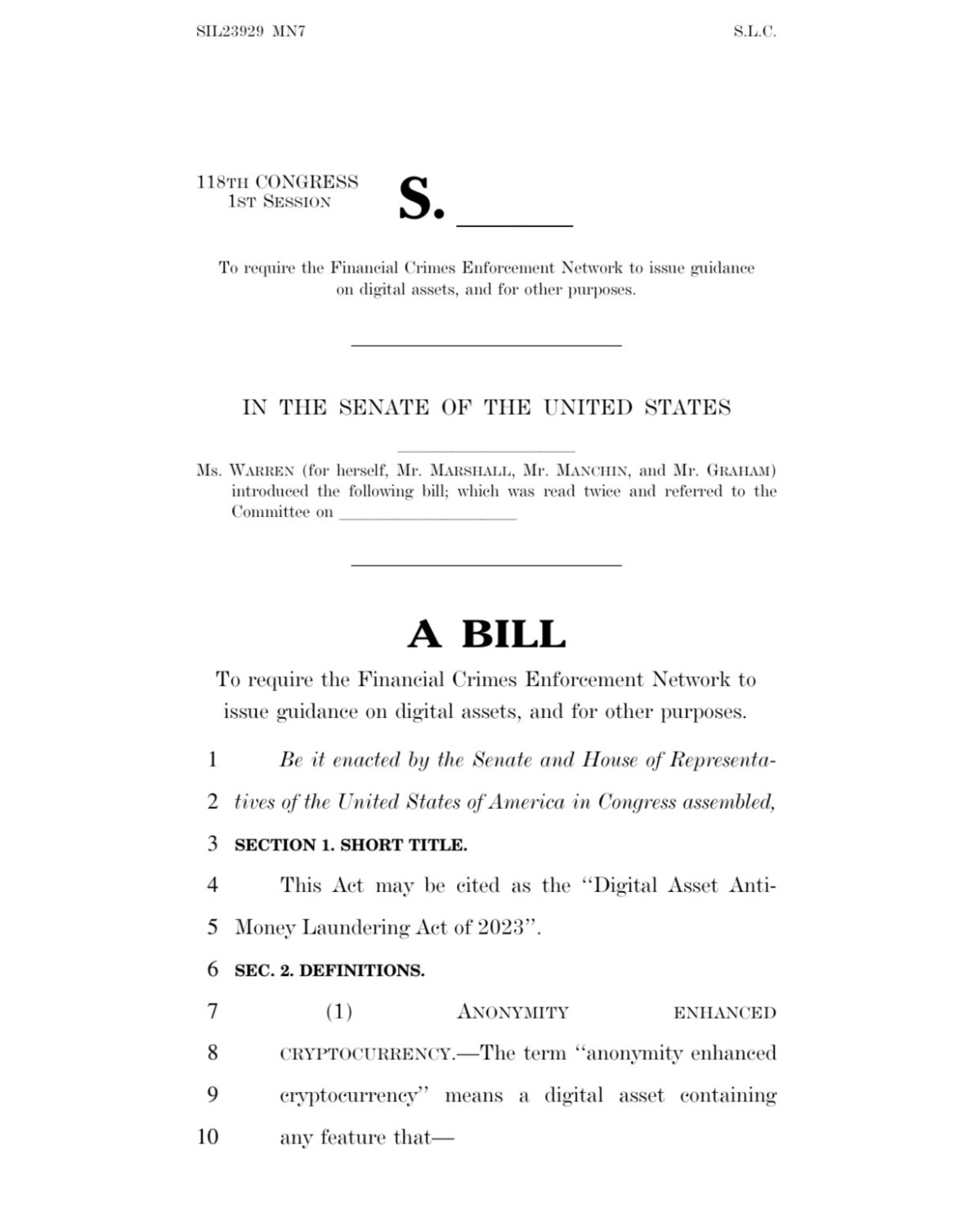 The Digital Asset Anti-Money Laundering Act of 2023.
The legislation also aims to eliminate privacy tools that safeguard crypto users from harmful entities. By targeting digital asset mixers and technologies that enhance anonymity, Warren’s initiative jeopardizes the privacy rights of law-abiding individuals. It is crucial to recognize that privacy is a fundamental right, not a privilege that can be easily disregarded. Numerous early Bitcoin (BTC) millionaires have faced kidnapping and torture due to the transparency of the Bitcoin blockchain; Warren’s approach would leave future Bitcoin users vulnerable to similar threats.
While she asserts that her actions are motivated by national security concerns, it is important to note that large banks would significantly benefit from reducing competition from cryptocurrencies. By imposing burdensome regulations, the bill would hinder crypto’s ability to compete fairly.
However, what about the assertion that digital assets are utilized by rogue nations and criminal organizations? While this concern is legitimate, it is vital to differentiate between the technology itself and the actions of a minority. The same rationale could be applied to cash, which has been used for illegal activities for centuries. Prohibiting cash would be an overreaction, just as overly restrictive regulations on crypto would be.
Related Posts
A significant issue is the bill’s stance on “unhosted” digital wallets, which enable individuals to circumvent AML and sanctions checks. While it is essential to prevent illicit transactions, the proposed requirement for banks and money service businesses to verify customer identities and report certain transactions involving unhosted wallets may lead to unintended consequences.
Mandating individuals to disclose personal information for every transaction contradicts the very principles that attract people to cryptocurrencies—privacy and pseudonymity. It is crucial to find a balance between security and individual rights. Excessive regulation could drive users away from regulated platforms, pushing them into unregulated environments that are harder to monitor.
Moreover, the bill’s emphasis on directing FinCEN to provide guidance on mitigating the risks associated with handling anonymized digital assets appears to misinterpret the fundamental principles of blockchain technology. Cryptocurrencies like Bitcoin are designed to be transparent yet pseudonymous. Attempting to eliminate this pseudonymity threatens one of the key features that make blockchain secure and appealing to users.
Related: BRC-20 tokens are presenting new opportunities for Bitcoin buyers
Another major concern is the potential overreach in extending BSA regulations to encompass digital assets. Mandating individuals involved in transactions exceeding $10,000 in digital assets through offshore accounts to file a Report of Foreign Bank and Financial Accounts (FBAR) may be excessive. This could impose unnecessary burdens on individuals using digital assets for legitimate purposes, such as cross-border remittances or investments.
Warren’s bill represents a blunt approach to a complex issue. Instead of stifling innovation and privacy, a more nuanced strategy would focus on targeting specific criminal activities and individuals. The existing AML framework, which large crypto exchanges adhere to, has proven effective in curbing illicit crypto usage, which is why only isolated incidents have been reported.
The Digital Asset Anti-Money Laundering Act is a fundamentally flawed piece of legislation. Warren’s proposal poses a genuine threat to the crypto community and risks benefiting large banks. It is crucial to seek a more balanced and effective solution that addresses concerns without suppressing the potential of this transformative technology.
J.W. Verret is an associate professor at George Mason University’s Antonin Scalia Law School. He is a practicing crypto forensic accountant and also practices securities law at Lawrence Law LLC. He is a member of the Financial Accounting Standards Board’s Advisory Council and a former member of the SEC Investor Advisory Committee. He also leads the Crypto Freedom Lab, a think tank advocating for policy changes to uphold freedom and privacy for crypto developers and users.
This article is for informational purposes only and is not intended to be and should not be construed as legal or investment advice. The views, thoughts, and opinions expressed here are solely those of the author and do not necessarily reflect or represent the views and opinions of Cointelegraph.
