Disclaimer: Information found on CryptoreNews is those of writers quoted. It does not represent the opinions of CryptoreNews on whether to sell, buy or hold any investments. You are advised to conduct your own research before making any investment decisions. Use provided information at your own risk.
CryptoreNews covers fintech, blockchain and Bitcoin bringing you the latest crypto news and analyses on the future of money.

Uzbekistan Approves Use of Stablecoins for Transactions and Tokenized Shares in Significant 2026 Reform

Uzbekistan is set to incorporate stablecoins into its official payment system and permit the issuance of tokenized stocks and bonds within a strictly regulated framework beginning in 2026, as reported by local media.
This initiative positions the nation to emerge as one of Central Asia’s most organized environments for regulated digital asset operations.
It signifies a significant transformation for a jurisdiction that previously enforced extensive restrictions on cryptocurrency usage but has spent recent years developing a more regulated and supervised framework for the industry.
Uzbekistan Prepares Licensed Exchanges for Tokenized Securities Trading in 2026
As per a report from local news source Kun on Friday, a new legal framework will come into effect on January 1, 2026, establishing a regulatory sandbox overseen by the National Agency for Perspective Projects in collaboration with the central bank.
This sandbox will facilitate the testing of stablecoins as a payment method within a controlled setting, where authorities will observe risks, market dynamics, and technical execution.
Pilot initiatives will also investigate a distributed ledger-based payment system and create a regulated marketplace for tokenized equities and bonds.
From that date, legal entities registered in Uzbekistan will be authorized to issue tokenized securities, with licensed stock exchanges preparing specialized trading platforms to facilitate their issuance and circulation.
This development follows several months of evaluation. In September, central bank chairman Timur Ishmetov indicated that stablecoins could be sanctioned for payments but only under stringent oversight due to their potential effects on monetary policy.
He warned that expectations surrounding digital currencies often surpass their practical applications in established payment systems, yet confirmed that the bank will persist in testing various models, including a wholesale CBDC aimed at expediting interbank settlements rather than catering to the public.
The decree builds upon Uzbekistan’s ongoing regulatory framework, which has mandated since January 2023 that all cryptocurrency transactions by residents must be conducted through locally licensed crypto asset service providers.
These regulations prohibit anonymous transactions, ban the use of foreign exchanges, require mandatory customer identification, and stipulate that providers retain transaction data for a minimum of five years.
Cryptocurrency is classified as an asset rather than legal tender, although stablecoins will now be the first category allowed for payment purposes within a controlled framework.
Related Posts
Mining remains legal but is subject to regulation, with companies required to utilize solar energy and register with the relevant agency.
New Rules Coincide With Industry Push to Standardize Blockchain Payments
The new stablecoin legislation follows a series of cost adjustments within the industry. In March 2024, monthly fees for crypto exchanges were increased to approximately $20,000 as part of a broader initiative to tighten market regulations and ensure compliance.
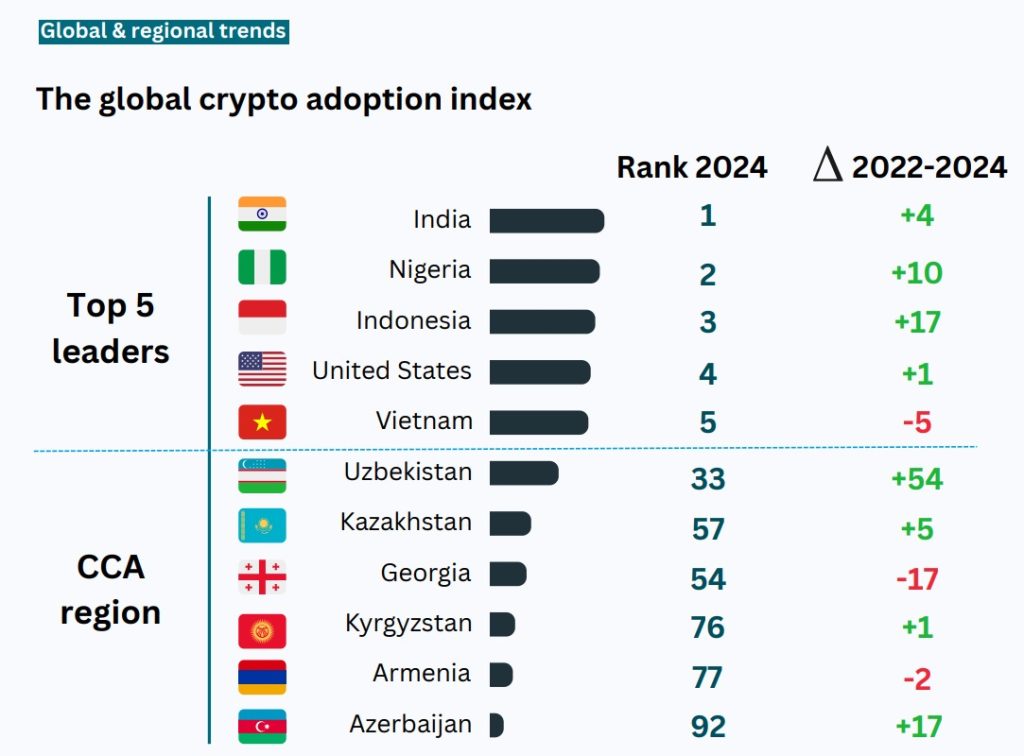
Uzbekistan has maintained a highly regulated approach even as activity expands. In 2024, nearly 1.5% of the population owned cryptocurrency, and licensed domestic providers processed transactions exceeding $1 billion.
The country ranked 33rd globally in adoption, leading Central Asia alongside Kazakhstan and Kyrgyzstan, both of which have pursued their own strategies regarding mining, payments, and licensing.
 Source: Rise Research
The global landscape surrounding payments is also evolving. Throughout 2025, several major jurisdictions formalized oversight for stablecoins.
The European Union began implementing its comprehensive MiCA regulations, the United States advanced federal legislation through the GENIUS Act, and regions such as Hong Kong and the UAE established licensing systems that bring stablecoin issuers under direct regulation.
Canada proposed its Stablecoin Act, while South Africa, Kenya, and Brazil advanced frameworks for stablecoin utilization in commerce and cross-border transactions.
Canada has moved to finalize stablecoin rules before its federal budget on Nov. 4, as officials seek alignment with the U.S. #Canada #stablecoinhttps://t.co/ICdUGsTA3a
— Cryptonews.com (@cryptonews) October 27, 2025
 Canada has moved to finalize stablecoin rules before its federal budget on Nov. 4, as officials seek alignment with the U.S. #Canada #stablecoinhttps://t.co/ICdUGsTA3a
These developments have occurred as blockchain-based payments continue to grow, with on-chain settlement volumes exceeding those seen in traditional card networks.
Another significant industry milestone was achieved as Fireblocks, Polygon Labs, Mysten Labs, Solana Foundation, TON Foundation, Stellar Development Foundation, and Monad Foundation established the Blockchain Payments Consortium aimed at standardizing the movement of digital assets across networks.
The post Uzbekistan Legalizes Stablecoins for Payments and Tokenized Stocks in Massive 2026 Overhaul appeared first on Cryptonews.
