Disclaimer: Information found on CryptoreNews is those of writers quoted. It does not represent the opinions of CryptoreNews on whether to sell, buy or hold any investments. You are advised to conduct your own research before making any investment decisions. Use provided information at your own risk.
CryptoreNews covers fintech, blockchain and Bitcoin bringing you the latest crypto news and analyses on the future of money.


The US Treasury executed a debt buyback initiative aimed at Treasury Inflation-Protected Securities valued at up to $500 million, with a settlement date of November 13, 2025, as part of ongoing measures to address the escalating national debt crisis.
This action occurs in the context of increasing alerts from financial leaders, including Ray Dalio, regarding the fiscal path of the United States, where government expenditures now exceed revenues by 40%, while proponents of cryptocurrency advocate for digital assets as possible solutions.
The buyback focused on TIPS set to mature between February 2040 and February 2055, with primary dealers presenting bids via the Federal Reserve Bank of New York’s FedTrade platform.
 Source: JEC
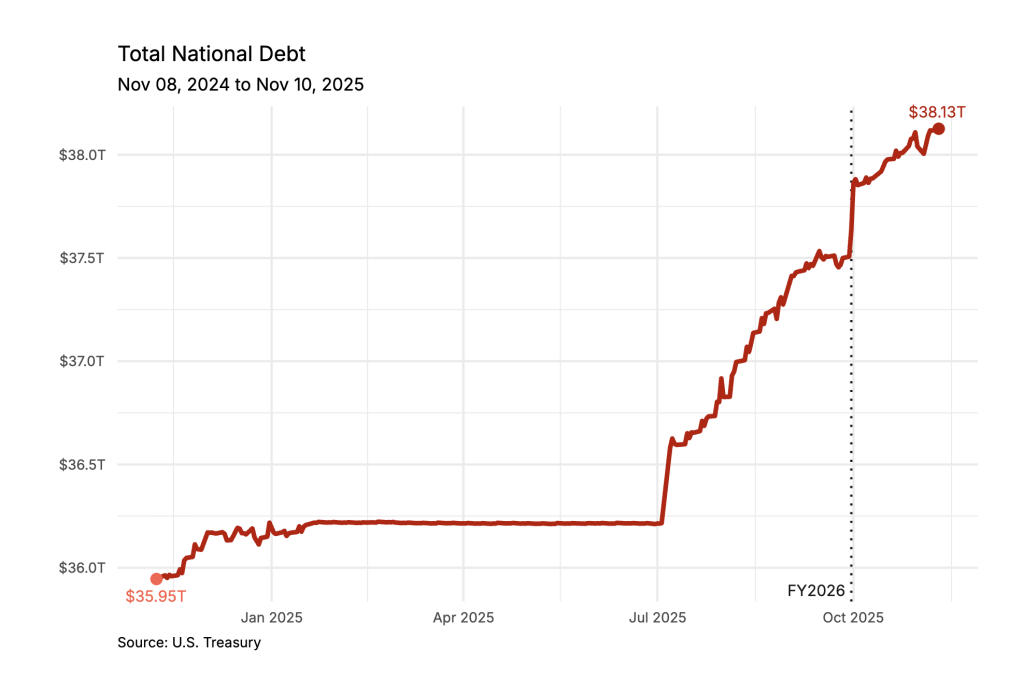
This operation is framed as a strategy for managing debt, as the total US debt nears $40 trillion, a milestone that has sparked significant discussion regarding sustainable fiscal policies and alternative financial systems.
It’s official:
The US government borrowed +$619 BILLION of debt during this 43-day government shutdown.
That’s +$14.4 billion PER DAY while the Federal government was shut down.
There’s only one thing that never stops in the US government:
Deficit spending.— The Kobeissi Letter (@KobeissiLetter) November 13, 2025
Dalio Warns of ‘Economic Heart Attack’ Within Three Years
Ray Dalio intensified his warnings regarding the debt crisis, asserting that the US is at risk of experiencing “an economic heart attack” unless the federal deficit is reduced from approximately 6% to 3% of GDP within the next three years.
The Bridgewater founder described a self-perpetuating cycle where excessive debt during economic downturns compels nations to print money, devalue their currency, increase inflation, and ultimately lead to political extremism as living standards deteriorate.
“We are operating with a $7 trillion expenditure and a $5 trillion revenue, we’re spending 40% more than we’re taking in, and this is a chronic issue,” Dalio articulated in a recent interview with Fox Business.
I want to explain in a nutshell why the US debt situation is at a very dangerous inflection point.
Put simply, the US is now spending 40% more than we’re taking in. This accumulation of debt service payments has spiraled over decades and is starting to squeeze away buying power.… pic.twitter.com/8IVZCUcoVb— Ray Dalio (@RayDalio) October 6, 2025
He likened the growing debt service payments to “plaque in the arteries, squeezing away buying power,” cautioning that the government must issue $12 trillion in debt, which includes $9 trillion in maturing obligations, $1 trillion in interest payments, and $2 trillion in new borrowing.
Dalio’s analysis from November 5 also raised additional concerns regarding Federal Reserve policy, indicating that quantitative easing measures combined with interest rate cuts into a developing bubble signify “stimulating into a bubble” rather than the historical trend of “stimulus into a depression.”
With AI stocks already exhibiting bubble-like traits, unemployment rates near historical lows, and inflation exceeding targets, he questioned whether the current monetary easing is edging toward debt monetization.
Consumer Debt Reaches Breaking Point
American households are experiencing unprecedented financial strain as student loan delinquencies surged to 14.3% in Q3 2025, marking the highest level ever recorded, while auto loan delinquencies reached 3% and credit card delinquencies climbed to 7.1%.
The Kobeissi Letter reported that consumers are “drowning in debt” despite relatively low unemployment figures.
Related Posts
 Source: The Kobeissi Letter
The crisis worsened following the end of student loan relief programs, with serious delinquencies rising 13.5 percentage points year-over-year as missed payments reemerged on credit reports.
Mortgage delinquencies increased to 1.3%, transitioning into serious delinquency, the highest level in eight years, while vehicle repossessions exceeded 1.7 million last year against a record $1.7 trillion in outstanding auto loans.
Car repos are at their highest since 2009. Over 1.7 million vehicles were repossessed last year as auto loans can’t be paid back.
The US now has a record $1.7 trillion in auto loans. Americans are drowning in debt.
If you want a new car wait, there will be many deals soon. pic.twitter.com/oLOPrgvjuL— Andrew Lokenauth | TheFinanceNewsletter.com (@FluentInFinance) November 8, 2025
Financial analysts caution that the wealth gap has reached extreme levels, with the top 10% of earners responsible for 49.2% of total US spending in Q2 2025, the highest since data collection began in 1989.
The impending resumption of wage garnishment for student loan defaults threatens to redirect billions from consumer spending, as nearly 2 million borrowers may see up to 15% of their paychecks withheld.
Economists Clash Over Debt Consequences
While Dalio’s warnings capture significant attention, economist Steve Keen contests the conventional debt narrative, asserting that governments that manage their own currency face fundamentally different limitations compared to households or corporations.
Keen highlighted that banks generate money when they lend, making credit an addition to aggregate demand rather than merely transfers between savers and borrowers.
President Trump heightened policy discussions by introducing a “tariff dividend” of at least $2,000 per American, potentially distributing over $400 billion to approximately 220 million adults earning below specific income thresholds.
The announcement drew immediate parallels to 2021 stimulus checks that preceded inflation nearing 10%, with critics questioning substantial handouts while stock markets remain near record highs and total US debt approaches $40 trillion.
Stimulus checks are back:
President Trump just announced the “tariff dividend,” a payment of AT LEAST $2,000 per American.
We expect 85%+ of US adults to receive this, resulting in $400+ BILLION handed out.
All as US debt nears $40 trillion.
What’s next? Let us explain. pic.twitter.com/1xVSyq4UUN— The Kobeissi Letter (@KobeissiLetter) November 9, 2025
What Does America’s Debt Crisis Mean for Crypto?
Trump framed cryptocurrency as a means of fiscal relief, asserting that it “takes a lot of pressure off the dollar,” while Senator Cynthia Lummis is promoting Strategic Bitcoin Reserve legislation, viewing it as the “only solution” to mitigate the National Debt.
The administration perceives cryptocurrency as a feasible hedge against the rising national debt.
However, market analysts remain divided, with some speculating that an increased focus on stablecoins could shift attention away from Bitcoin accumulation strategies, despite an overall favorable regulatory sentiment toward digital assets as alternatives to debt.
The post US Treasury Buys Back $142M in Debt — Here’s What It Means for Crypto appeared first on Cryptonews.
