Disclaimer: Information found on CryptoreNews is those of writers quoted. It does not represent the opinions of CryptoreNews on whether to sell, buy or hold any investments. You are advised to conduct your own research before making any investment decisions. Use provided information at your own risk.
CryptoreNews covers fintech, blockchain and Bitcoin bringing you the latest crypto news and analyses on the future of money.


The Senate Agriculture Committee has unveiled revised legislation for the crypto market structure and has set a markup date for January 27, even though it has not garnered support from the Democrats, indicating a possible transition to a partisan approach after prolonged bipartisan discussions have stalled.
Chairman John Boozman announced the legislative text yesterday, recognizing that “differences remain on fundamental policy issues” while expressing appreciation for the partnership with Senator Cory Booker.
“While it’s regrettable that we couldn’t come to a consensus, I am thankful for the collaboration that has enhanced this legislation,” Boozman remarked, adding that the markup will take place at 3 p.m. in the Russell Senate Office Building.
BREAKING: Chairman @JohnBoozman unveils updated market structure legislation ahead of the January 27th markup. https://t.co/PB7O9FMJlZ pic.twitter.com/k7FuIBgEsk
— Senate Ag Committee Republicans (@SenateAgGOP) January 22, 2026
Legislative Path Narrows as Banking Panel Delays CLARITY Act
The Agriculture Committee’s move to promote its Digital Commodity Intermediaries Act comes as the Senate Banking Committee has postponed discussions on the parallel CLARITY Act until late February or March, according to sources.
The Banking panel has shifted its focus to housing legislation following President Trump’s advocacy for affordability, with the president stating that he is taking “immediate steps” on the housing bill, which remains a priority and part of the “American Dream.”
This delay followed the public withdrawal of support by Coinbase CEO Brian Armstrong over aspects he deemed “catastrophic,” including limitations on tokenized equities and stablecoin yield.
Patrick Witt, Executive Director of the President’s Crypto Council, countered Armstrong’s position of “no bill is better than a bad bill,” cautioning that postponing legislation could lead to future Democratic lawmakers enacting “punitive legislation in the wake of a crisis, à la Dodd-Frank.”
“You might not appreciate every aspect of the CLARITY Act, but I can assure you that you’ll dislike a future Democratic version even more,” Witt wrote.
Meanwhile, President Trump confirmed at Davos 2026 that he anticipates signing crypto market structure legislation “very soon,” indicating that his administration is striving to ensure “America remains the crypto capital of the world.“
JUST IN:
President Trump expresses hope to sign the crypto market structure bill (CLARITY Act) soon. pic.twitter.com/2tQQqeefwP
— Altcoin Daily (@AltcoinDaily) January 21, 2026
 President Trump expresses hope to sign the crypto market structure bill (CLARITY Act) soon. pic.twitter.com/2tQQqeefwP
Democratic opposition has escalated due to ethical concerns, with Senator Adam Schiff insisting on regulations covering the White House and Senator Ruben Gallego deeming ethical guardrails “a red line.”
Key Differences Between Competing Bills Shape Industry Response
The updated bill differs from the Banking’s CLARITY Act on several significant issues, particularly concerning stablecoin yield, which has been the primary source of division within the industry.
Related Posts
CLARITY’s Section 404 specifically forbids digital asset service providers from offering interest or yield solely for holding payment stablecoins, though it allows for “activity-based” incentives for transactions, loyalty programs, staking, or governance participation.
The new legislation adopts a fundamentally different stance by entirely excluding “permitted payment stablecoins” from CFTC oversight, deferring regulation to frameworks such as the GENIUS Act instead of establishing specific yield guidelines.
Importantly, the bill also categorizes meme coins explicitly as digital commodities under CFTC jurisdiction, defining them as assets “inspired by internet memes, characters, or current events, where promoters aim to attract an enthusiastic community primarily for speculative purposes.“
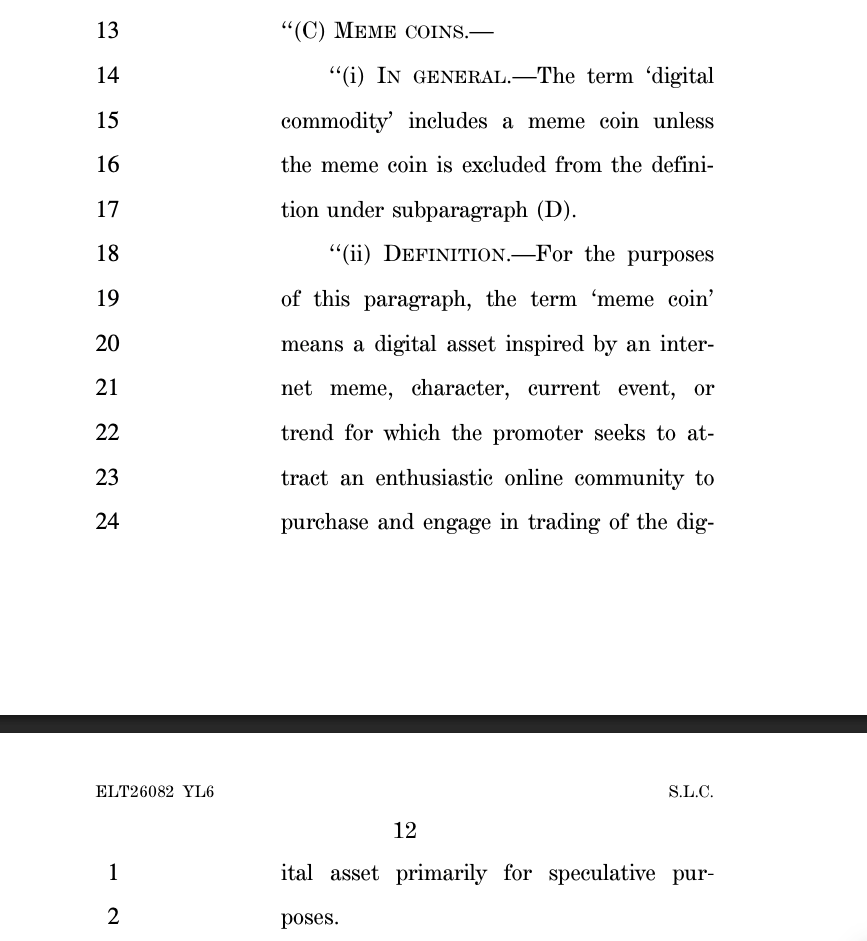 An excerpt of the Republican draft crypto bill. | source: Senate Agriculture Committee
Conversely, CLARITY introduces the concept of “ancillary assets” with exemptions for tokens that were the principal assets of ETFs listed as of January 1, 2026.
Regarding developer protections, the bill establishes an Office of the Digital Commodity Retail Advocate within the CFTC, while CLARITY proposes a CFTC-SEC Micro-Innovation Sandbox for smaller firms.
Both bills aim to protect software developers from regulation, although CLARITY’s Section 604 raised concerns from Judiciary Committee leaders Chuck Grassley and Dick Durbin that it could “materially limit prosecutors’ ability to pursue financial crime cases.“
Banking Lobby Secures Stablecoin Restrictions Amid Industry Split
The debate over stablecoin yield has revealed significant divides between crypto platforms and traditional banks.
Bank of America CEO Brian Moynihan recently cautioned that as much as $6 trillion in deposits (approximately 30% to 35% of US commercial bank deposits) could transition to stablecoins, while JPMorgan CFO Jeremy Barnum referred to yield-bearing stablecoins as “a parallel banking system that incorporates something that resembles a deposit that yields interest, without the corresponding safeguards.“
Galaxy Digital also issued a warning that the Banking’s draft could provide the Treasury with “Patriot Act–style” surveillance powers, including the authority to freeze transactions for up to 30 days without court orders.
In light of this growing tension with banks, Armstrong indicated that Coinbase is considering compromises with them during discussions at Davos, stating, “we’re going to continue to work on the market structure legislation and meet with some of the bank CEOs to determine how we can create a win-win situation.“
Coinbase CEO @brian_armstrong announced he will take US crypto market structure discussions to Davos, seeking a resolution with banks as legislation progress stalls in Washington. #Coinbase #CryptoMarketStructure https://t.co/GKvYIkcTSs
— Cryptonews.com (@cryptonews) January 20, 2026
 Coinbase CEO @brian_armstrong announced he will take US crypto market structure discussions to Davos, seeking a resolution with banks as legislation progress stalls in Washington. #Coinbase #CryptoMarketStructure https://t.co/GKvYIkcTSs
Despite the regulatory ambiguity, Clear Street analyst Owen Lau remarked that “institutional use cases continue to grow even without a favorable Clarity Act,” highlighting ongoing blockchain adoption by significant financial institutions.
The post US Senate Crypto Bill Heads to Markup Without Democrat Support appeared first on Cryptonews.
