Disclaimer: Information found on CryptoreNews is those of writers quoted. It does not represent the opinions of CryptoreNews on whether to sell, buy or hold any investments. You are advised to conduct your own research before making any investment decisions. Use provided information at your own risk.
CryptoreNews covers fintech, blockchain and Bitcoin bringing you the latest crypto news and analyses on the future of money.


Ukraine has moved to limit access to Polymarket, exacerbating a growing global crackdown on prediction markets, which regulators are increasingly viewing as illegal gambling or derivatives trading.
This decision has brought renewed attention to the rapidly expanding crypto platform, raising concerns about whether markets associated with real-world occurrences can function alongside national gambling, financial, and public policy regulations, particularly regarding issues related to war and geopolitics.
The prohibition was enacted on Dec. 10, 2025, by Ukraine’s National Commission for the Regulation of Electronic Communications under Resolution No. 695.
The directive mandates that internet service providers block access to online platforms that organize, conduct, or facilitate gambling activities without a valid domestic license.
War-Linked Bets Prompt Ukraine to Ban Polymarket
As part of the enforcement measures, the domain polymarket.com was added to Ukraine’s official list of blocked websites, effectively denying access for users within the nation.
Local news outlets reported the enforcement on Monday, confirming that the block is now in effect.
Ukrainian authorities have cited Polymarket’s role in enabling bets on geopolitical outcomes related to Russia’s invasion as a significant factor behind the action.
Although Polymarket does not provide fixed odds like traditional betting sites, regulators contend that the difference is mostly technical.
The platform allows users to trade shares associated with specific outcomes, with prices indicating the market’s implied probability.
From Ukraine’s perspective, this arrangement still qualifies as gambling when offered without proper authorization, particularly when the underlying events involve an active military conflict.
Polymarket, established in 2020 by Shane Coplan, has emerged as one of the leading prediction platforms globally, boasting an estimated valuation of approximately $8 billion.
All transactions on the platform are conducted using the USDC stablecoin on the Polygon blockchain, making transactions and settlements transparent and publicly accessible.
Proponents often highlight this transparency as an important distinction from offshore betting sites, but regulators in various jurisdictions have remained skeptical.
Related Posts
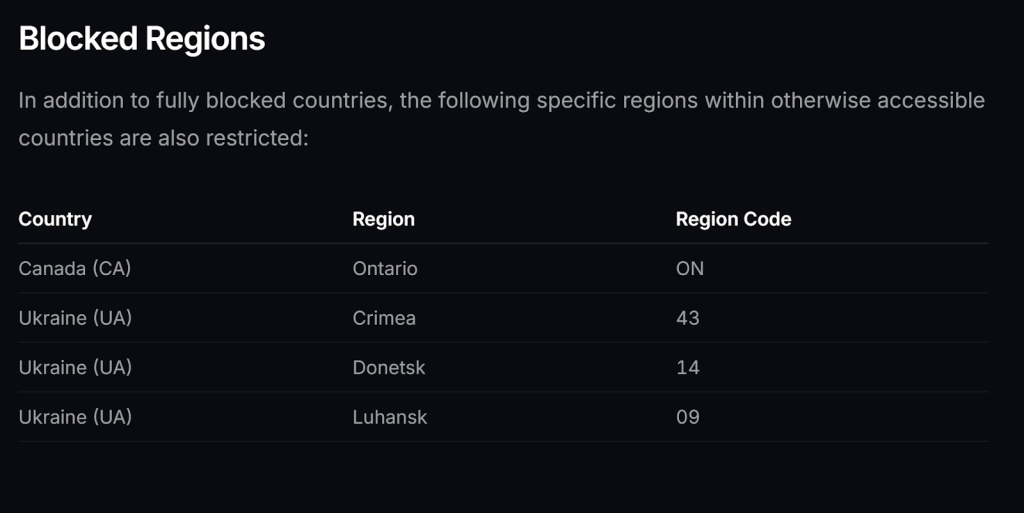
Ukraine’s decision aligns it with a growing number of jurisdictions that have limited or entirely blocked Polymarket.
The platform is currently inaccessible in at least 33 countries, which include the United States, the United Kingdom, France, Germany, Italy, Poland, Singapore, Australia, Iran, and Russia.
 Source: Polymarket
In certain areas, access is partially restricted, permitting users only to close existing positions while prohibiting new trades.
Polymarket’s own documentation attributes these restrictions to a combination of international sanctions, local gambling regulations, financial laws, and anti-money laundering mandates.
Prediction Markets Under Increasing Global Scrutiny
The Ukrainian ban also mirrors a wider global initiative to regulate prediction markets as their reach and influence grow. In the United States, scrutiny has heightened in recent weeks.
On Jan. 9, the Tennessee Sports Wagering Council sent cease-and-desist letters to Polymarket, Kalshi, and Crypto.com.
Tennessee directed @Kalshi, @Polymarket, and @cryptocom to cease sports-related contracts and issue refunds by Jan. 31, 2026.#Crypto #Predictionhttps://t.co/wYtnlKL94h
— Cryptonews.com (@cryptonews) January 11, 2026
 Tennessee directed @Kalshi, @Polymarket, and @cryptocom to cease sports-related contracts and issue refunds by Jan. 31, 2026.#Crypto #Predictionhttps://t.co/wYtnlKL94h
Regulators accused these platforms of providing unlicensed sports betting products in breach of state law, despite their registration with the Commodity Futures Trading Commission as designated contract markets.
At the federal level, concerns have expanded beyond licensing to issues of public integrity. On Jan. 6, New York Representative Ritchie Torres announced intentions to introduce the Public Integrity in Financial Prediction Markets Act of 2026.
@RitchieTorres seeks to prohibit officials from participating in prediction markets following a $400K Maduro wager.
#PredictionMarkets #USPolitics https://t.co/SgGankYd1U— Cryptonews.com (@cryptonews) January 6, 2026
The enforcement actions coincide with Polymarket’s efforts to regain a presence in the U.S. market.
After leaving the country in 2022 and paying a $1.4 million fine to resolve CFTC allegations, the platform has been testing a limited U.S. exchange after acquiring QCX LLC and obtaining a designated contract market license.
The post Ukraine Blocks Polymarket Over ‘War Bets’ as Global Crackdown Widens appeared first on Cryptonews.
