Disclaimer: Information found on CryptoreNews is those of writers quoted. It does not represent the opinions of CryptoreNews on whether to sell, buy or hold any investments. You are advised to conduct your own research before making any investment decisions. Use provided information at your own risk.
CryptoreNews covers fintech, blockchain and Bitcoin bringing you the latest crypto news and analyses on the future of money.

UK FCA Discloses 87% of Cryptocurrency Companies Did Not Obtain Licensing Compliant with Anti-Money Laundering Regulations

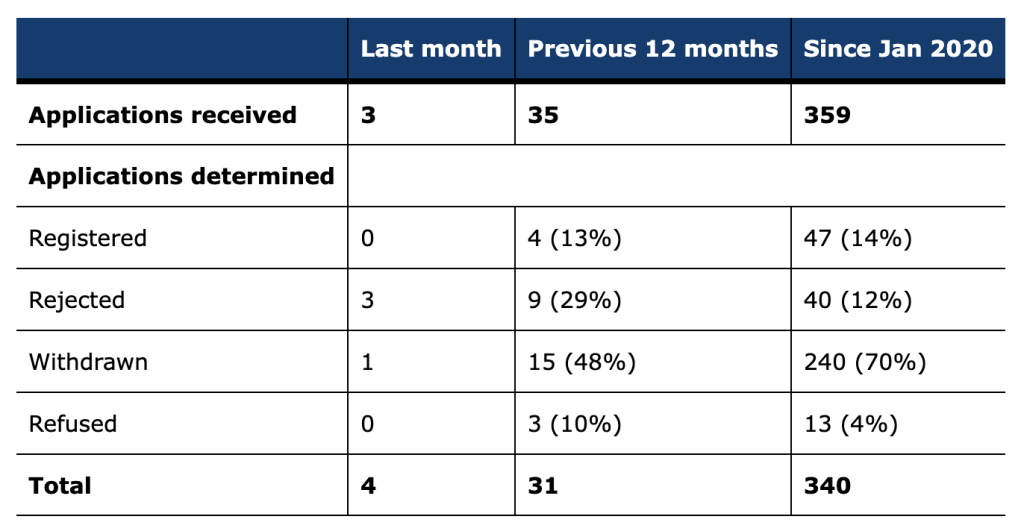
The UK Financial Conduct Authority (FCA) announced on September 3 a significant 87% failure rate for crypto companies attempting to obtain licensing under the nation’s money laundering regulations in the most recent fiscal year.
The report indicates that only four firms—BNXA (a payment partner of Binance), a PayPal U.K. subsidiary, and Komainu (a crypto custody joint venture of Nomura)—received approval from a total of 35 applications submitted between April 2023 and March 2024.
The remaining applications were either denied, declined, or withdrawn due to incomplete submissions or failure to satisfy the FCA’s stringent criteria.
Since the FCA commenced its oversight of the crypto sector’s anti-money laundering compliance in January 2020, it has processed 359 applications, with only 44 firms successfully registering.
 Source: FCA
44 Out of 356 Applications Approved, What Is Happening?
The FCA’s report indirectly highlights the challenges many crypto firms face during the registration process.
Feedback from industry stakeholders suggests that prolonged wait times, limited feedback, and what some characterize as inconsistent treatment by the FCA have rendered the process particularly difficult.
This situation has prompted some companies to withdraw their applications or pursue registration in more crypto-friendly jurisdictions, enabling them to continue servicing UK customers from abroad.
A primary criticism from rejected applicants is the lack of transparency and clarity regarding the FCA’s expectations. The FCA has defended its stance, asserting that it provides comprehensive guidance to assist firms in understanding the registration requirements.
The regulator’s feedback reveals that numerous applications were missing essential elements needed for a complete evaluation, with some submissions considered invalid due to inadequate quality or incomplete details.
The FCA’s rigorous standards aim to ensure that crypto firms comply with strong anti-money laundering (AML) and counter-terrorist financing (CTF) protocols.
Nonetheless, the regulator’s strict approach has ignited discussions about whether the regulatory landscape is overly restrictive, potentially hindering innovation and driving businesses offshore.
Related Posts
UK Crypto Position Amid Growing Public Interest
Looking forward, the FCA is set to gain more authoritative control over the crypto sector, pending new legislation that would empower it to authorize crypto companies to operate fully within the UK.
However, this regulatory development may take time due to the new Labour government’s decision to pause crypto-specific legislative initiatives following its assumption of office in July 2024.
As of September 2024, the FCA’s ongoing challenge is to balance strict regulatory oversight with the necessity of nurturing a dynamic and innovative crypto industry.
The regulator has expressed its commitment to maintaining high standards, yet recent statistics indicate otherwise. The obstacles encountered by crypto firms attempting to navigate this landscape are becoming increasingly complex.
To assist potential applicants, the FCA has provided extensive feedback on the quality of applications received, highlighting both effective and ineffective practices under the Money Laundering, Terrorist Financing, and Transfer of Funds (Information on the Payer) Regulations 2017.
This feedback is intended to help firms better prepare their applications and comprehend the FCA’s requirements, potentially enhancing the approval rate in the future.
Aligning with the FCA’s expectations and upholding rigorous compliance standards will be crucial for both current and prospective applicants aiming to establish a presence in the UK market.
This is especially significant as a recent survey by Zumo and Focaldata indicated that over a third of young adults in the UK regard cryptocurrency as a vital electoral issue ahead of the forthcoming General Election.
The survey, which included more than 3,000 UK adults, found that 34% of individuals aged 18-34 believe that politicians should prioritize the growth of the crypto industry, with 38% of 18-24 year-olds having directly invested in crypto.
Many young adults view digital assets as a potential long-term financial opportunity; numerous individuals have friends or family involved in crypto investments.
The interest in digital assets among young adults suggests that the country’s regulatory stance requires improvement.
The post UK FCA Reveals 87% of Crypto Firms Failed to Secure Licensing Under Money Laundering Rules appeared first on Cryptonews.
