Disclaimer: Information found on CryptoreNews is those of writers quoted. It does not represent the opinions of CryptoreNews on whether to sell, buy or hold any investments. You are advised to conduct your own research before making any investment decisions. Use provided information at your own risk.
CryptoreNews covers fintech, blockchain and Bitcoin bringing you the latest crypto news and analyses on the future of money.


The Conservatives were not anticipated to triumph in the UK’s general election, as polls consistently indicated that Labour would reclaim power after a 14-year period.
However, it was a pivotal and noteworthy evening for British politics, with the Tories experiencing their most significant defeat to date, losing an astonishing 250 seats.
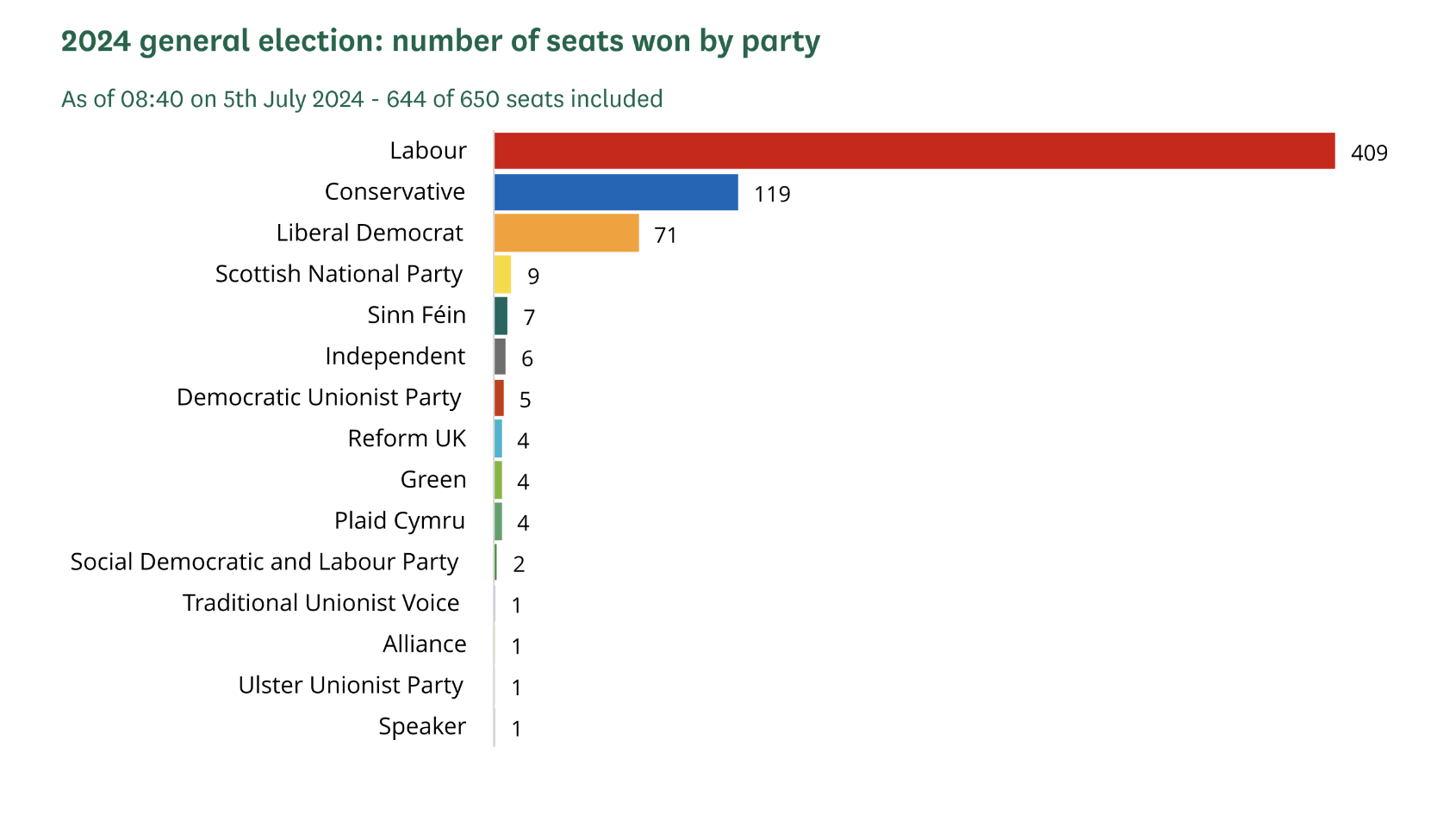 Source: UK Parliament
In the meantime, Sir Keir Starmer — the newly appointed prime minister — has achieved a substantial majority, securing 412 out of the 650 available seats.
Unavoidably, the focus now shifts to the implications this has for the cryptocurrency sector in the world’s sixth-largest economy. In brief, the impact is considerable.
Rishi Sunak’s government had vigorously promoted digital assets, outlining a vision for the UK to emerge as a “global crypto hub.” These ambitions may be sidelined with Sir Keir in 10 Downing Street, particularly since he will have more urgent issues to address.
The significant turnover of MPs, with 300 new representatives set to enter the Commons, indicates that the crypto industry has lost some of its most crucial connections in Westminster.
Evidence of this can be seen in the status of the All-Party Parliamentary Group on crypto and digital assets, which was responsible for reviewing policies affecting the sector.
A total of eight Conservative MPs were part of this group — with chairwoman Lisa Cameron resigning from her political role before the election took place. She was unlikely to win regardless.
Out of the seven remaining Tories, all lost their seats, meaning the crypto sector has now officially lost its representation in the House of Commons. Currently, only unelected members of the House of Lords remain in the group.
This should raise concerns among businesses and investors who have been advocating for increased regulatory clarity.
‘Labour aren’t interested’
David Gerard, a prominent critic of cryptocurrencies, informed Cryptonews that there was “little evidence that any party in the 2024 election cared about crypto.”
He stated: “Neither Labour nor the Conservatives mentioned it in the weeks since the election was announced. I don’t believe the public is particularly interested in crypto at the moment — they are focused on other pressing issues.”
Gerard’s assertion holds merit. The cost-of-living crisis, coupled with the burden of high interest rates on mortgage payments, is a far more urgent concern.
One could argue that political parties willing to discuss crypto might have faced backlash for being out of touch — similar to the criticism Rishi Sunak received when he revealed (and later abandoned) plans for the UK to introduce an official non-fungible token.
“I was somewhat surprised that the Tories didn’t even mention crypto — Rishi Sunak has previously promoted blockchain. However, I suspected at the time that this was simply due to a lack of ideas,” Gerard added.
A significant factor was undoubtedly the numerous gaffes and scandals that overshadowed Sunak’s campaign. He faced condemnation for departing early from D-Day commemorations, and his party was engulfed by allegations that senior officials speculated on the election date — diverting attention from his campaign messages.
With Sir Keir Starmer now in charge, is there any chance he will continue to support digital assets in the same manner as his predecessor?
“I’ve noticed a lot of hopeful thinking in the crypto media that Labour will take action for crypto when in power. However, there is simply no evidence that they are particularly interested,” Gerard remarked.
A cautious welcome
Cryptonews contacted several British crypto exchanges and lobbying organizations for their responses to Labour’s significant victory — but few were willing to publicly comment on political matters. This may indicate a desire to avoid premature conclusions about what Sir Keir’s administration will entail. It could also reflect a reluctance to mourn the loss of Tories who supported their cause, given the party’s current scandals.
Kraken’s UK managing director Bivu Das stated it will “largely be business as usual” for the crypto sector as a policy framework has already been established, but he cautioned: “Legislation is still pending, and time is running out for the UK to capitalize on the opportunity … The incoming government has a chance to continue fostering innovation and growth in this emerging asset class and reinforcing the UK’s status as a leading jurisdiction for blockchain-based innovation.”
Earlier in January, before the election was announced, Labour had unveiled details of their “plan for financial services,” which primarily focused on tokenization and the introduction of a central bank digital currency, informally referred to by some as “Britcoin.” However, neither of these policies made it into the manifesto — with crypto not mentioned at all.
Related Posts
A representative for Britain’s trade association for the digital assets sector, CryptoUK, informed Cryptonews that the group had established strong connections with the previous government and adopted an optimistic stance.
“We have built solid relationships with Labour MPs and policymakers, and we aim to strengthen these connections moving forward to promote the UK’s digital assets industry,” they stated.
While CryptoUK acknowledged that “job growth and inclusivity are key priorities” for Sir Keir Starmer, it argued that the digital assets sector “can significantly contribute to these objectives.”
Warning that a “comprehensive strategy” for the sector “remains elusive,” the spokesperson added: “As the landscape evolves rapidly, CryptoUK urges Labour to prioritize clarity and proactive policymaking to fully leverage our sector’s potential.”
Reasons to be cheerful?
Although it may seem like it, the crypto sector is not starting from scratch as Labour returns to power for the first time since 2010, when Bitcoin was merely 18 months old.
Recognizing the shifting political landscape, Coinbase made the strategic choice to host a breakfast in Davos attended by Rachel Reeves, who now becomes the first female Chancellor of the Exchequer (finance minister) in UK history.
“The next Labour government will collaborate with the tech sector to bring jobs and prosperity to Britain,’ she posted on X at the time.
Additionally, other senior Labour officials have also expressed support for Web3.
Former MP Andy Burnham, now Labour’s Mayor of Greater Manchester and widely regarded as a potential future prime minister, attended an event hosted by the Manchester Blockchain Alliance last month that received little media coverage at the time.
In significant remarks, Burnham stated that Web3 “fascinated” him — and he believes the sector could democratize technology and enhance inclusion.
Positioning Manchester as the ideal location for businesses in this field, he expressed a desire to “ensure the talent we have can come in… to establish this as the Web3 powerhouse we aspire to be” — and assured executives at the event that he was “in.”
Cryptonews reached out to Burnham’s office for comments on this feature, but a spokesperson indicated he was unable to respond due to the election campaign.
However, Lisa McClory from the Manchester Blockchain Alliance told Cryptonews: “In the coming years, the crypto sector will need to adapt to a wave of new regulations globally, which will present challenges. Blockchain, alongside AI, is part of the essential toolkit of digital technologies required to deliver real-world applications for businesses and society.
“We hope to see innovation-friendly regulation as well as governmental support for founders and entrepreneurs in navigating these new regulatory frameworks.”
Another noteworthy point is that Nigel Farage — the polarizing right-wing figure — has finally become an MP on his eighth attempt. He has been a vocal opponent of CBDCs, even participating in the Bitcoin Amsterdam conference in 2022. Unfortunately, given that his nascent Reform UK party holds only four seats, it is improbable that his support for crypto will significantly influence policy changes.
What now for ousted Tories?
Hundreds of former Conservative MPs are now coming to terms with their unemployment — and eventually, some will likely seek lucrative positions in the private sector.
It is highly probable that some will gravitate towards the crypto industry, following the example of former chancellor Philip Hammond, who is now the chairman of the custody firm Copper.
However, with the Tories significantly weakened, now reduced to just 121 seats, they will have considerably less influence in the corridors of power than before.
July 4 marked a seismic shift in the UK — the repercussions of which will not be fully realized for weeks, months, or even years.
Given the country’s struggles with an uncertain economy, a beleaguered health service, and conflicts in Ukraine and the Middle East, crypto will likely be far down Sir Keir Starmer’s agenda.
That is, if it is on his agenda at all.
The post UK Election: Why Labour’s Big Win May Be Bad News for Crypto appeared first on Cryptonews.
