Disclaimer: Information found on CryptoreNews is those of writers quoted. It does not represent the opinions of CryptoreNews on whether to sell, buy or hold any investments. You are advised to conduct your own research before making any investment decisions. Use provided information at your own risk.
CryptoreNews covers fintech, blockchain and Bitcoin bringing you the latest crypto news and analyses on the future of money.


According to a recent analysis by FinCEN of 137,153 Bank Secrecy Act reports, US financial institutions processed $312 billion in suspicious transactions associated with Chinese money laundering networks from January 2020 to December 2024.
These unexpectedly large figures come to light as cryptocurrency exchanges encounter heightened regulatory scrutiny regarding money laundering, even though traditional banking systems manage significantly larger amounts of illicit funds.
FinCEN has released an Advisory and Financial Trend Analysis, raising concerns about Chinese money laundering networks, which represent a considerable risk to the U.S. financial system. https://t.co/QejJmzQaYw
— Financial Crimes Enforcement Network (FinCEN) (@FinCENnews) August 28, 2025
Chinese money laundering networks have formed intricate alliances with drug cartels based in Mexico, taking advantage of currency restrictions in both nations.
Mexican currency regulations restrict large dollar deposits in local banks, while China’s currency controls limit overseas transfers by its citizens. This regulatory loophole enables cartels to sell illicit dollars to Chinese individuals looking to bypass Beijing’s capital controls.
The networks extend beyond drug trafficking to include human trafficking, healthcare fraud, and real estate transactions amounting to $53.7 billion in suspicious activities.
FinCEN reported 1,675 cases related to human trafficking and 43 reports involving $766 million in questionable adult day care center activities in New York alone.
Banks Manage Majority of Criminal Funds While Crypto Faces Scrutiny
Banks were responsible for $246 billion of the total suspicious transactions, while money service businesses managed $42 billion and securities firms processed $23 billion.
The average annual flow through US banking systems from Chinese money laundering operations alone reached $62 billion.
Historical instances highlight systemic banking vulnerabilities to criminal exploitation.
Wachovia Bank laundered $350 billion for Mexican drug cartels from 2007 to 2010, incurring only a $160 million penalty despite the enormous scale.
Danske Bank processed $228 billion in suspicious transactions from Russia between 2007 and 2015, disregarding internal warnings throughout that time.
Likewise, HSBC paid $1.9 billion in 2012 for permitting drug cartels to transfer hundreds of millions through accounts, with criminals utilizing specially designed cash deposit boxes that fit seamlessly into bank slots.
TD Bank consented to pay over $3 billion after prosecutors discovered the institution had been used to launder more than $470 million through Chinese networks in New York and New Jersey.
In fact, dating back to 2021, the 1MDB scandal involved over $1 billion misappropriated through global banking networks, with funds used to acquire luxury real estate, yachts, and artwork in major cities.
Related Posts
Bank of Credit and Commerce International laundered billions for drug cartels and corrupt governments before its closure in 1991, which led to stricter international banking regulations.
Criminal organizations recruit bank employees as willing insiders and utilize counterfeit Chinese passports to facilitate account openings.
Money mules frequently claim occupations such as “student,” “housewife,” or “retired” during onboarding to justify large transaction volumes that do not align with their stated professions.
Regulators Focus on Crypto Despite Minimal Share of Illicit Activity
Cryptocurrency transactions account for ‘less than 1%‘ of total money laundering activities globally, as reported by TRM Labs.
Indeed, Chainalysis data indicates that illicit crypto volumes reached approximately $189 billion over five years, in contrast to over $2 trillion laundered annually through traditional financial systems worldwide.
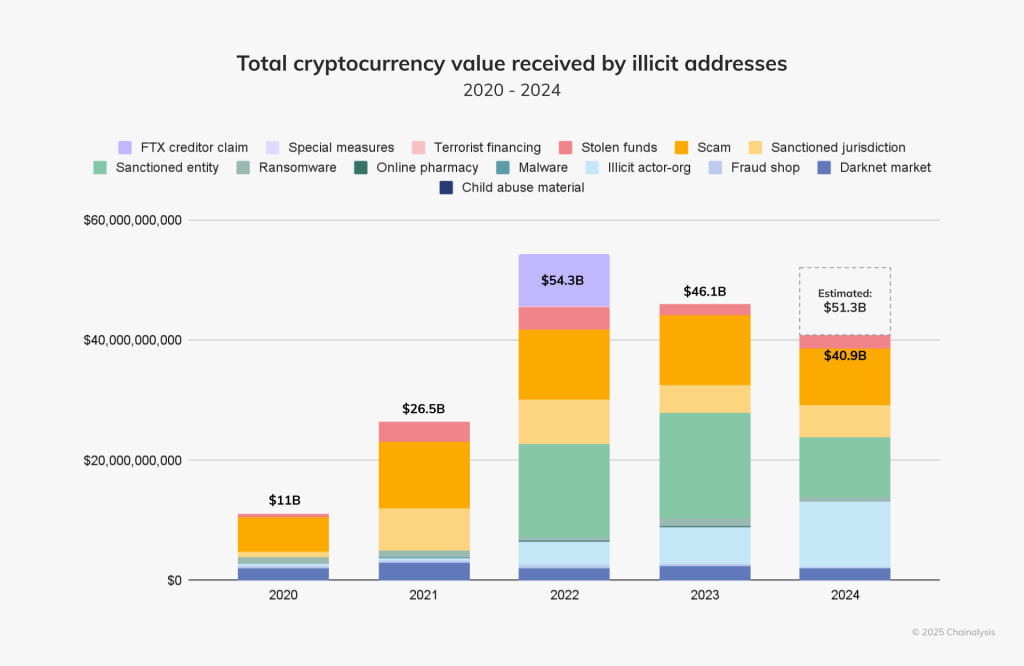 Source: Chainalysis
Despite this discrepancy, regulators are ramping up their enforcement actions against cryptocurrency.
Most recently, Binance Australia was mandated to appoint an external auditor within 28 days after AUSTRAC identified “serious concerns” regarding its anti-money laundering measures.
French authorities have also initiated investigations into Binance for alleged violations, while European regulators are contemplating penalties against OKX following $100 million in purportedly laundered funds.
Australian enforcement has expanded through systematic compliance reviews, with AUSTRAC focusing on 13 remittance providers while investigating 50 additional platforms.
The agency canceled or denied renewals for nine providers that failed to meet their obligations, contrasting sharply with the limited penalties imposed on the banking sector despite significantly larger suspicious transaction volumes.
Senator Elizabeth Warren continues to advocate for stricter cryptocurrency regulations, asserting, “Bad actors are increasingly turning to cryptocurrency to enable money laundering.”
However, FinCEN data indicates that Chinese money laundering networks predominantly operate through traditional banking channels rather than digital assets.
Blockchain analytics firm Chainalysis reported illicit crypto transactions reached $51.3 billion in 2024, an 11.3% increase, but still represent a small fraction of the $312 billion in suspicious banking transactions identified during the same timeframe.
The post US Banks Moved $312B in Chinese Drug Money, But Crypto Gets the Blame appeared first on Cryptonews.
