Disclaimer: Information found on CryptoreNews is those of writers quoted. It does not represent the opinions of CryptoreNews on whether to sell, buy or hold any investments. You are advised to conduct your own research before making any investment decisions. Use provided information at your own risk.
CryptoreNews covers fintech, blockchain and Bitcoin bringing you the latest crypto news and analyses on the future of money.


The Super Representative community of Tron has voted to reduce network transaction fees by 60%, lowering energy unit prices from 210 sun to 100 sun, marking the most significant fee reduction since the inception of the blockchain.
The proposal was implemented on August 29, as Tron seeks to maintain its status as the leading USDT rail, with a stablecoin supply of $80.97 billion, surpassing Ethereum’s $73.8 billion.
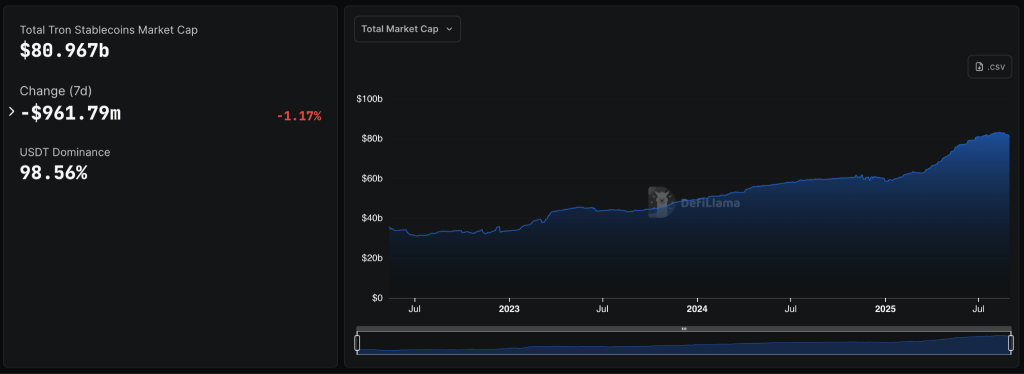 Source: DefiLlama
Tron Leads the Stablecoin Race
The fee reduction occurs as the appreciation of the TRX token diminishes Tron’s competitive edge against other networks.
TRX prices have risen from $0.12 in early 2024 to $0.32 by Q3 2025, resulting in USDT transfer fees increasing from $1.64 to $4.28, while TRC20 transfer costs rose from $0.67 to $0.87.
Justin Sun indicated that the community proposal would affect short-term profitability but anticipates that increased transaction volume will foster long-term revenue growth.
On August 26, 2025, the Tron Super Representative community proposed a 60% reduction in Tron network fees. This represents the largest fee cut since the establishment of the Tron network. The proposal has been approved and will take effect at 20:00 (GMT+8) this Friday!
Here’s my view on…— H.E. Justin Sun
(Astronaut Version) (@justinsuntron) August 29, 2025
 (Astronaut Version) (@justinsuntron) August 29, 2025
The network handles over $24.6 billion in daily USDT transfers, nearly seven times the volume of Ethereum, while maintaining a 98.56% dominance in its stablecoin ecosystem.
Tron’s fee structure aims to increase its user base by 45% to 38.9 million eligible accounts capable of executing standard USDT transfers.
In May, the network processed 273 million transactions across 28.7 million active addresses, with 75% utilizing gasless transaction models, which promote adoption in regions with high remittance activity.
Strategic Fee War Intensifies Blockchain Competition
Tron’s significant fee reduction is intended to address rising transaction costs that jeopardized its leadership in stablecoin payments.
Analysis from the network suggests that a 60% reduction could attract 12 million additional transfer users while sustaining transaction volumes that generate revenue, despite lower individual fees.
The proposal was approved following three weeks of community discussions, with Super Representatives recognizing the short-term revenue implications.
Quarterly dynamic fee assessments will take into account TRX price changes, network activity levels, and growth rates to balance profitability with competitive positioning.
USDT transfer fees on Tron decreased from 2.47 TRX to 0.72 TRX in July, reflecting a 70% reduction that reinforced the network’s position as a low-cost payment option.
Major exchanges, including Binance, endorse TRC-20 as the default choice, labeling it “low fee, high speed” in comparison to Ethereum’s higher expenses.
Related Posts
The fee reduction alters TRX supply dynamics toward inflation at current transaction levels.
Tron’s analysis indicates that a 50% fee reduction would produce 18.7 million new TRX tokens during the observed period, reversing the earlier deflationary trend of 76.1 million tokens burned.
 Source: GitHub
However, increased transaction volume could counteract inflationary pressures by generating higher total fees.
The network’s gasless model already represents 75% of activity, while DeFi protocols like JustLend maintain a total value locked of $6 billion, despite fee changes.
Tron reported $308 million in fee revenue during June, even with the availability of gasless features.
USDT Dominance Faces Regulatory and Competitive Pressures
Tron accounts for 51% of all circulating USDT globally, with a supply of $80.97 billion, compared to Tether’s total issuance of $157.1 billion across all blockchains.
The network processes daily volumes exceeding $23.5 billion, consistently surpassing Ethereum’s $20 billion in USDT settlement activity.
Regional adoption also significantly contributes to Tron’s stablecoin success, especially in Latin America, the Middle East, North Africa, and Asia-Pacific markets, where freelancers and merchants prioritize cost efficiency.
Regulatory frameworks, including the US GENIUS Act, EU MiCA, and Hong Kong’s Stablecoin Bill, have also facilitated its path to dominance.
Nevertheless, competition continues to escalate from Ethereum Layer-2 solutions and Solana, prompting the chain to optimize for enhanced scalability and reduced costs.
Amid this growth, Nasdaq-listed Tron Inc. has filed to register $1 billion in securities for TRX token acquisitions that will emulate MicroStrategy’s Bitcoin treasury model.
Tron Inc. filed to register up to $1 billion in securities as it shifts its core strategy toward establishing a crypto treasury focused on TRX.#TRON #TRXhttps://t.co/ZwsRDeIAIx
— Cryptonews.com (@cryptonews) July 29, 2025
 Tron Inc. filed to register up to $1 billion in securities as it shifts its core strategy toward establishing a crypto treasury focused on TRX.#TRON #TRXhttps://t.co/ZwsRDeIAIx
The company’s traditional toy business did not yield positive cash flow in 2024, leading to a shift toward crypto treasury strategies.
Additionally, there are ongoing governance issues regarding Tron Inc.’s board composition, which is chaired by Justin Sun’s father, with advisors from the Tron DAO and Tronscan development teams.
Concerns have arisen regarding a recent $100 million reverse merger funding sourced from a Hong Kong trust where company directors also serve, raising questions about the governance structure.
The post Tron Votes to Slash Network Fees 60% to Defend Stablecoin Dominance appeared first on Cryptonews.
