Disclaimer: Information found on CryptoreNews is those of writers quoted. It does not represent the opinions of CryptoreNews on whether to sell, buy or hold any investments. You are advised to conduct your own research before making any investment decisions. Use provided information at your own risk.
CryptoreNews covers fintech, blockchain and Bitcoin bringing you the latest crypto news and analyses on the future of money.


Throughout the past year, numerous scientists, technology executives, billionaires, and lawmakers have raised concerns regarding artificial intelligence (AI) — and now, even the Pope has joined the conversation.
In a substantial 3,412-word letter dated December 8, Pope Francis — the leader of the Catholic Church — cautioned about the potential risks AI poses to humanity and outlined necessary measures for its regulation. This letter was issued as the Roman Catholic Church prepares for the World Day of Peace on January 1, 2024.
Pope Francis advocates for an international treaty to govern AI, ensuring its ethical development and application; otherwise, there is a danger of descending into a “technological dictatorship.”
Related Posts
“I urge the global community of nations to collaborate in adopting a binding international treaty that regulates the development and use of artificial intelligence in its various forms.”
The risks associated with AI emerge when developers prioritize a “desire for profit or thirst for power” over the fundamental wish for individuals to live freely and peacefully, the Pope elaborated.
“The inherent dignity of each human […] must underlie the development of new technologies and serve as undeniable criteria for assessing them […] so that digital advancement can proceed with appropriate respect for justice and contribute to the promotion of peace.”
Technologies that do not adhere to this principle “exacerbate inequalities and conflicts” and, as such, cannot be regarded as genuine progress, he noted.
Additionally, the Pope highlighted that the rise of AI-generated misinformation represents a “serious problem,” which could foster increasing distrust in the media.
Recently, the Pope became a target of generative AI when a fabricated image of him in a luxury white puffer jacket went viral in March.
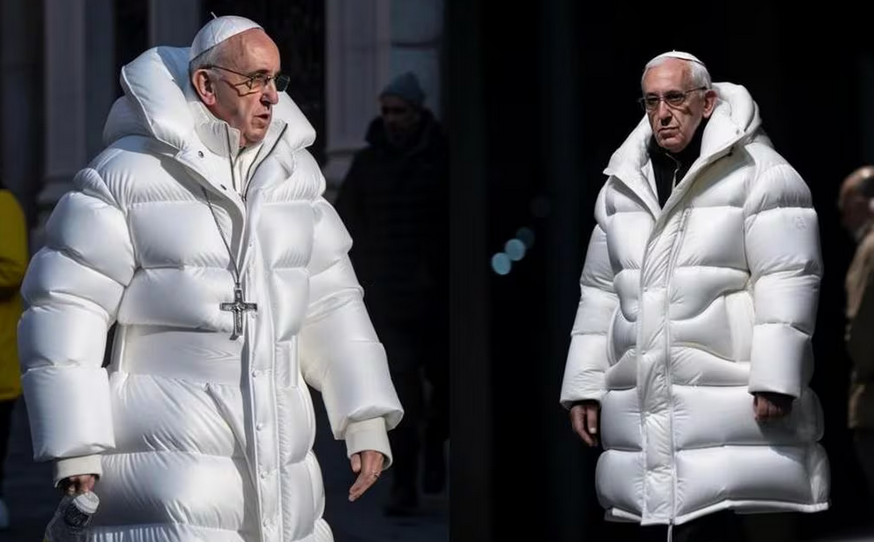 Fake AI-generated photo of the Pope. Source: Boston Globe
However, Pope Francis also recognized the advantages of AI in enhancing manufacturing efficiency, simplifying transportation, and facilitating access to markets, as well as revolutionizing the processes of data accumulation, organization, and verification.
Nonetheless, he expressed concern that AI could disproportionately benefit those in control, leaving a significant segment of the population without jobs to sustain themselves:
“There is the substantial risk of disproportionate benefit for the few at the price of the impoverishment of many.”
Pope Francis has consistently cautioned against the misuse of emerging technologies, asserting that “both theoretical and practical moral principles” should be integrated into them. He is often perceived as more technologically aware and progressive than his predecessors.
The Pope’s recent comments follow a year of widespread alarm regarding the potential threats posed by AI.
Technology leaders, including Tesla CEO Elon Musk and Apple co-founder Steve Wozniak, have voiced their concerns about the rapid advancement of AI. This prompted them, along with over 2,600 tech leaders and researchers, to sign a petition in March 2023 advocating for a pause in AI development, citing that AI more advanced than GPT-4 could present “profound risks to society and humanity.”
U.S. President Joe Biden has also expressed apprehensions. His administration issued an executive order in late October focusing on the “safe, secure, and trustworthy development and use of artificial intelligence” to mitigate the risks associated with AI.
Related: NFT and Islamic education: A new frontier to teach religion?
Even filmmakers and celebrities from Hollywood are contributing their perspectives on the matter.
In July, Canadian filmmaker James Cameron reportedly stated that he has been warning about the dangers of AI since directing The Terminator nearly 40 years ago.
”I warned you guys in 1984 and you didn’t listen,” Cameron told CTV News.
“I think the weaponization of AI is the biggest danger […] I believe we will enter a situation akin to a nuclear arms race with AI, and if we don’t develop it, others certainly will, leading to escalation,” he added.
Magazine: Experts want to give AI human ‘souls’ so they don’t kill us all
