Disclaimer: Information found on CryptoreNews is those of writers quoted. It does not represent the opinions of CryptoreNews on whether to sell, buy or hold any investments. You are advised to conduct your own research before making any investment decisions. Use provided information at your own risk.
CryptoreNews covers fintech, blockchain and Bitcoin bringing you the latest crypto news and analyses on the future of money.


Liquidity staking has become a vital method for improving investment efficiency and engaging in DeFi within today’s blockchain sector. As its popularity increases, more developers are aiming to create platforms to address this rising demand.
Establishing a liquidity staking platform necessitates a comprehensive understanding of the fundamental principles of blockchain technology and the use of various specialized development tools. In this article, we will present the tools for developers creating staking products, assisting you in utilizing the right resources to build an efficient, secure, and scalable platform with optimal results.
Steps to Develop a Liquidity Staking Product
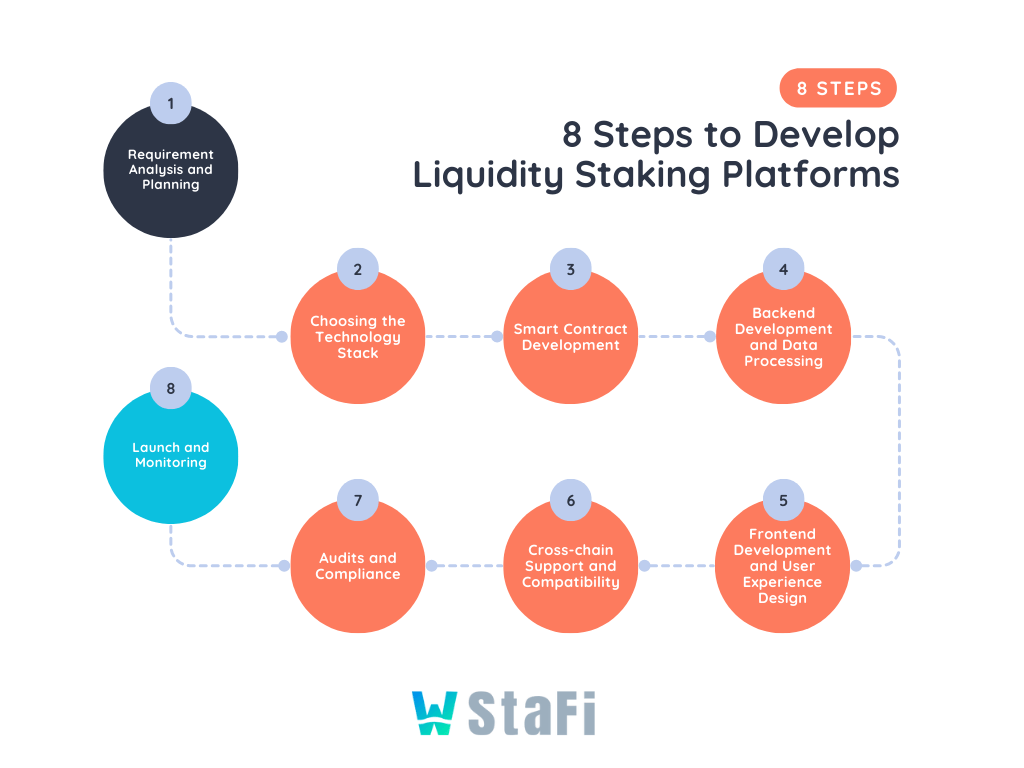
When developing a liquidity staking product, the following are the essential steps from planning to launch, with each step being crucial:
- Requirements Analysis and Planning: Initially, identify the target users of the platform, the supported blockchains and asset types, and the core functionalities of the platform, such as staking, redemption, and reward distribution.
- Selecting the Tech Stack: Choose the appropriate blockchain protocols and development tools, including smart contract platforms, development frameworks, and API services. Ensure that the selected technology supports the platform’s scalability and security.
- Smart Contract Development: Design and create smart contracts to securely and efficiently manage functions such as staking, reward distribution, and token redemption.
- Backend and Data Processing: Create an efficient backend system to process user requests, manage staking data, and provide real-time information. This includes database design and API implementation.
- Frontend and User Experience Design: Develop an intuitive and user-friendly interface, ensuring that users can easily stake, view rewards, and redeem tokens. Optimizing the user experience is vital for the platform’s success.
- Cross-Chain Support and Compatibility: To enhance the platform’s scalability, integrate cross-chain technology to facilitate asset transfers and staking across different blockchains. If the platform is intended to operate within a single blockchain ecosystem, this step may be temporarily omitted.
- Security Audits and Compliance: Perform multi-layered security testing, including audits for smart contracts, backend systems, and user data protection. Additionally, ensure that the platform adheres to relevant regulations and standards.
- Launch and Monitoring: After the product launch, continuously monitor the platform’s performance to ensure efficient and secure operation. Gather user feedback and consistently improve features and user experience.
Now that we understand the requirements for an excellent liquidity staking platform and the key steps in development, what developer tools are essential to achieve this? Here, we present the tools you will need.
Best Developer Tools for Building Liquidity Staking Products
- LSaaS Liquidity Staking Platform Infrastructure
LSaaS (Liquid Staking as a Service) is a liquidity staking-as-a-service solution that enables developers to quickly create liquidity staking products without starting from scratch. As a leading provider of PoS blockchain liquidity staking infrastructure, StaFi Protocol’s LSaaS solution streamlines the development and deployment process for liquidity staking platforms. Developers no longer need to construct staking infrastructure from the ground up; instead, they can utilize professional tools and services for rapid deployment.
StaFi LSaaS supports multi-chain ecosystems such as Ethereum, Solana, Polygon, Cosmos, Eigenlayer, and more, allowing developers to deploy LST (Liquidity Staking Tokens) and LRT (Liquidity Re-Staking Tokens) within weeks or even days.
The platform features rapid deployment, modular design, customizable support, and multi-chain compatibility. Developers can easily modify staking tools and reward mechanisms, and issue liquidity staking tokens (LST) or liquidity re-staking tokens (LRT) without operating validator nodes. This enhances asset yields and liquidity within the DeFi ecosystem.
To experience StaFi LSaaS, join the Discord channel and submit your request.
- Smart Contract Development
Smart contracts are the foundation of a liquidity staking platform, and developers require a secure and efficient development environment. Common tools include:
- Hardhat and Foundry: Smart contract development frameworks for EVM-compatible chains, providing support for testing, debugging, and deployment.
- Solidity: Utilized for writing contracts on EVM chains.
- Rust: Used for writing contracts on ecosystems like Solana.
- OpenZeppelin: Offers audited Solidity contract libraries, minimizing security risks.
- By using StaFi LSaaS, developers can immediately deploy its SDK and optimized modules or customize specific feature requirements. This significantly reduces the development cycle for liquidity staking products, shortening the timeline from several months to just a few weeks or even days.
- Tools to Maximize Staking Returns
Enhancing staking returns is essential for improving the user experience. Key tools include:
- LlamaRisk: Analyzes the risks and returns of liquidity staking assets.
- Yield Aggregators (e.g., Yearn Finance): Automatically optimizes DeFi staking returns.
- Re-staking Protocols (e.g., EigenLayer, Karak): Facilitate re-staking to increase yield.
- Validator Management Tools
Effective validator management is crucial for liquidity staking products. The following tools simplify operations:
Related Posts
- SSV.Network: A decentralized validator management solution that enhances security and stability.
- Obol Network: Supports distributed validator technology (DVT) to minimize single points of failure.
- Eth2 Launchpad: An official Ethereum validator management tool, suitable for both individuals and institutions.
- Frontend Development Tools
The user interface of a liquidity staking platform must balance smoothness and visualization capabilities. Recommended tools include:
- React.js, Next.js: For building high-performance Web3 frontend applications.
- wagmi and RainbowKit: Optimizing EVM wallet connections and interaction experiences.
- D3.js, Chart.js: For data visualization, enhancing user understanding.
Why Should You Use StaFi LSaaS Services?
StaFi LSaaS services provide several key advantages for developers and project teams, making liquidity staking deployment more efficient, secure, and cost-effective. Here are the reasons to choose StaFi LSaaS:
- Save Time: Launch in weeks or even days. StaFi LSaaS significantly reduces the development cycle compared to building from scratch, enabling rapid market entry with minimal effort.
- Secure and Reliable: Utilize tested and audited code. StaFi LSaaS offers secure and reliable solutions, eliminating the need for developers to write and audit code from the ground up, saving costs and reducing risks.
- Market-Proven Reliability: StaFi LSaaS is widely adopted and recognized. Employing a proven tech stack ensures stability and mitigates security vulnerabilities.
- Seamlessly Integrate into the DeFi Ecosystem: StaFi LSaaS is compatible with LSTFi, allowing for easy integration into DeFi, enhancing yield potential and market appeal.
- Developer Toolkit: Accelerate development. StaFi LSaaS provides a comprehensive toolkit with modules and interfaces that enable easy customization and faster deployment.
- Customizable: StaFi LSaaS offers robust customization support, allowing for modular design and cross-chain compatibility to meet various market and technical requirements.
By utilizing StaFi LSaaS, developers can save time, reduce costs, ensure security, and quickly deploy efficient and secure liquidity staking solutions. StaFi LSaaS helps enhance market competitiveness and provides comprehensive support for development needs.
 The way to integrate to StaFi LSaaS with few clicks
How Much Does It Cost to Develop a Liquidity Staking Product?
The development cost of a liquidity staking product depends on the development approach, required features, on-chain deployment expenses, and security audit requirements. The estimated cost ranges are as follows:
- Costs for Self-Development (Building from Scratch)
Interested in exploring collaboration opportunities? Contact StaFi Protocol now to embark on a new chapter in liquidity staking!
How Long Does It Take to Develop a Liquidity Staking Product?
The development timeline depends on the development approach and team expertise. The typical phases are as follows:
- If working with StaFi LSaaS:
StaFi LSaaS provides a standard toolkit that simplifies liquidity staking integration. The service is widely adopted, decentralized, and highly secure, ensuring that developers can quickly get started. By using StaFi LSaaS, developers can significantly shorten the development cycle for liquidity staking products, reducing it from several months to just a few weeks or even days, greatly improving efficiency and enabling faster time-to-market. Contact StaFi Protocol now to save months of development time.
Conclusion
As a leading Liquidity Staking-as-a-Service (LSaaS) solution, StaFi LSaaS considerably shortens development cycles, lowers technical barriers, and offers market-validated security and multi-chain compatibility. Compared to full self-development, StaFi LSaaS allows developers to deploy LST and LRT within hours to weeks, reducing costs by over 80% and accelerating product launches.
In the future, StaFi Protocol will introduce AI-powered features and launch the Open Stack Platform and Open Modularity Platform to expedite LSaaS ecosystem growth and promote modular development and intelligent advancement of liquidity staking products.
Whether you are a DeFi protocol, exchange, wallet development team, or PoS chain project, StaFi LSaaS can assist you in quickly and securely building staking products. If you wish to expedite your launch, contact StaFi Protocol now to begin a new chapter in liquidity staking.
The post How to Build an Excellent Liquid Staking Protocol appeared first on Cryptonews.
