Disclaimer: Information found on CryptoreNews is those of writers quoted. It does not represent the opinions of CryptoreNews on whether to sell, buy or hold any investments. You are advised to conduct your own research before making any investment decisions. Use provided information at your own risk.
CryptoreNews covers fintech, blockchain and Bitcoin bringing you the latest crypto news and analyses on the future of money.

The Market Exhibits Fear, While Institutions Remain Steady: Examining the ‘Extreme Fear’ Threshold

Retail investors are currently selling off Bitcoin in a state of panic. Anxiety is pervasive. The Fear and Greed Index remains at 12, indicating extreme fear.
Conversely, the volume of perpetual futures is actually increasing. Such a divergence does not occur without reason.
The market has experienced a loss of nearly $800 billion over the past month. It is severe. However, the crucial question is whether smart money is discreetly positioning itself ahead of the next significant movement.
When fear is pronounced and volume rises simultaneously, it often signals that something is about to change.
Key Takeaways
- JPMorgan continues to hold a positive outlook for 2026, despite the total market capitalization decreasing from $3.1 trillion to $2.3 trillion.
- The Crypto Fear & Greed Index is currently at 12 (“Extreme Fear”), a level historically linked to market bottoms.
- Bitcoin is trading at $67,610, considerably below its estimated production cost of $77,000.
- Whale activity in perpetual markets indicates that complex institutional hedging is prevailing over spot selling.
Is This Institutional Hedging or Strategic Accumulation?
Let’s take a moment to consider.
Who is purchasing when the market is this fearful? Bitcoin is priced around $67,610 and Ether is close to $1,950, both significantly down this month.
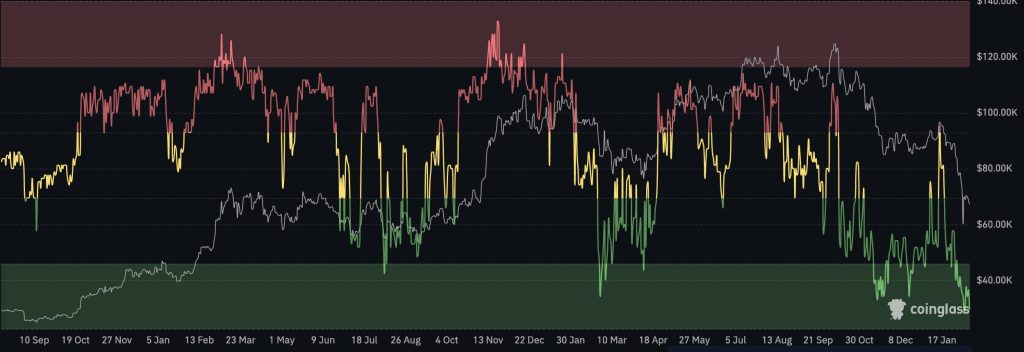 Source: Coinglass
Related Posts
Spot charts appear bleak, and retail investors are clearly in a state of panic. Nevertheless, the volume of perpetual futures is rising rapidly, which typically indicates that sophisticated players are entering with structured positions rather than emotional long positions.
This does not resemble speculative euphoria. When retail investors rush in, funding rates typically spike positively. Instead, BTC funding is nearly flat, and ETH funding is negative.
There are essentially two plausible explanations for this: institutional hedging… or strategic positioning in anticipation of a larger movement.
Will Bitcoin Price $50K Floor Hold?
The charts appear grim at the moment, without a doubt. However, from a fundamental perspective, it may lean bullish in the long term.
JPMorgan estimates that Bitcoin’s production cost is approximately $77,000. BTC is trading well below that threshold.
Historically, when the price falls below the production cost, it does not remain there for long. Miners either cease operations or pressure builds for a recovery.
Bitcoin mining is entering a challenging phase.
Electricity costs are increasing while the Bitcoin price has declined.
There is now a significant gap between hashrate and BTC price.
The global average power cost is around $0.17 per kWh.
At that level, many miners are operating at a massive… pic.twitter.com/rlCKTpb8Ss— THE HUNTER (@TrueGemHunter) February 11, 2026
Nonetheless, the downside risk remains. Chief equity strategist John Blank cautioned that Bitcoin could drop to $40,000 within 6 to 8 months.
This would represent a full capitulation scenario. All traders are currently focused on $60,000 as the critical support level to monitor.
The post The Market Is Terrified, Institutions Aren’t. Analyzing the ‘Extreme Fear’ Floor appeared first on Cryptonews.
