Disclaimer: Information found on CryptoreNews is those of writers quoted. It does not represent the opinions of CryptoreNews on whether to sell, buy or hold any investments. You are advised to conduct your own research before making any investment decisions. Use provided information at your own risk.
CryptoreNews covers fintech, blockchain and Bitcoin bringing you the latest crypto news and analyses on the future of money.


A rising tide of research and market insights is altering long-standing beliefs regarding the future of trading.
Experts in both traditional finance and cryptocurrency markets are now discussing a scenario once deemed improbable: the gradual decline of day trading as Artificial General Intelligence (AGI) approaches realization.
While AGI is not yet a reality, advancements in sophisticated multimodal systems and autonomous trading agents are steering markets toward a landscape where machines take precedence in price discovery, leaving minimal space for human responses.
Current trading automation illustrates how swiftly advantages diminish when machines take control.
As Algorithms Command 70% of Crypto Trading, Analysts Suggest AGI Could Eliminate Retail Alpha
High-frequency trading revolutionized equities years ago, and its principles have extended into crypto markets with the emergence of firms like Jump, Wintermute, and GSR.
By 2024, Kaiko indicated that over 70% of trading activity on platforms such as Binance and Coinbase was driven by algorithms rather than human traders.
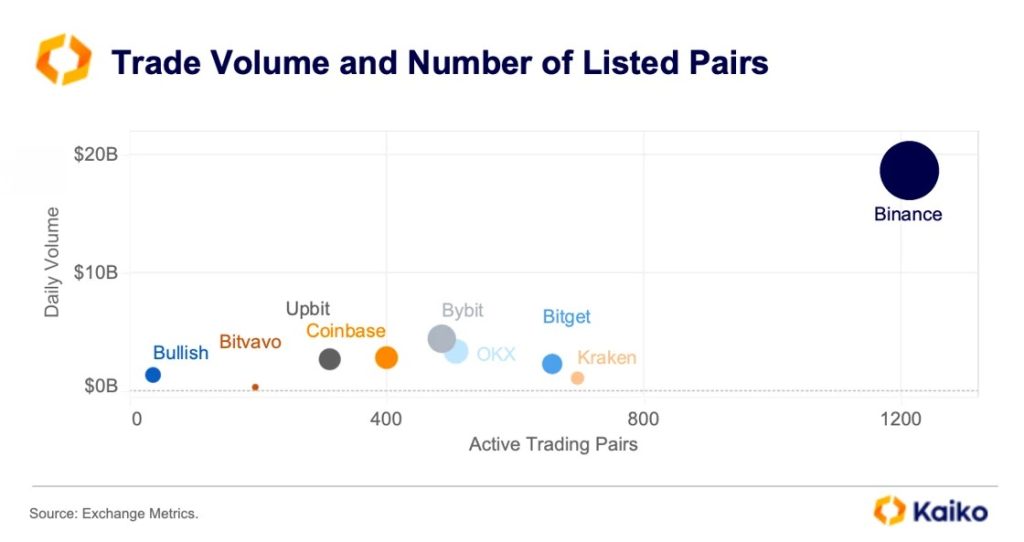 Source: Kaiko
This transition has transformed market structure fundamentally, narrowing spreads and speeding up execution while simultaneously making it increasingly challenging for retail traders to gain profits during periods of high volatility.
Researchers highlight these trends as preliminary evidence of increasing efficiency.
During the Solana memecoin boom in 2024, trading bots, especially “sniper” and “AI” bots, generally outperformed human traders due to their enhanced speed, automation, and absence of emotional bias.
Small AI systems designed to identify whale activity and track blockchain flows reacted more swiftly than discretionary traders, often positioning themselves ahead of human participants’ comprehension of the situation.
Each progression in automation has consistently diminished the opportunities available to retail traders, and analysts contend that AGI would extend this trend to its logical conclusion.
The distinction between today’s narrow AI and future AGI lies at the heart of this discussion.
Current models excel in specific tasks such as scanning order books, interpreting market sentiment, or spotting arbitrage. They lack the ability to generalize across different domains or apply human-like reasoning.
In contrast, AGI is anticipated to learn new tasks with minimal guidance, adapt to unfamiliar situations, and synthesize information from various unrelated sources.
Related Posts
In financial markets, this would entail analyzing blockchain flows, interpreting global macroeconomic indicators, assessing political risks, identifying whale movements, and evaluating supply chain disruptions, all within a cohesive system capable of generating real-time predictions.
Market theorists refer to the potential outcome as the “Perfect Efficiency Paradox.” If an AGI system achieves the ability to predict price movements with near-perfect accuracy, the market would adjust instantaneously.
When every market participant operates with the same level of intelligence, traditional trading behaviors would collapse.
Prices would shift faster than humans can respond, volatility would decrease, arbitrage opportunities would vanish, and liquidity provision would transition to a machine-driven process rather than a competitive strategy.
Analysts caution that this dynamic could result in what they term a liquidity black hole, where trading persists but the advantages that once made day trading feasible cease to exist.
AI Market Makers Transition From Theory to Practice as Automation Increases
Concerns regarding this shift have been voiced for years. DWF Labs noted in July that AI-driven market makers will enhance liquidity, particularly in smaller crypto assets with historically thin order books and broad spreads.
Economist Alex Krüger envisioned a future of hyper-efficient markets with minimal room for errors.
BitMEX founder Arthur Hayes stated that AI would ultimately outperform any human trader, while Ethereum co-founder Vitalik Buterin expressed worries that advanced systems could dominate MEV extraction and diminish human involvement in essential market functions.
#BitMex co-founder and former CEO, @CryptoHayes, has set his sights on a futuristic concept that could revolutionize the DeFi industry: self-sovereign AI DAOs. #CryptoNews #DAO #DeFihttps://t.co/dEQ064RVOj
— Cryptonews.com (@cryptonews) August 1, 2023
 #BitMex co-founder and former CEO, @CryptoHayes, has set his sights on a futuristic concept that could revolutionize the DeFi industry: self-sovereign AI DAOs. #CryptoNews #DAO #DeFihttps://t.co/dEQ064RVOj
These insights were initially regarded as hypothetical, but increasing levels of automation have since lent them greater significance.
As automation accelerates, the human role on trading desks is already evolving.
Experts suggest that while humans will not entirely vanish, they will transition toward risk supervision, regulatory oversight, and interpreting unusual occurrences that fall outside model expectations.
Execution itself is shifting to autonomous systems. The rise of AI trading agents reflects this change.
These tools can analyze markets, select strategies, adjust risk parameters, execute trades via APIs, and learn from outcomes without manual intervention. Projections indicate that the AI trading bot market could reach approximately $75.5 billion by 2034.
The post The Day Trading Died: Why AGI Might Be the Last Market Maker appeared first on Cryptonews.
