Disclaimer: Information found on CryptoreNews is those of writers quoted. It does not represent the opinions of CryptoreNews on whether to sell, buy or hold any investments. You are advised to conduct your own research before making any investment decisions. Use provided information at your own risk.
CryptoreNews covers fintech, blockchain and Bitcoin bringing you the latest crypto news and analyses on the future of money.

Tether Suspends $3.3 Billion in USDT Following Recent Data Indicating 30x Discrepancy with USDC

Key Takeaways:
- Tether and Circle have frozen $3.3 billion and $109 million in cryptocurrency, respectively, from 2023 to 2025.
- The findings highlight significant differences in how the two leading issuers of dollar-pegged stablecoins manage illicit financial activities.
- The increasing frequency of stablecoin freezes has ignited discussions regarding the diminishing levels of decentralization and privacy.
According to a recent analysis, Tether and Circle froze $3.3 billion and $109 million in cryptocurrency, respectively, between 2023 and 2025, revealing notable disparities in how the two primary issuers of dollar-pegged stablecoins address illicit finance.
The report, prepared by blockchain forensics firm AMLBot and shared with Cryptonews this week, examined on-chain stablecoin freezing activities across the Ethereum (ERC-20) and Tron (TRC-20) blockchains.
It discovered that Tether, the organization behind the USDT stablecoin, reported the highest amount of frozen assets over the two-year period, blacklisting 7,268 cryptocurrency wallet addresses. More than 2,800 of these blocked addresses were coordinated with U.S. agencies. Collectively, these wallets hold $3.29 billion.
The report states, “Tether’s freezing and reissuance mechanisms have returned millions of dollars to victims and assisted authorities in seizing funds linked to terrorism, human trafficking, and fraud.”
Circle, the issuer of the USDC stablecoin, blacklisted 372 addresses and froze a total of $109 million on Ethereum. When including data from Tron, the largest USDT network, USDT freezes surpass USDC by a factor of 30 in both asset value and address count.
Tether: Proactive, High-Velocity Freezing
Slava Demchuk, CEO of AMLBot, noted that the significant disparity in blocked funds should not be interpreted as a measure of relative compliance strictness.
“The volume of freezes is not a direct indicator of ‘better’ or ‘worse’ compliance,” he told Cryptonews in an interview, adding:
“USDT’s figures are higher because more illicit and high-risk activities are conducted in USDT, particularly on Tron. Additionally, Tether has adopted a more interventionist enforcement model that leaves a clear on-chain footprint.”
Conversely, USDC’s “smaller footprint reflects both lower exposure to those flows and a more limited, court-driven intervention policy.”
As of 2025, the supply of USDT exceeded $191 billion, with its user base reaching 500 million for the first time in October. Circle has approximately $78 billion of USDC in circulation, according to data from The Block.
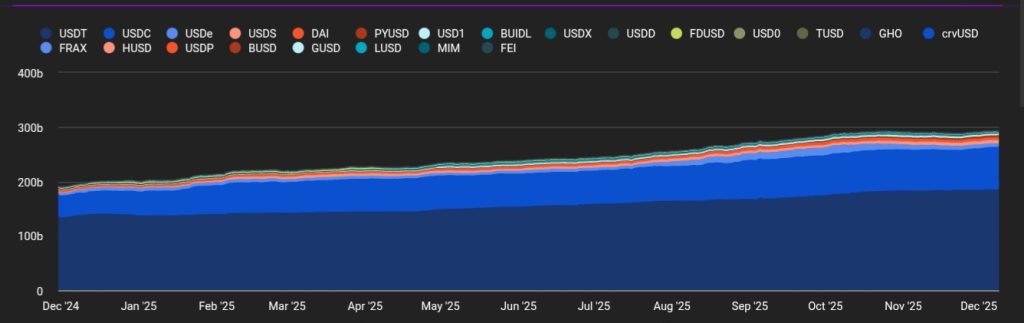 Total stablecoin supply. Source: The Block
As Demchuk elaborated,
“The key takeaway from our data is straightforward: USDT is not frozen 30 times more frequently because Tether is stricter. It’s because USDT is the asset that criminals prefer the most.”
He indicated that Tron-based USDT “dominates high-risk corridors,” placing Tether directly in the path of illicit transactions and necessitating a more “proactive freeze model.”
AMLBot’s data indicates that over 53%, or $1.75 billion, of the USDT Tether blocked was issued on Tron, a low-cost blockchain favored by both legitimate and fraudulent users in Africa, Asia, and Eastern Europe.
Tether has faced ongoing scrutiny regarding its transparency concerning reserves and compliance practices. The El Salvador-based company, reportedly raising $20 billion at an approximate $500 billion valuation, has recently positioned itself as a partner to global law enforcement agencies.
According to the AMLBot report, Tether employs a comprehensive, rapid-response enforcement model, collaborating with over 275 law enforcement agencies and blockchain intelligence firms across 59 jurisdictions.
Tether’s smart contracts enable it not only to freeze wallet addresses but also to destroy, or ‘burn,’ seized tokens and reissue “clean replacements” to victims, a system that has processed up to $2.7 billion in stolen assets.
For instance, between September and November 2025, Tether burned up to 30 million tokens. In July 2024, the firm froze $130 million in USDT, including $30 million associated with Cambodia’s Huione Group, which was blocked on Tron.

Related Posts
Circle: Freeze Only If Legally Required
Tether’s readiness to freeze funds without a court order, sometimes to safeguard users who have been hacked, carries inherent risks. The company requires approval from multiple Tether officials before freezing a wallet.
This process results in delays that cybercriminals have taken advantage of, leading to losses of approximately $78 million since 2017, according to the AMLBot report. Privacy advocates have also criticized Tether for its “preemptive” freezing actions.
Centralized control has its advantages. Quick action from Tether here saved 85k from vanishing into the void. However, let’s be honest – this is why self-custody and proper security measures are essential. Not your keys, not your coins isn’t merely a catchy phrase.
— T (@agentic_t) July 20, 2025
In April 2025, Texas-based Riverstone Consultancy Inc. filed a lawsuit against Tether after it blocked nearly $45 million at the request of the Bulgarian Police Department, claiming the action circumvented necessary legal procedures.
In contrast, New York-based Circle adopts a more restricted, strictly legalistic approach. Under its Stablecoin Access Denial Policy, USDC can only be frozen to comply with court orders, sanctions, or regulatory requirements.
“This order-driven approach results in activity appearing in tall but infrequent spikes (batch actions), unlike USDT’s more continuous daily enforcement flow,” the report noted.
Unlike Tether, Circle does not burn or reissue frozen funds. Once a wallet address is blacklisted, it cannot send or receive USDC until the restriction is lifted. Circle also publicly discloses all blacklisted addresses and their token balances, with audits aimed at enhancing transparency.
The AMLBot report highlights that stablecoin freezes have become an essential tool for investigators, enabling authorities to halt illicit flows that would otherwise be challenging to intercept in traditional cash-based systems.
However, Demchuk cautioned that current practices remain inconsistent. “We observe that today’s freeze and recovery mechanisms genuinely assist law enforcement … but the system is still evolving,” he tells Cryptonews.
“What’s lacking is stronger governance: clearer rules for cross-border requests, a transparent process for users to contest erroneous freezes, and some independent oversight of issuer powers. Such enhancements would safeguard users’ rights without undermining the tools investigators depend on.”
Companies freeze stablecoins – a type of cryptocurrency designed to maintain a stable value, typically pegged to the U.S. dollar — when issuers blacklist an address, rendering the tokens stored in the wallet unusable.
Decentralization In Focus As Crypto Freezes Soar
AMLBot’s findings emerge as stablecoins encounter heightened scrutiny from policymakers. Regulators in the United States and European Union have announced intentions to strengthen oversight regarding issuer compliance standards, real-time reporting, and consumer protections.
Furthermore, the increasing frequency of cryptocurrency asset freezes by entities such as Tether and Circle has sparked discussions about the decline of decentralization and privacy, which are fundamental principles of the crypto sector.
Dmytro Tarasiuk, product director at the self-regulatory crypto platform Core3, informed Cryptonews that it would be “misleading and unjust” to evaluate crypto’s ideological foundations by analyzing the actions of Tether and Circle, which he characterized as “inevitably centralized players.”
“Indeed, the original concept of crypto was rebellious, bold, and revolutionary — money without a ‘big brother,’ without an authority capable of blocking or approving transactions. That ideal existed only for a short time.”
Tarasiuk contended that as the crypto market expanded, its unregulated nature attracted both scammers and genuine innovators, steering the sector toward conventional business models, including government engagement.
“Stablecoins have become the most crucial component of the entire crypto ecosystem,” Tarasiuk asserted. “When we discuss adoption, we’re referring to stablecoin transactions. Nothing in crypto is as recognizable to non-crypto individuals globally as USDT on TRC-20.”
“When we consider institutional capital, stablecoins serve as the entry point for all tokenized assets and off-chain investment flows,” he added. “And when we discuss governmental interest, Circle and Tether are now the 8th largest holders of U.S. Treasury bills compared to countries.”
In this context, Tarasiuk stated that freezes and blacklisting “are not arbitrary or ideological betrayals; they are indicators of the market’s institutionalization.”
The post Tether Freezes $3.3B USDT as New Data Shows 30x Gap With USDC appeared first on Cryptonews.
