Disclaimer: Information found on CryptoreNews is those of writers quoted. It does not represent the opinions of CryptoreNews on whether to sell, buy or hold any investments. You are advised to conduct your own research before making any investment decisions. Use provided information at your own risk.
CryptoreNews covers fintech, blockchain and Bitcoin bringing you the latest crypto news and analyses on the future of money.


Stablecoin issuer Tether has introduced an open-source Bitcoin mining operating system, a strategic step that positions it within the mining infrastructure sector typically dominated by large, vertically integrated corporations.
The software, referred to as Mining OS, or MOS, was revealed on February 2 at the Plan 9 Forum in San Salvador and is being promoted as a production-ready system suitable for mining operators of various scales.
Bitcoin Mining is intricate.
Mining OS by Tether (MOS) simplifies it.
Introducing MOS — the open-source operating system for genuine mining infrastructure.
Modular. Scalable. Designed for energy + hardware + data.
Explore the Documentation: https://t.co/3zcBHFFzRp
Join our… pic.twitter.com/G0GwbtfLKT— Tether (@tether) February 2, 2026
 Mining OS by Tether (MOS) simplifies it.
Tether asserted that MOS will facilitate the control, monitoring, and automation of Bitcoin mining through a unified control layer by integrating hardware performance, energy usage, site infrastructure, and operational metrics.
Tether’s MOS Consolidates Disparate Mining Software into a Unified System
Bitcoin mining often relies on fragmented software stacks to manage machine utilization, power systems, cooling, and site logistics.
MOS aims to replace this patchwork by viewing each element as a coordinated “worker” within a single operating system, enabling operators to monitor and manage their entire setup in real-time.
The company claimed that the system tracks not only hashrate but also energy efficiency, device health, and site-level infrastructure.
Additionally, it highlighted a peer-to-peer and modular architecture that can be implemented on lightweight hardware in small setups or on industrial sites housing hundreds of thousands of machines.
Tether described MOS as robust and versatile, independent of centralized third-party software providers.
Tether also announced a Mining Software Development Kit, or Mining SDK, which serves as the foundation of MOS, to be released alongside the open-source community in the near future, together with the operating system.
Tether CEO Paolo Ardoino remarked that the transition to open-source for the mining stack aims to reduce entry barriers and decrease reliance on proprietary platforms.
Bitcoin Miners Face Challenges Following 2025 Downturn
The launch occurs at a challenging time for the Bitcoin mining industry.
Related Posts
Miners have endured one of the most significant profitability squeezes in the sector’s history as Bitcoin prices have continued to experience a downturn since 2025.
Network hashrate surged from approximately 800 exahash per second at the beginning of the year to a peak of about 1.15 zettahash per second in October, driving mining difficulty to unprecedented levels.
Bitcoin’s network hashrate has fallen below 1,000 exahash per second (EH/s) for the first time since mid-September.#Bitcoin #Mininghttps://t.co/yF5wm7389Z
— Cryptonews.com (@cryptonews) January 19, 2026
Simultaneously, the post-halving block reward of 3.125 BTC and decreasing transaction fees have lowered revenue per hash unit.
By late 2025, the hash price had dropped to around $35 to $40 per petahash per second per day, while the average cash cost for public miners was estimated to be near $44.
All-in production costs, including depreciation, were significantly higher.
Even operators with efficient fleets and low-cost electricity found themselves operating close to breakeven, leading to increased debt levels as companies financed new hardware and infrastructure enhancements.
As 2026 began, some relief was observed. The network hashrate dipped below 1,000 EH/s for the first time since September, falling to 870 EH/s at times following winter storms and reduced profitability.
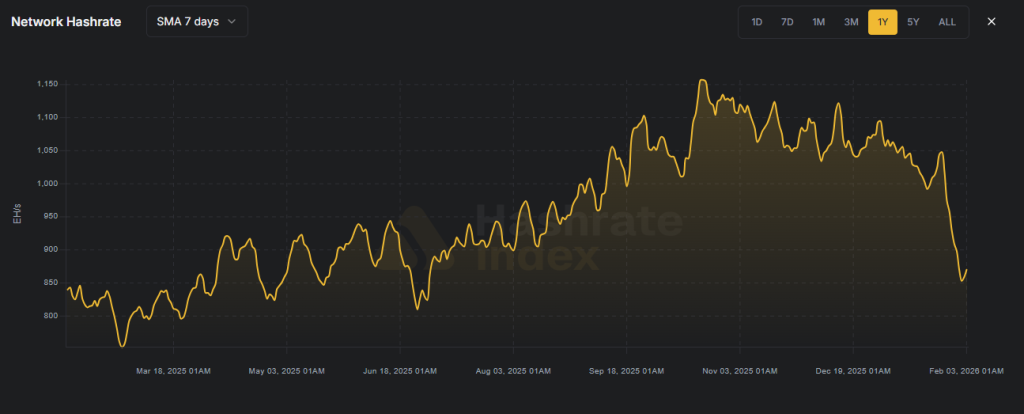 Source: hashrate index
Difficulty has adjusted downward multiple times, and hashprice has shown slight improvement.
Analysts have suggested that this pullback could temporarily enhance margins for the remaining miners, though competition remains fierce.
Within this context, Tether’s entry into mining software contributes to its growing presence in the digital asset ecosystem.
Widely recognized as the issuer of USDT, Tether reported over $10 billion in net profit in 2025 and has branched into tokenized gold through XAUT, as well as forming payment partnerships like Opera’s MiniPay wallet.
The post Tether Launches Open‑Source MiningOS to Challenge Bitcoin Mining Giants appeared first on Cryptonews.
