Disclaimer: Information found on CryptoreNews is those of writers quoted. It does not represent the opinions of CryptoreNews on whether to sell, buy or hold any investments. You are advised to conduct your own research before making any investment decisions. Use provided information at your own risk.
CryptoreNews covers fintech, blockchain and Bitcoin bringing you the latest crypto news and analyses on the future of money.


Three major automotive manufacturers, Toyota, BYD, and Yamaha, have begun to accept USDT as a payment method in Bolivia, as reported by Tether CEO Paolo Ardoino.
Ardoino marked this achievement in a post on X on September 21, stating that USDT is the “digital dollar” now benefiting hundreds of millions, especially in developing nations.
Toyota, BYD, Yamaha accepting USDT in Bolivia
“Your vehicle in digital dollars”
USDT serves as the digital dollar for countless individuals in emerging markets.
Ubiquity. pic.twitter.com/0X0SH3USXX— Paolo Ardoino
(@paoloardoino) September 21, 2025
This announcement regarding stablecoin adoption coincides with Bolivia’s Central Bank (BCB) reporting crypto payment transactions totaling $294 million in the first half of 2025, marking a 630% increase from $46.5 million in 2024.
“Digital Dollar” Strategy, How USDT Payments in Bolivia Started
The initiative originated from Bolivia’s decision to lift the crypto ban on June 25, which granted official recognition to “virtual assets” and allowed financial institutions to facilitate client transactions with crypto exchanges.
Yvette Espinoza from the Autoridad de Supervisión del Sistema Financiero (ASFI), Bolivia’s financial oversight body, highlighted that this initiative has allowed the country to conduct crypto transactions within a regulated environment.
On March 13, Bolivia broadened the use of cryptocurrency in the public sector when President Luis Arce’s cabinet permitted YPFB to carry out crude oil import transactions using either USD or cryptocurrency.
Starting in October 2024, Bolivia’s Banco Bisa introduced custodial services for Tether’s USDT, enabling customers to engage in trading activities.
Recently, Bolivia’s Central Bank entered into a memorandum of understanding with El Salvador’s National Commission of Digital Assets to promote crypto development, viewing it as a “trusted alternative” to conventional currencies.
Additionally, Latin America is experiencing a rise in the adoption of crypto payments.
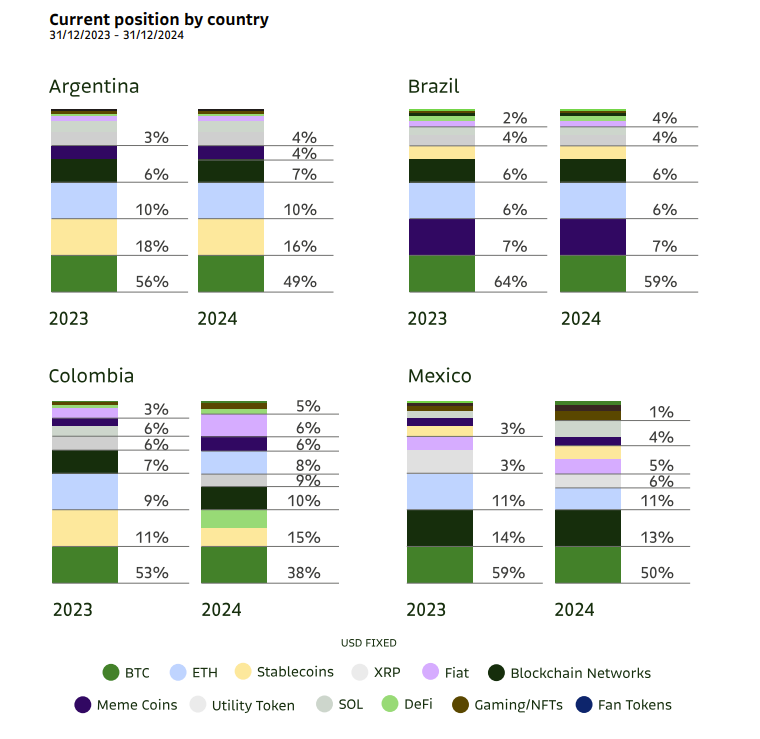
A recent regional analysis by Bitso indicates that economic instability and currency devaluation across Latin America have made stablecoins like USDC and USDT essential tools for wealth preservation.
Inflation Crisis Fuels Stablecoin Adoption in Latin America
Argentina, facing inflation exceeding 100%, has turned to stablecoins as a safeguard against financial instability.
Brazil has seen steady growth due to clear regulations and a vibrant technology sector.
Crypto adoption increased by 6% to 1.9 million users, with stablecoins accounting for 26% of transactions.
Related Posts
 Source: Bitso
Colombian investors have also adopted stablecoins following restrictions on USD banking services.
Mexico remains a leading regional crypto hub, where Bitcoin and USDT dominate international transfers amid a 23% depreciation of the peso.
Regional data supports this upward trend.
The latest Chainalysis Global Crypto Adoption Index shows that Latin America’s crypto adoption rose from 53% in 2024 to 63% year-over-year, solidifying the region’s position as one of the fastest-growing markets for cryptocurrency.
 Source: Chainalysis
Latin America accounted for 9.1% of global cryptocurrency value between July 2023 and June 2024, processing nearly $415 billion in digital assets during this timeframe.
This growth is evident in country rankings, with three Latin American nations among the top 20 crypto adopters of 2025: Brazil (5th), Venezuela (18th), and Argentina (20th).
Bolivian legislator Mariela Baldivieso from the Comunidad Ciudadana party remarked that comprehensive cryptocurrency integration could enhance the region’s economic stability.
Baldivieso indicated that Bolivia’s crypto adoption is positioning the country among the top five adopters in Latin America, bolstered by progressive policy reforms.
¡Un gran paso para la adopción de criptoactivos en Bolivia!
Starting this Monday, October 28, a new service for custody, buying, and selling USDT will be available. This marks a significant advancement towards the integration of cryptocurrencies in the country, bringing us closer to… pic.twitter.com/a7zzhsn0c0— Mariela Baldivieso (@baldmariela) October 27, 2024

Importantly, Bolivia’s expansion of USDT payments is not the first instance of Toyota exploring blockchain and cryptocurrency payment initiatives.
In July 2024, Toyota Blockchain Lab revealed plans for an Ethereum ERC-4337-based MOA (Mobility-Oriented Account) system, which would create vehicle-specific blockchain identities to support fully autonomous operation.
Following this, the finance division of the Toyota Group announced its plans to issue blockchain-based security token bonds (ST bonds).
These Toyota Wallet ST bonds provide exclusive benefits to holders who also possess Toyota Wallet memberships.
The post Toyota, BYD, and Yamaha Now Accept USDT Payments in Bolivia, Tether CEO Confirms appeared first on Cryptonews.
