Disclaimer: Information found on CryptoreNews is those of writers quoted. It does not represent the opinions of CryptoreNews on whether to sell, buy or hold any investments. You are advised to conduct your own research before making any investment decisions. Use provided information at your own risk.
CryptoreNews covers fintech, blockchain and Bitcoin bringing you the latest crypto news and analyses on the future of money.


Key Takeaways:
- Botanix co-founder Alisia Painter predicts the stablecoin market will surpass $1 trillion in 2026.
- Growth will be fueled by institutional adoption, the rise of yield-bearing tokens, and enhanced cross-border payments.
- More than 20% of active stablecoins are expected to feature embedded yield or programmability next year.
The stablecoin market is projected to more than triple to reach $1 trillion in circulation by 2026, driven by institutional adoption, new yield-bearing tokens, and stronger cross-border payment infrastructure, according to an industry executive.
“The biggest shift will be from static stablecoins to yield-bearing stablecoins and synthetic dollars backed by real assets,” Alisia Painter, co-founder and chief operating officer of Bitcoin DeFi builder Botanix Labs, told Cryptonews.
“More than 20% of all active stablecoins will offer embedded yield or programmability features [in 2026]. This trend will accelerate cross-chain settlement, payroll, and international commerce.”
Painter noted that users will begin to “treat digital dollars as savings instruments rather than static balances,” particularly in ecosystems anchored to Bitcoin, where users already view on-chain assets as long-term stores of value.
The stablecoin market currently stands at an all-time high of $310 billion, according to DefiLlama. Tether’s USDT dominates with a 60% market share, valued at $186 billion, followed by Circle’s USDC at $78.5 billion.
Ethena’s “synthetic dollar” USDe ($6.6 billion), Sky Dollar’s USDS ($6.4 billion), and MakerDAO’s DAI ($4.6 billion) complete the top five largest dollar-pegged stablecoins.
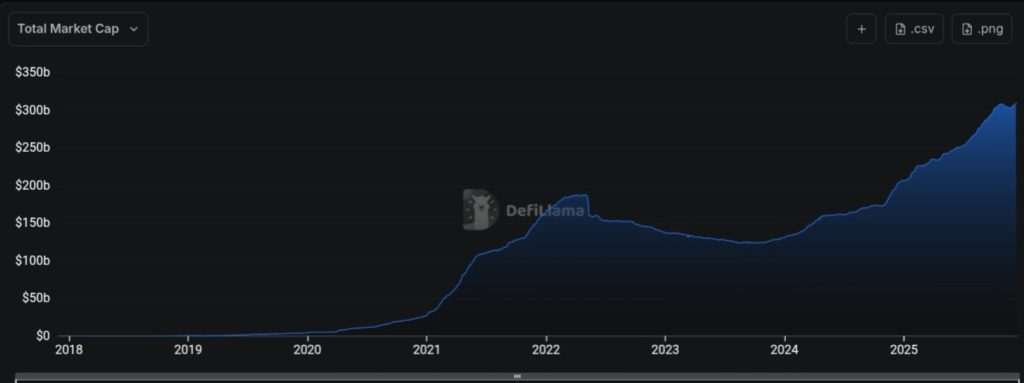
Stablecoin market cap. Source: DefiLlama
Painter stated that while stablecoins will continue to grow as a sub-sector, the focus is shifting toward programmable instruments that can be embedded in payment systems, tokenized Treasury products, and fintech applications.
“Institutions will demand stablecoins that do more than sit idle, and yield models anchored in Bitcoin-based collateral will become more popular,” she said, adding:
“Institutions and fintech platforms are integrating stablecoins as payment and settlement tools. Circle processed more than $12 trillion [in USDC] in on-chain transaction volume in 2023, demonstrating how quickly stablecoins are becoming mainstream financial infrastructure.”
From Static Stablecoins to Programmable Dollars
Another key driver is the rise of tokenized U.S. Treasuries, whose supply exceeded $3 billion this year, marking a tenfold increase in about two years and demonstrating “significant institutional appetite for yield-backed digital dollars.”
Demand for high-yield, blockchain-settled assets is underpinned by synthetic dollars such as USDe and USDf—stablecoins that do not rely on physical dollars or government debt to maintain their peg. Instead, they combine assets like Ethereum or Bitcoin with derivatives positions.
Painter highlighted that upgrades at major blockchains, including new Bitcoin-based networks and Ethereum scaling systems, have reduced fees and boosted speed, “making stablecoins more practical for everyday payments.”
She emphasized that growth will not stem merely from increased usage, but from newer stablecoin designs that embed yield directly into balances.
“Users will no longer need to move between a stablecoin and a separate yield product. The stablecoin performs both functions [accruing return].”
Yield-bearing stablecoins are particularly attractive in emerging markets battling high inflation—economies where dollar-denominated savings already play a significant role, said Painter, who has been involved with Bitcoin since 2015.
“In markets where annual inflation exceeds 20%, a yield-bearing dollar becomes a natural default for both personal savings and small business treasury management, and it often acts as an entry point into Bitcoin.”
Stablecoins serve as a lifeline for people in Nigeria who send money across borders and trade. Traditional remittance channels charge up to 7% in fees, whereas crypto significantly reduces those costs, according to a Chainalysis adoption report.
Crypto adoption is also rising in Southeast Asia. In the Philippines, where remittances account for about 9% of GDP, more than a million merchants now accept stablecoins through mobile wallet-linked platforms.

This shift is impacting Bitcoin-based decentralized finance (DeFi), Painter told Cryptonews. Lending markets will need to adjust for the fact that their baseline collateral, the stablecoin itself, earns yield, she stated.
Related Posts
Automated market makers will require new pricing models that account for continuous stablecoin interest accrual, the Botanix COO added.
“New primitives designed specifically for Bitcoin-based financial systems will emerge, including products that separate principal and yield streams or combine stable yield with native Bitcoin incentives.”
However, these new stablecoin functions also bring technical and regulatory challenges.
Regulatory and Technical Challenges
“Yield-bearing products require more granular and more frequent reporting, including duration of assets, counterparty exposure, and proof that user assets are segregated,” Painter detailed.
Draft U.S. legislation may restrict certain forms of interest distribution to retail users, she said. On the technical side, questions remain regarding how yield is delivered on-chain, how interest rates are updated, and how assets interact with DeFi lending and automated market systems.
“Poorly designed yield logic could create accounting issues across DeFi.”
Didier Lavallée is the founder and CEO of Canadian crypto company Tetra Digital Group. Tetra is developing CADD, a fully regulated stablecoin, with backing from the National Bank of Canada, Shopify, and Wealthsimple.
Speaking to Cryptonews, Lavallée said 2026 will be the year when non-USD stablecoins grow in adoption and volume, driven by increased regulatory clarity worldwide.
“More and more countries are adopting frameworks and regulations to allow for innovation. It’s only a matter of time before stablecoin ecosystems fragment into regional and local markets.”
Stablecoin oversight advanced sharply in 2025, with frameworks such as Europe’s MiCA, the U.S. GENIUS regulatory blueprint, and recent guidance from the U.S. Office of the Comptroller of the Currency (OCC).
“Banks now have a clearer framework for how they can hold stablecoins for network fees, offer custody, and participate directly in blockchain networks,” said Kevin Lehtiniitty, CEO of stablecoin payments network Borderless.xyz, in an interview with Cryptonews.
“Around the world, regulators are publishing similar roadmaps focused on payments innovation and stablecoin integration,” he added. Lehtiniitty expects the trend to continue in 2026 as more institutions enter the market.
2025: A Breakout Year for Stablecoins
Borderless has begun integrating directly with banks and stablecoin issuers, the CEO said, expanding its coverage across new corridors to align with the changing regulatory environment.
The company also launched a public benchmark showing stablecoin-to-fiat foreign currency (FX) rates to increase transparency in a market long criticized for opaque trading. Borderless tracks real-time FX spreads across stablecoin venues.
“Our goal is to ensure partners can access safe and regulated liquidity as stablecoins become more embedded in global cross-border payments,” Lehtiniitty said.
He predicts a bifurcated FX market next year as liquidity deepens.
“We generally see two types of liquidity providers,” he noted. “‘Bare-metal’ venues competing [on the narrowest possible spreads], and ‘orchestrator or aggregator’ venues that focus on premium features and functionality.”
As liquidity grows, spreads in low-cost venues are tightening, making stablecoin FX increasingly competitive with traditional fiat payments.
Lehtiniitty said the amount of spread charged will continue to fragment as companies explore different strategies.
“For payment companies and fintechs, it will be increasingly important to have multi-venue connectivity and execution capabilities.”
Meanwhile, 2025 was a breakout year for stablecoins, experts say. Key milestones included:
- Regulatory clarity across the U.S., Europe, and emerging markets.
- Stablecoin issuers going public, signaling market maturity.
- A surge in institutional adoption, from banks to global fintechs. More than 80% of banks have a digital asset strategy in place.
- Record usage in cross-border payments and trading.
“We believe that these developments are setting the stage for stablecoins to become an essential financial instrument in 2026 as well as more use cases for it,” said Borderless’ Lehtiniitty.
