Disclaimer: Information found on CryptoreNews is those of writers quoted. It does not represent the opinions of CryptoreNews on whether to sell, buy or hold any investments. You are advised to conduct your own research before making any investment decisions. Use provided information at your own risk.
CryptoreNews covers fintech, blockchain and Bitcoin bringing you the latest crypto news and analyses on the future of money.


South Korean cryptocurrency exchanges observed a 62% increase in stablecoin trading volumes as the won dropped to its lowest levels against the dollar in several years, leading platforms to enhance their marketing efforts around dollar-pegged tokens.
As reported by The Korea Times, the trading volume of Tether (USDT) across the country’s five leading won-based exchanges reached 378.2 billion won ($261 million) when the exchange rate surpassed 1,480 won per dollar last Wednesday, according to data from CryptoQuant.
This increase follows escalating currency pressures that caused the won to decline for nine consecutive days against the dollar, marking its longest losing streak since 2008, as noted by Bloomberg.
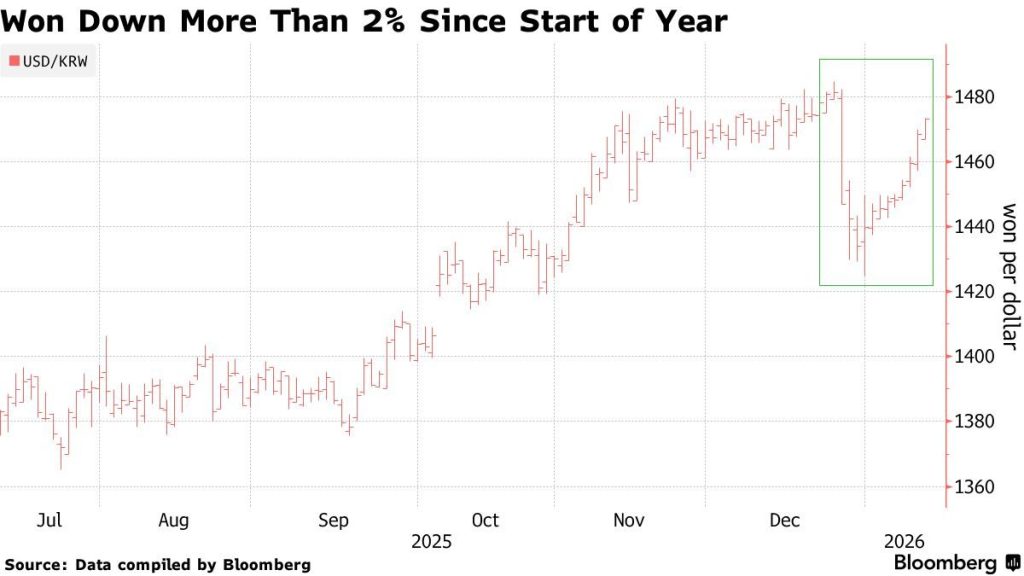 Source: Bloomberg
Prominent exchanges such as Korbit, Coinone, Upbit, and Bithumb initiated vigorous promotional campaigns focused on stablecoins, including USDC and USDe, by eliminating trading fees and offering rewards to enhance volumes during what industry representatives termed a downturn in the overall crypto markets.
Banks Reduce Dollar Rates as Government Supports Currency
The Chosun Daily reported that South Korea’s leading commercial banks have reduced dollar deposit interest rates to nearly zero in response to government pressure aimed at defending the exchange rate.
Shinhan Bank decreased its annual rate from 1.5% to 0.1% effective January 30, while Hana Bank lowered rates from 2% to 0.05% for its Travelog Foreign Currency Account.
This coordinated action followed the authorities’ summoning of bank leaders, requesting that they “avoid excessive marketing that promotes foreign currency deposits such as dollars.”
Banks reacted by introducing incentives for converting to won, with Shinhan offering a 90% preferential rate for clients converting dollar deposits back to won, plus an additional 0.1 percentage point rate boost for those who subsequently subscribe to won-term deposits.
Dollar deposit balances at the five major banks decreased by 3.8% from the end of the month to 63.25 billion dollars as of January 22, marking the first decline after three months of continuous increases.
Corporate deposits, which make up 80% of total dollar holdings, fell sharply from 52.42 billion dollars at year-end to 49.83 billion dollars, indicating that the authorities’ recommendation to sell dollars spot, coupled with views that the exchange rate had peaked, contributed to the decline.
Individual dollar deposits grew at a much slower rate, increasing by only 109.64 million dollars compared to the previous month’s surge of 1.09 billion dollars.
Related Posts
Presidential Intervention Promotes Won Stabilization
President Lee Jae-myung made a rare verbal intervention regarding the exchange rate during a press conference on January 21, stating that authorities expected the rate to decrease to around 1,400 won within one to two months.
Following his comments, the won-dollar rate instantly fell from 1,481.4 won to 1,467.7 won, ultimately closing at 1,471.3 won.
 Source: TheChosunDaily
Market analysts highlighted the unusual nature of a sitting president specifying both a target exchange rate and a timeline, noting that Lee’s statement carried significantly more weight than U.S. Treasury Secretary Scott Bessent’s earlier remark that the won’s recent decline was “inconsistent with Korea’s strong fundamentals.”
Meanwhile, demand for dollar exchanges slowed, with average daily won-to-dollar conversions amounting to 16.54 million dollars from January 1-22, while dollar-to-won conversions surged to 5.2 million dollars daily, significantly surpassing last year’s average of 3.78 million dollars and indicating increased profit-taking.
Indeed, according to CNBC, South Korea’s GDP growth in the fourth quarter slowed to 1.5% year over year, falling short of economists’ expectations of 1.9%, as construction investment contracted by 3.9% and exports decreased by 2.1% compared to the previous quarter.
This year, the won has depreciated by nearly 2% against the dollar, making it one of the worst-performing currencies in Asia, while South Korean retail investors acquired around 2.4 billion dollars of U.S. equities on a net basis through mid-January, reflecting an increase of approximately 60% from the same timeframe last year.
The broader economic slowdown occurs as Seoul pushes forward with significant crypto policy reforms despite regulatory standoffs regarding stablecoin governance.
Earlier this month, South Korea lifted its nine-year ban on corporate cryptocurrency trading, allowing listed companies to invest up to 5% of their equity capital in the top 20 cryptocurrencies, while lawmakers passed amendments to the Capital Markets Act and Electronic Securities Act to establish legal frameworks for tokenized securities trading starting January 2027.
South Korea has launched guidelines, allowing listed companies and professional investors to invest up to 5% of their equity capital in crypto. #SouthKorea #CorporateCryptoInvestment #CryptoInvestment https://t.co/d55u3TDsBF
— Cryptonews.com (@cryptonews) January 12, 2026
Korea Exchange Chairman Jeong Eun-bo committed to launching spot Bitcoin ETFs and extending trading hours to 24/7 as part of efforts to eliminate the “Korea discount,” although comprehensive digital asset legislation remains stalled due to disputes between the Financial Services Commission and the Bank of Korea over stablecoin issuance regulations.
The post Stablecoin Trading Surges 62% in Korea as Dollar Strengthens Against Won appeared first on Cryptonews.
