Disclaimer: Information found on CryptoreNews is those of writers quoted. It does not represent the opinions of CryptoreNews on whether to sell, buy or hold any investments. You are advised to conduct your own research before making any investment decisions. Use provided information at your own risk.
CryptoreNews covers fintech, blockchain and Bitcoin bringing you the latest crypto news and analyses on the future of money.

Stablecoin Cryptocurrency Supply Reaches $315 Billion in Q1 as USDC Increases and USDT Declines

The total supply of stablecoins reached an unprecedented $315 billion in Q1 2026, increasing by approximately $8 billion from the previous quarter, despite a contraction in the overall cryptocurrency market.
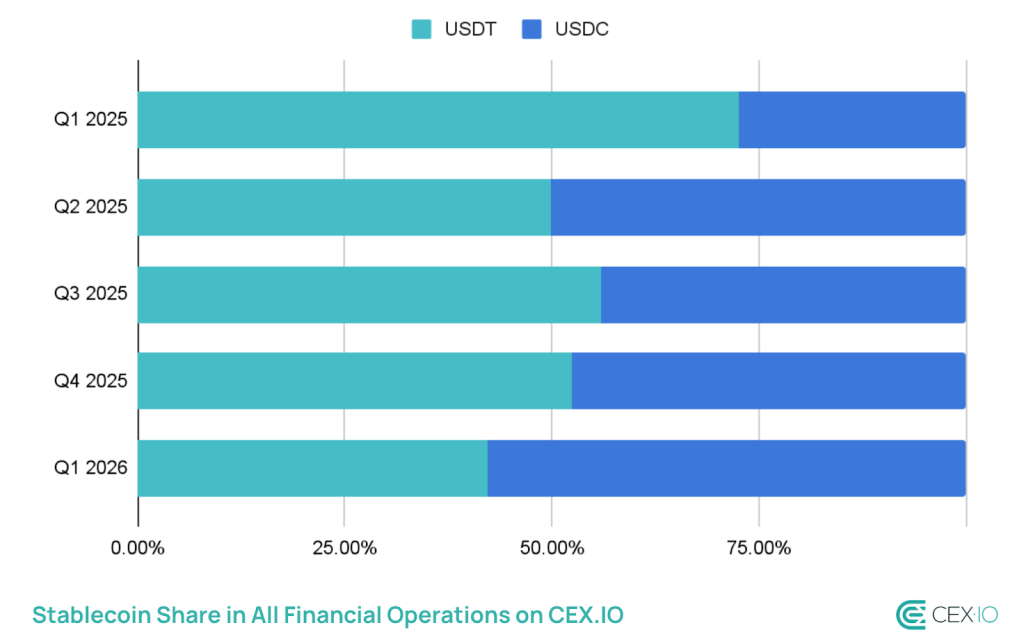
This headline figure conceals a more intricate narrative: USDC is gaining market share from USDT, and the pace of this shift is quicker than many market observers anticipated.
USDC’s supply has surged by 220% since late 2023, reaching around $78 billion, fueled by institutional B2B settlements, payroll systems, and automated payment infrastructures established by Visa and Stripe.
While USDT remains the leading issuer in terms of total supply, its market share has diminished—a divergence that CEX.IO identified as one of the key market dynamics of the quarter.
Key Takeaways:
- The total stablecoin supply reached a record $315B in Q1 2026, up by approximately $8B quarter-over-quarter—the slowest growth since Q4 2023, yet still an increase during a market downturn.
- Stablecoins represented 75% of the total crypto trading volume in Q1—the highest proportion recorded.
- Total stablecoin transaction volume exceeded $28 trillion, surpassing the combined volumes of Visa and Mastercard.
- USDC’s supply increased by 220% since late 2023 to around $78B, while USDT’s market share declined amid this divergence.
- Retail-sized transfers decreased by 16%—the largest decline on record—while automated systems accounted for roughly 76% of all stablecoin transaction volume.
- Yield-bearing stablecoins now constitute a $3.7 billion subsector, introducing new fragmentation and regulatory challenges.
Discover: The best crypto to diversify your portfolio during market turbulence
Stablecoins also captured 75% of the total crypto trading volume in Q1—the highest share on record—while total transaction volume surpassed $28 trillion, a figure that consistently exceeds those of major payment networks like Visa and Mastercard combined. The slowing growth rate is evident; however, demand is not diminishing.
USDC Gain Is a Regulatory Story, Not Just a Market Share Story
The rise of USDC is not a result of organic retail adoption. Data from CEX.IO indicates that institutional programmatic capital—B2B corridors, payroll settlements, and treasury management—serves as the primary catalyst.
USDC’s transaction velocity reached 90x, with an average transfer size of $557, a profile that aligns with frequent, smaller institutional transactions rather than large trades.
 Source: CEX.IO Research
Circle’s strategic positioning in anticipation of potential U.S. stablecoin legislation has been intentional. With the Clarity for Payment Stablecoins Act still under discussion and regulatory frameworks for digital assets evolving in Washington, regulated issuers like Circle possess a structural advantage in attracting compliance-sensitive institutional capital. This distinction is significant—it is not merely market share gained through yield or liquidity depth.
Analysts assessing the quarter characterized the shift clearly: “This isn’t retail adoption; it’s institutional programmatic money.” The figure that substantiates this is USDC’s average transfer size of $557—significantly smaller than USDT’s larger individual trades, yet indicative of high-frequency, automated institutional flows that reflect broader trends in tokenization and institutional adoption reshaping digital asset infrastructure.
Related Posts
If U.S. stablecoin legislation is enacted with provisions favoring regulated, audited issuers, USDC’s growth becomes structural. Conversely, if it stalls, the competitive advantage diminishes, allowing USDT’s established liquidity depth to regain its dominance.
USDT Still Leads – But the Competitive Moat Is Narrowing
USDT continues to be the largest stablecoin by supply and the primary liquidity instrument across emerging market corridors and Tron-based DeFi.
Its focus on Tron, where low fees enhance retail and cross-border transfer volumes, provides a user base that USDC’s Ethereum-centric institutional approach does not currently compete with.
The decline in USDT’s market share in Q1 coincides with the most significant recorded drop in retail-sized transfers—down 16%—which impacts one of USDT’s core use cases.
At the same time, automated systems now represent approximately 76% of all stablecoin transaction volume, indicating that the organic retail demand that historically supported USDT’s dominance in high-frequency small-value transfers is diminishing.
 Source: CEX.IO
CEX.IO noted this as evidence of “a more sophisticated, but potentially less organic, market structure.”
Tether’s response has been limited to quarterly reserve attestations and geographic expansion rather than product-level innovation. This approach is defensible as long as it maintains network effects.
However, it could become a liability if institutional capital continues to shift towards regulated instruments and USDC’s programmatic integrations expand within Western payment infrastructure.
Monitor Circle’s May attestation and Tether’s Q2 report to see if the supply divergence increases. If USDC surpasses $90 billion while USDT remains stagnant, this quarter’s share shift may evolve from a temporary fluctuation to a discernible trend.
The total supply figure of $315 billion indicates that stablecoins serve as the foundational layer of the market. The USDC/USDT divide reveals who is constructing upon it.
Explore: The best pre-launch token sales with asymmetric upside potential
The post Stablecoin Crypto Supply Hits $315B in Q1 as USDC Gains, USDT Slips appeared first on Cryptonews.
