Disclaimer: Information found on CryptoreNews is those of writers quoted. It does not represent the opinions of CryptoreNews on whether to sell, buy or hold any investments. You are advised to conduct your own research before making any investment decisions. Use provided information at your own risk.
CryptoreNews covers fintech, blockchain and Bitcoin bringing you the latest crypto news and analyses on the future of money.


Japan’s developing stablecoin industry could soon transform the nation’s sovereign debt environment, potentially changing the role of the Bank of Japan (BOJ) in its $9 trillion Japanese government bond (JGB) market.
JPYC, the Tokyo-based entity responsible for Japan’s inaugural yen-pegged stablecoin, has indicated that digital asset firms might become significant holders of government bonds as their reserves expand.
JPYC introduced its yen-backed stablecoin on October 27, following Japan’s updated Payment Services Act, which serves as the country’s first legal framework for stablecoins.
Japan will see its first yen-pegged stablecoin go live on Monday, marking a major step toward digital finance as blockchain use moves into the mainstream. #Japan #Stablecoins https://t.co/lBe453KWzH
— Cryptonews.com (@cryptonews) October 27, 2025
The startup has issued approximately $930,000 worth of tokens, aiming for a circulation target of 10 trillion yen ($66 billion) over the next three years.
The tokens are fully convertible to yen and supported by bank deposits and JGBs, designed for smooth transactions across blockchain networks.
JPYC Plans to Invest 80% of Stablecoin Proceeds in Government Bonds
Founder and CEO Noritaka Okabe informed Reuters that stablecoin issuers might take on the role traditionally occupied by the BOJ, which has been reducing its bond purchases after years of aggressive monetary easing.
“With the BOJ tapering bond buying, stablecoin issuers could emerge as the biggest holders of JGBs in the next few years,” Okabe stated.
He noted that while authorities could influence bond duration, managing total holdings would be difficult.
At present, the BOJ is the leading entity in Japan’s JGB market, holding around 50% of the 1,055-trillion-yen market, followed by insurance companies and domestic banks. Foreign investors and public pensions represent smaller portions.
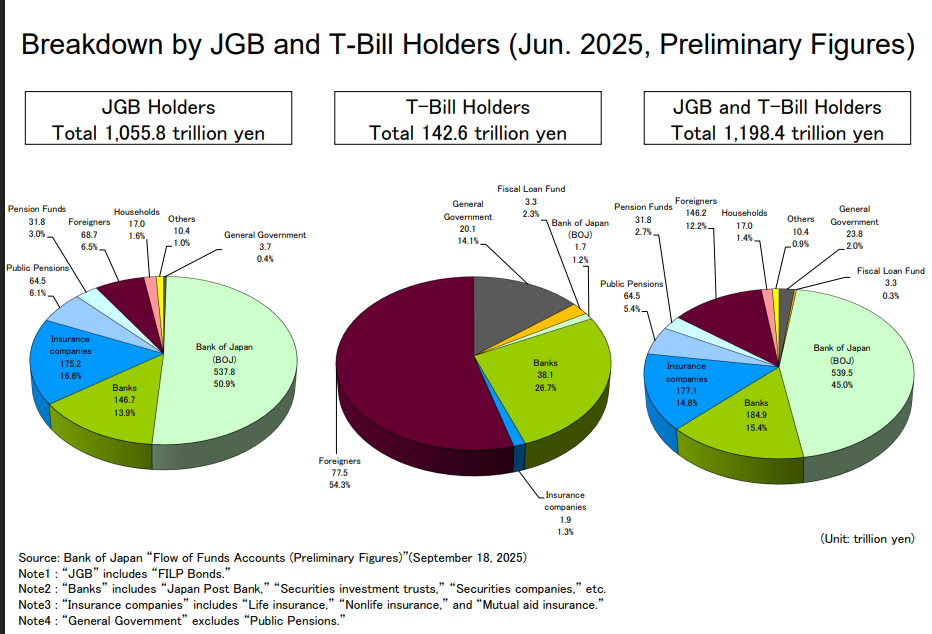 Source: MOF
As the BOJ scales back its purchases, there is uncertainty regarding whether domestic financial institutions, which have reduced holdings during the ultra-loose policy period, will absorb the new supply, particularly as the government increases debt issuance to support spending plans.
Okabe proposed that stablecoin issuers could bridge this gap, with JPYC intending to allocate 80% of its proceeds to JGBs and 20% to bank deposits.
Related Posts
The launch of JPYC coincides with Japan’s adoption of digital finance, as cashless payments rose to 42.8% in 2024, up from 13.2% in 2010.
The Financial Services Agency (FSA) has backed efforts to incorporate stablecoins into mainstream finance.
On November 7, the FSA officially endorsed a pilot initiative under its Payment Innovation Project involving Japan’s three largest banks: Mitsubishi UFJ Financial Group, Sumitomo Mitsui Financial Group, and Mizuho Financial Group.
Japan’s FSA stated that it would support a collaborative yen-backed stablecoin pilot project led by three major Japanese banks. #JapanFSA #YenStablecoin #StablecoinProject https://t.co/kNuZ28y1mV
— Cryptonews.com (@cryptonews) November 7, 2025
The pilot aims to create a shared framework for issuing yen-backed stablecoins, initially focusing on corporate clients with the potential for a future dollar-pegged coin.
JPYC Aims to Boost Yen’s Role in Digital Finance With Fee-Free Stablecoin Launch
Worldwide, stablecoins are predominantly pegged to the U.S. dollar, accounting for over 99% of the market.
Okabe mentioned that reliance on the dollar raises hedging and transaction costs for Japanese companies, and JPYC could provide a domestic alternative while enhancing the yen’s position in global digital finance.
The JPYC offers transactions without fees at launch, generating revenue mainly from interest on JGB holdings. This strategy aims to encourage real-world adoption and test a regulated digital yen.
The initiative aligns with broader regional movements, as South Korea and Hong Kong investigate regulated local stablecoins and crypto products.
Japan’s major banks are also progressing toward stablecoin issuance. The three megabanks, with FSA backing, plan to experiment with both yen- and dollar-pegged tokens, establishing a corporate settlement framework and potentially challenging the dominance of U.S.-backed stablecoins such as USDT and USDC.
Mitsubishi UFJ, Sumitomo Mitsui, and Mizuho launch yen stablecoins to challenge USDT and USDC with 1T yen ($6.64B) over 3 years planned. #Japan #Stablecoin https://t.co/PBXiMRTNY8
— Cryptonews.com (@cryptonews) October 17, 2025
 Mitsubishi UFJ, Sumitomo Mitsui, and Mizuho launch yen stablecoins to challenge USDT and USDC with 1T yen ($6.64B) over 3 years planned. #Japan #Stablecoin https://t.co/PBXiMRTNY8
Japanese authorities remain vigilant. Policymakers have cautioned that inadequately designed stablecoins could divert funds away from regulated banking systems and diminish the role of commercial banks in payments.
Any expansion of issuance is anticipated to undergo thorough examination concerning asset backing, redemption rights, and reserve segregation.
The post Stablecoin May Replace Central Bank Demand in Japan’s $9 Trillion Bond Market appeared first on Cryptonews.
