Disclaimer: Information found on CryptoreNews is those of writers quoted. It does not represent the opinions of CryptoreNews on whether to sell, buy or hold any investments. You are advised to conduct your own research before making any investment decisions. Use provided information at your own risk.
CryptoreNews covers fintech, blockchain and Bitcoin bringing you the latest crypto news and analyses on the future of money.

Sony Surprises Financial Markets: Technology Company Pursues U.S. Banking License for Issuing Proprietary Stablecoin

Sony has caught Wall Street off guard as its banking arm, Sony Bank, submitted a request to the U.S. Office of the Comptroller of the Currency (OCC) to create a national cryptocurrency bank under its subsidiary “Connectia Trust.”
This initiative positions the Japanese technology leader to potentially become one of the first significant global enterprises to launch a U.S. dollar–backed stablecoin through a federally regulated entity.
The application details intentions to issue a stablecoin pegged to the U.S. dollar, manage the reserve assets that support it, and offer custody and management services for digital assets.
This filing places Sony among a select group of companies, including Coinbase, Circle, Paxos, Stripe, and Ripple, which are currently seeking OCC approval to function as national digital banks.
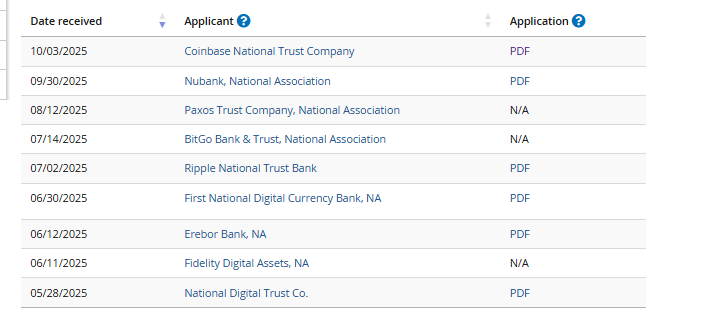 Source: OCC
If granted approval, Sony would become the first major global tech firm to obtain a U.S. bank charter specifically linked to stablecoin issuance.
This development illustrates the significant progress stablecoins have made from being a niche within cryptocurrency to becoming a widely accepted financial instrument, especially following the passage of the GENIUS Act in the U.S., which created a unified federal framework for stablecoin issuers, mandating full backing by cash or Treasuries and ensuring token holder redemption rights.
Is the OCC Quietly Opening the Door to a New Era of Crypto Banking?
As per Sony’s application, Connectia Trust aims to issue a USD-pegged stablecoin, maintain corresponding reserves in cash or Treasuries, and provide digital asset custody and management services.
The company stated that these operations fall within the OCC’s previously sanctioned scope of allowable national bank activities.
“In its initial phase, Trust Bank plans to engage in digital asset activities that the OCC has deemed permissible under existing national bank legal frameworks,” Sony Bank noted in its application.
“These encompass the issuance of dollar-pegged stablecoins and the upkeep of corresponding reserve assets, non-fiduciary digital asset custody services, and fiduciary asset management for affiliates.”
Currently, Anchorage Digital Bank is the sole crypto-native institution to have obtained a full de novo OCC charter, although it encountered compliance issues that resulted in a temporary cease-and-desist order in 2022, which was lifted this August.
The OCC, an independent bureau of the U.S. Treasury, plays a vital role in this context. It is the only regulatory body authorized to issue a national bank charter, enabling a firm to legally conduct banking activities across all U.S. states under a single license.
An OCC charter has become a coveted gateway to legitimacy, providing crypto firms access to the Federal Reserve’s payment systems and establishing trust with institutional partners.
The US Senate has confirmed former crypto executive Jonathan Gould as OCC chief in a 50–45 vote, marking him as the first permanent head since 2020.#OCC #JonathanGould https://t.co/ipM7YhaG8B
— Cryptonews.com (@cryptonews) July 11, 2025
 The US Senate has confirmed former crypto executive Jonathan Gould as OCC chief in a 50–45 vote, marking him as the first permanent head since 2020.#OCC #JonathanGould https://t.co/ipM7YhaG8B
The OCC has received more than 15 applications from fintech and crypto companies seeking trust charters, indicating a renewed regulatory openness under OCC chief Jonathan Gould, a former blockchain executive appointed earlier this year.
Related Posts
Gould, who previously held the position of chief legal officer at Bitfury, has publicly stated that the OCC “does not impose blanket barriers” to banks involved in digital asset activities.
His confirmation signified a policy shift: in May, the OCC released new guidance explicitly permitting national banks to buy, sell, and hold cryptocurrencies on behalf of clients, provided they adhere to safety and risk management standards.
This change has transformed the OCC into a more crypto-friendly regulator under the Trump administration, following several years of uncertainty.
The OCC clears the way for banks to manage customer-held crypto, trade assets, and outsource custody services to third parties. #Banking #DigitalAssetshttps://t.co/SUIKNLycQD
— Cryptonews.com (@cryptonews) May 8, 2025
Importantly, the agency recently granted Erebor Bank conditional national status, demonstrating a willingness to support digital-first institutions once more.
Could Sony’s Connectia Trust Redefine How Big Tech Enters Crypto Banking?
The clarity in regulation has triggered a wave of new OCC applications from financial and tech companies eager to take advantage of what has become one of the most profitable markets in cryptocurrency.
The overall stablecoin market capitalization now surpasses $300 billion, primarily led by Tether (USDT) and Circle’s USD Coin (USDC), according to DefiLlama.
 Source: DefiLlama
Projections indicate that the market could siphon off $1 trillion from global banks by 2028, making Sony’s entry well-timed for a rapidly expanding segment of the digital economy.
The ramifications extend beyond finance. Sony Bank, already recognized for consistent profits from mortgage lending and foreign currency operations, has been aggressively expanding into digital banking.
Analysts suggest that the stablecoin initiative could serve as a foundation for Sony’s broader ecosystem strategy.
Similar to JPM Coin, Connectia Trust’s tokens may initially function as closed-loop settlement assets, utilized internally for treasury transfers, cross-border payments among subsidiaries, or digital transactions within Sony’s entertainment network.
This could facilitate stablecoin-enabled payments across PlayStation, Sony Music, and Sony Pictures, or enable instant settlements between Sony’s international branches.
Such integration would provide Sony with a competitive advantage in programmable money applications, aligning its financial division with its global entertainment and gaming sectors, a potential first for a consumer technology conglomerate.
Notably, Sony has been engaged in the blockchain space for some time. In January, Sony Group unveiled Soneiun, an Ethereum layer-2 network developed in collaboration with Startale Group, broadening its reach into decentralized infrastructure.
The company initially hinted at the project in 2023, and the chain now holds over $75.87M in total locked value.
The post Sony Shocks Wall Street: Tech Giant Seeks U.S. Bank License to Issue Its Own Stablecoin appeared first on Cryptonews.
