Disclaimer: Information found on CryptoreNews is those of writers quoted. It does not represent the opinions of CryptoreNews on whether to sell, buy or hold any investments. You are advised to conduct your own research before making any investment decisions. Use provided information at your own risk.
CryptoreNews covers fintech, blockchain and Bitcoin bringing you the latest crypto news and analyses on the future of money.


Solana (SOL) is currently priced at $87, reflecting a 69% decline from its January 2025 high of approximately $295.91. The long-short ratio has risen above 3:1 on certain platforms, with retail investors holding 65.5% long positions. This is an atypical reading for an asset trading below all significant moving averages.
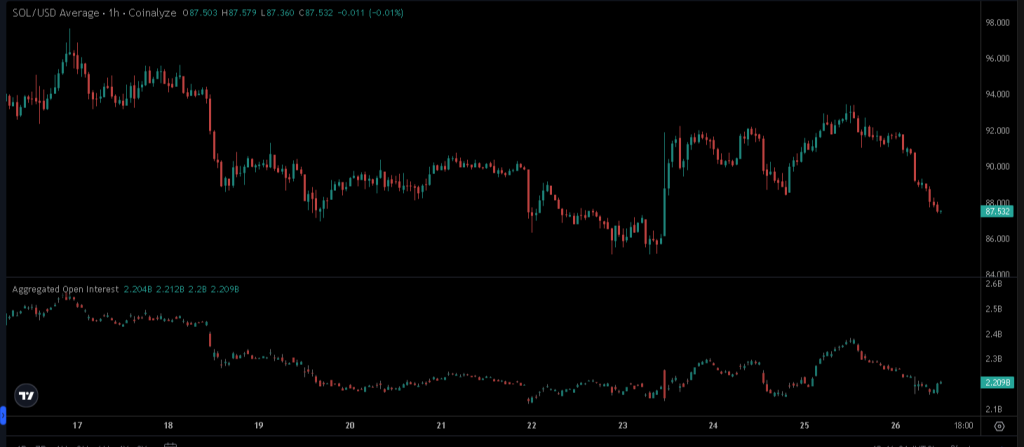
(Source – Coinalyze)
The open interest reveals the underlying situation. Open interest stands at about $2.2 billion and is decreasing, even as the long bias grows stronger. An increase in price alongside a reduction in open interest is indicative of a classic squeeze pattern. This does not signify accumulation or strong conviction.
The calculations do not support a genuine rally at this point.
Discover: The best pre-launch token sales
SOL Derivatives Setup: Squeeze Risk or Breakout Fuel?
The long-short ratio is often misinterpreted by many traders observing it. It reflects the distribution of position counts, not the weight of capital. Longs and shorts are consistently matched 1:1 in notional size within derivatives markets. A 3:1 long-short ratio indicates that three times as many traders are positioned long, rather than three times the capital being long. This distinction is essential for grasping the actual risk involved.
The current setup’s instability arises from the contrast between the bullish sentiment and the lack of new capital. A sustained long bias with increasing open interest indicates strong conviction. Conversely, a sustained long bias with decreasing open interest suggests a squeeze is underway, with shorts being forced out rather than bulls entering the market. The neutral funding rate of 0.0038% per 4-hour period supports this: it indicates short covering rather than new long positions.
On February 28, a significant liquidation event drove SOL down to a 52-week low of $77.91, according to exchange data. Short liquidations on March 5 amounted to $2.58 million, accounting for 75.6% of total liquidations, compared to just $0.83 million in long liquidations. This 3:1 liquidation skew closely mirrors the ratio skew. The mechanics of the squeeze are already in motion.

(Source – SOLUSD, TradingView)
Related Posts
Key technical levels delineate the binary outcome. The 200-day moving average is positioned around $150, significantly above the current price, representing the upper limit of any substantial recovery. In the near term, the Changelly model identifies April channel resistance at $102.51, with $100.37 as the lower boundary of that range. Below the current price, the $77.91 low from February serves as the last structural support before a potential drop.
The bullish scenario: if the price surpasses $90–$92 with increasing open interest, funding rates turn positive, and the long bias becomes self-reinforcing as momentum traders enter the market. SOL’s high-beta nature means that a confirmed breakout can accelerate quickly; similar setups in other Layer 1s have resulted in 20–30% price movements within days once the squeeze momentum transitions to genuine accumulation.
The bearish scenario: if the price falters at resistance, overleveraged long positions may begin to unwind, and the same reflexivity that could drive prices higher may instead lead to a downward cascade. The Fear & Greed Index at 9, indicating Extreme Fear, along with a 65.5% long position reading, places the current positioning in a cautionary zone for potential pullbacks, as analysts note. A drop below $80 would trigger the next liquidation cluster.
The long-short ratio serves as a pressure indicator. Currently, it is elevated. This pressure will resolve through either continuation or liquidation, and without an expansion in open interest, the likelihood of liquidation increases. Regulatory developments concerning crypto derivatives oversight also pose a macro concern for leveraged positions across the industry.
Discover: The best pre-launch token sales
Bitcoin Hyper Targets Early Mover Upside as Solana Tests Key Levels
As Solana navigates a precarious derivatives setup without structural confirmation of a reversal, institutional investors are shifting their focus to Bitcoin Hyper, a Bitcoin-native Layer 2 infrastructure initiative aimed at delivering EVM-compatible execution speed to BTC liquidity without the need for wrapped tokens.
This project sets itself apart with sub-second finality on a Bitcoin-settled chain, targeting the DeFi and perpetuals markets that are currently led by Solana and Ethereum Layer 2s. Its presale has successfully raised $5.9M thus far, with the current token price at $0.0115 and a staking APY locked at 108% for early participants.
The presale period will conclude prior to the public DEX listing, which historically represents a high-risk, high-reward entry point for infrastructure projects. Year-end SOL projections ranging from $250–$300 reflect broader expectations for Layer 1 recovery — however, early-stage infrastructure projects with fixed presale pricing present asymmetric upside independent of SOL’s immediate squeeze resolution.
Join the Bitcoin Hyper Presale Now
This article is intended for informational purposes only and does not constitute investment advice. Cryptocurrency investments carry significant risks, including the potential for total capital loss. Always perform your own research before making any financial decisions.
The post Solana Long-Short Ratio Signals Unusual Derivatives Positioning appeared first on Cryptonews.
