Disclaimer: Information found on CryptoreNews is those of writers quoted. It does not represent the opinions of CryptoreNews on whether to sell, buy or hold any investments. You are advised to conduct your own research before making any investment decisions. Use provided information at your own risk.
CryptoreNews covers fintech, blockchain and Bitcoin bringing you the latest crypto news and analyses on the future of money.


Seven prominent financial associations in China jointly announced that the tokenization of real-world assets (RWA) constitutes an unlawful financial practice, shortly after reinforcing their prohibition on cryptocurrency trading.
A local report indicated that the China Internet Finance Association, China Banking Association, China Securities Association, China Asset Management Association, China Futures Association, China Association of Listed Companies, and China Payment and Clearing Association issued a notice cautioning both domestic and international participants that RWA activities have no legal standing under Chinese law.
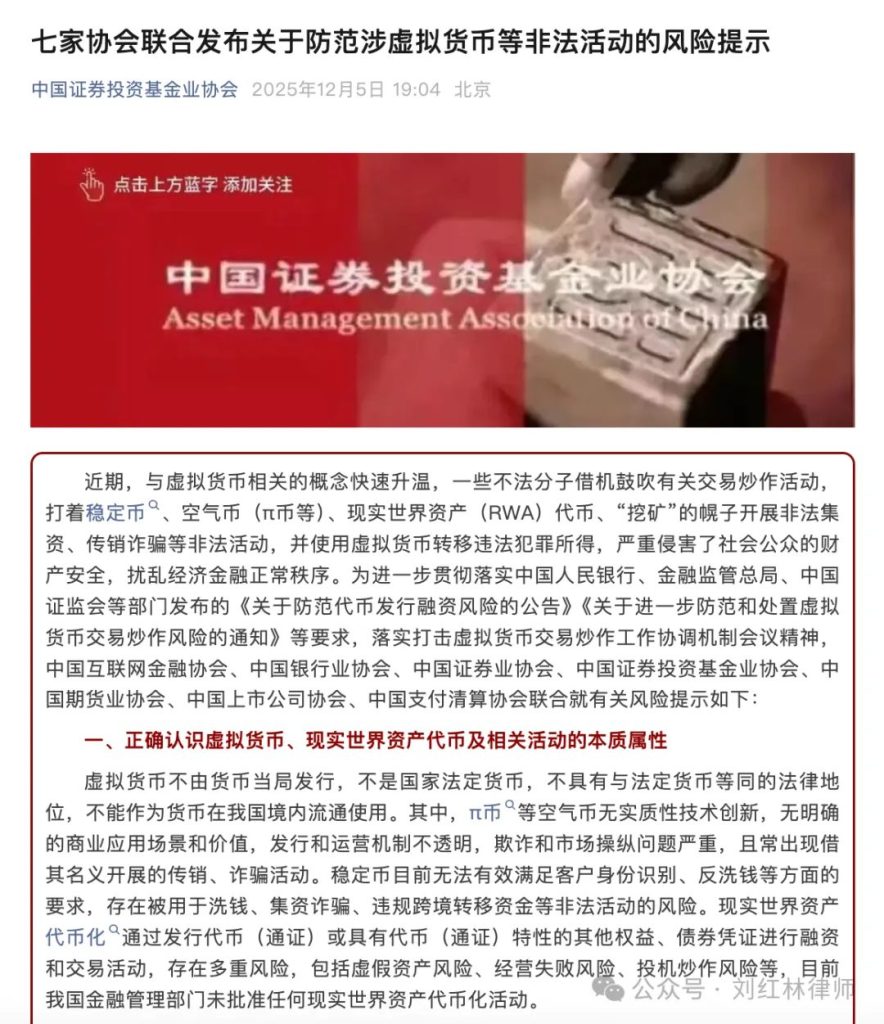 Source: Weixin
The statement categorized RWA alongside stablecoins, “worthless cryptocurrencies,” and crypto mining as key examples of illegal virtual currency activities, effectively labeling tokenization initiatives as high-risk fraudulent schemes rather than emerging financial technologies that are pending regulatory guidance.
Attorney Liu Honglin characterized the unified announcement as “a clear cross-industry, cross-regulatory ‘unified messaging’ initiative,” pointing out that such collaborations among associations typically occur only during crucial moments aimed at mitigating systemic financial risks.
RWA: Financing Activities Governed by Securities Law
The collective notice explicitly characterized real-world asset tokenization as “financing and trading activities through the issuance of tokens or other rights and debt instruments with token-like features,” indicating that such operations entail “numerous risks, including the potential for fictitious assets, the risk of business failure, and the risk of speculation.”
Regulators highlighted that “the financial regulatory authorities in our country have not sanctioned any real-world asset tokenization activities,” dispelling any notion that projects could assert they are in regulatory consideration or awaiting registration approval.
This position contrasts with that of nations like Singapore, which is anticipated to lead global RWA adoption by 2025.
Officials notably outlined three significant breaches of existing Chinese law relating to RWA operations.
 Source: Weixin
Projects that offer tokens to the public while fundraising may face illegal fundraising accusations, while facilitating transactions or issuing tokens without authorization constitutes unauthorized public securities offerings.
Token trading that involves leverage or speculative mechanisms may be considered illegal futures business activities, with these classifications grounded directly in China’s Criminal Law and Securities Law rather than general policy advisories.
Related Posts
The document asserted that RWA token structures cannot ensure legal ownership or the liquidation of underlying assets, irrespective of the project teams’ beliefs in the authenticity of their assets and the transparency of technology, as regulators determined that risk spillover remains unmanageable even in supposedly compliant projects.
China’s securities regulator is subtly urging domestic brokerages to cease their real-world asset (RWA) tokenization activities in Hong Kong. #RWA #China https://t.co/wPU4yuNGRK
— Cryptonews.com (@cryptonews) September 22, 2025
The warning specifically targeted projects attempting to evade regulations through “real-world asset anchoring,” “overseas compliance pathways,” and “technology service output” narratives.
Joint Liability Under New Enforcement Framework
The notice was aimed not only at project operators but at the entire Web3 service ecosystem that supports RWA activities, stating that “domestic staff of relevant overseas virtual currency and real-world asset token service providers, as well as domestic institutions and individuals who knowingly or should have known they are involved in virtual currency-related businesses and continue to provide services to them, will be held accountable according to law.”
This “knowing or should have known” criterion establishes a legal presumption of liability based on reasonable objective judgment rather than requiring evidence of subjective intent, directly undermining the common Web3 operational model of offshore company registration with mainland Chinese personnel.
Attorney Honglin remarked that this implies teams cannot evade responsibility by asserting they are merely providing technology services or infrastructure support.
Project planners, technology outsourcing providers, marketing agents, influencer promoters, and payment interface providers all face potential legal repercussions if they offer services to RWA projects aimed at Chinese users.
The directive noted that even employing a single operations individual in China could expose ostensibly offshore projects to legal risks.
This enforcement strategy effectively dismantles the entire domestic Web3 service chain centered around RWA within China, as supportive services lose viable business models alongside the prohibition of primary operations.
The crackdown follows a series of fraudulent schemes operating under RWA branding, with the document stating that “criminals are exploiting this to promote related trading and speculative activities, using stablecoins, worthless coins (such as π coin), Real-World Asset (RWA) tokens, and ‘mining’ as a cover to conduct illegal fundraising, pyramid schemes, and other illicit activities.”
Chinese investors inject $188 million into digital yuan stocks after PBOC announces interest-bearing CBDC wallets starting January 2026. #China #CBDC https://t.co/mhze2uEyHn
— Cryptonews.com (@cryptonews) December 30, 2025
 Chinese investors inject $188 million into digital yuan stocks after PBOC announces interest-bearing CBDC wallets starting January 2026. #China #CBDC https://t.co/mhze2uEyHn
The timing coincides with China’s efforts to internationalize its digital yuan through a new Shanghai operations center focused on cross-border payments and blockchain services, while simultaneously preventing major tech companies like Ant Group and JD.com from issuing stablecoins in Hong Kong to maintain the state’s monopoly on currency issuance.
The post Seven Chinese Financial Associations Declare RWA Tokenization Illegal appeared first on Cryptonews.
