Disclaimer: Information found on CryptoreNews is those of writers quoted. It does not represent the opinions of CryptoreNews on whether to sell, buy or hold any investments. You are advised to conduct your own research before making any investment decisions. Use provided information at your own risk.
CryptoreNews covers fintech, blockchain and Bitcoin bringing you the latest crypto news and analyses on the future of money.


SEC Chair Paul Atkins has recognized that the U.S. is ’10 Years Behind’ in terms of crypto regulation and has committed to accelerating progress in the sector.
He stated, “The crypto aspect is our job one,” highlighting it as a key focus for the regulatory agency.
During the DC Fintech Week event held at Amazon HQ on Wednesday, Atkins mentioned that the SEC aims to establish a solid framework to attract back industry participants who may have departed the country, fostering an environment conducive to innovation.
Atkins Commits to Accelerating U.S. Crypto Development
“I like to say that we’re the securities and innovation commission now,” he remarked.
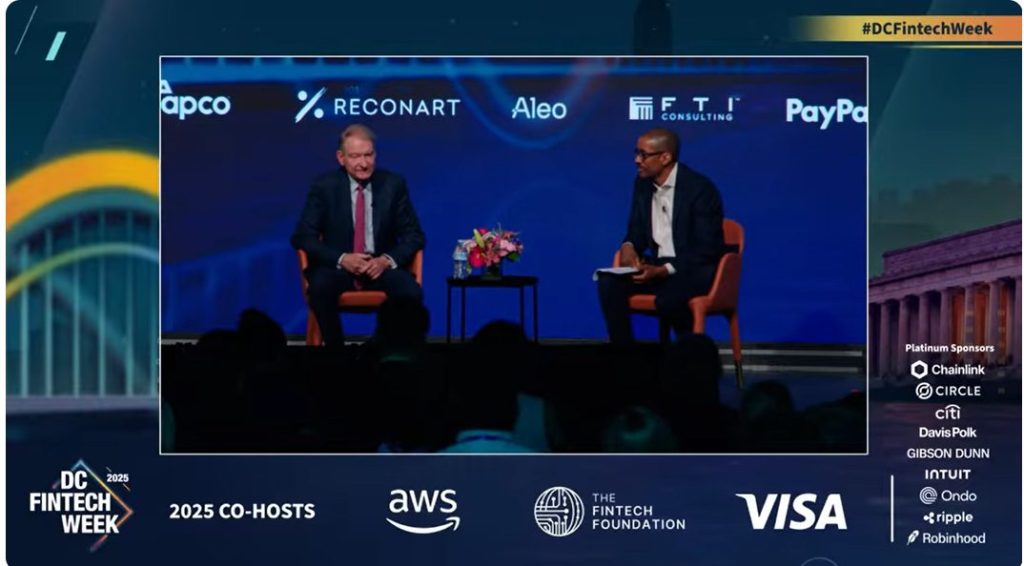 Source: YouTube
When inquired about how regulatory bodies can foster innovation, Atkins replied that the previous approach to the digital asset sector had been somewhat insincere, but assured that the situation has evolved.
The SEC is now fully engaged in crypto regulation and plans to introduce an “innovation exemption” to allow experimentation with novel concepts.
“We at SEC with respect to our statutes have pretty broad authority for exemptions to be made, and so I think we can be, you know, very forward-leaning in that in order to accommodate new ideas,” he stated.
“And if the ideas are not good, the free market reaction would tell.”
He pointed out that the crypto sector benefits from having pro-crypto leaders at the SEC, like “crypto mama,” whose expertise in the field aids the agency in embracing innovation.
He underscored that crypto is the agency’s primary focus to bridge the 10-year gap created by earlier regulatory methods.
When asked about tokenization and real-world assets, Atkins indicated that tokenization is crucial because blockchain technology represents the most thrilling aspect of crypto.
“Tokenization is not necessarily the numerous crypto coins as many would come and go, but I think putting things on-chain presents huge potential benefits for the financial industry and elsewhere.”
He further noted that the transparency of blockchain makes it exceptionally powerful for addressing compliance challenges.
The 1946 Howey Test Faces Challenges with Modern Crypto
Related Posts
Atkins’ remarks have reignited discussions on how current securities laws, particularly the Securities Act of 1933 and the Securities Exchange Act of 1934, pertain to digital assets.
According to the 1933 Act, any asset deemed a “security” must be registered with the SEC unless an exemption is applicable.
The 1934 Act extends oversight to secondary markets, regulating broker-dealers, exchanges, and market manipulation.
The classification issue often hinges on the Howey Test, a 1946 Supreme Court standard that determines whether a transaction qualifies as an “investment contract.”
 Source: Kyrian Alex
The SEC has utilized this test to initiate enforcement actions against token issuers such as Ripple and Coinbase, contending that many crypto offerings fulfill these criteria.
However, the test’s applicability to decentralized networks remains contentious.
Critics argue that blockchain tokens, which can power networks, facilitate governance, or represent stable value, do not conform neatly to the traditional definition of a security.
SEC’s Innovation Exemption Expected by Year-End
Atkins acknowledged that the regulatory delay is negatively impacting U.S. competitiveness, as regions like the UAE and Singapore develop clearer frameworks for digital assets.
He suggested a shift away from the agency’s enforcement-first approach towards a more collaborative framework that balances investor protection with innovation.
This may involve expanding no-action letters and enhancing coordination with the CFTC and the Treasury Department.
In September, Atkins mentioned that the SEC is collaborating closely with Congress to provide technical assistance on securities law.
“We want to see this get over the finish line,” he stated, referencing the passage of the GENIUS Act, which granted statutory recognition to stablecoins, as a sign of increasing momentum.
@SECGov Chair Paul Atkins proposed an “Innovation Exemption” to fast-track crypto products, aligning with blockchain policy moves in Congress. #Crypto #SEChttps://t.co/pkWAeCaffd
— Cryptonews.com (@cryptonews) September 23, 2025
Speaking on Fox Business, Atkins confirmed that by the end of the year, the agency plans to introduce an “innovation exemption” aimed at allowing crypto firms to launch new products without facing immediate onerous requirements.
The post “We’re 10 Years Behind”, SEC Chair Vows to Fast-Track U.S. Crypto Progress appeared first on Cryptonews.
