Disclaimer: Information found on CryptoreNews is those of writers quoted. It does not represent the opinions of CryptoreNews on whether to sell, buy or hold any investments. You are advised to conduct your own research before making any investment decisions. Use provided information at your own risk.
CryptoreNews covers fintech, blockchain and Bitcoin bringing you the latest crypto news and analyses on the future of money.

Russia to Prevent Data Processing Facilities from Utilizing Inexpensive Energy for Cryptocurrency Mining

The Russian government is preparing to prohibit domestic data processing centers from engaging in cryptocurrency mining if they utilize subsidized electricity.
The Russian news outlet RBC has reported that the government has revised a draft law on mining that previously passed its initial reading in the State Duma in 2022.
Officials are currently collaborating with legislators to refine the legislation in anticipation of a second reading.
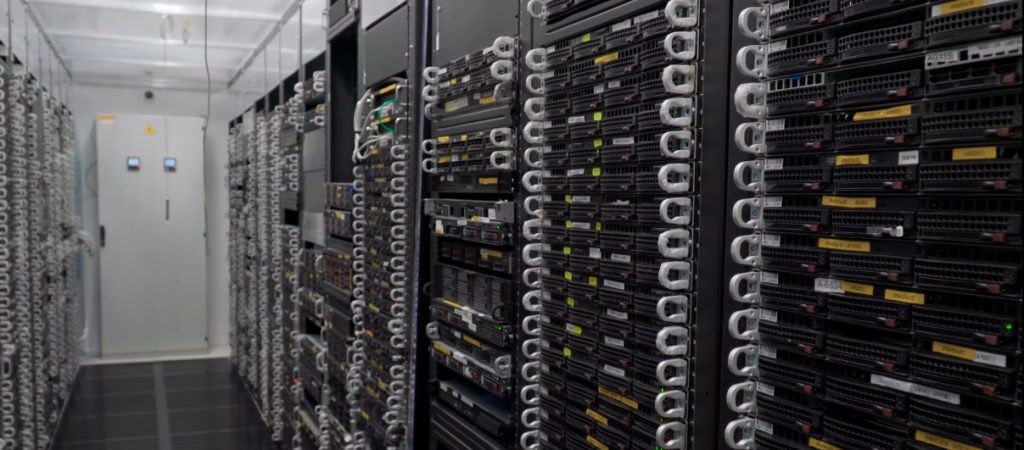 Inside a Russian data processing center. (Source: @regruvideo/YouTube/Screenshot)
Mining Cryptocurrency Likely to Be Prohibited in Numerous Russian Data Centers
The proposed legislation suggests that data processing centers must enroll in a registry managed by the Ministry of Digital Development and Communications.
This enrollment will require operators to commit to not mining cryptocurrency at their facilities. Only those operators who make such commitments will be eligible to receive electricity at reduced rates.
The bill’s creators assert that its purpose is to prevent miners from obtaining benefits when paying for electricity.
These benefits will be exclusively available to data centers that have been officially designated as “communication facilities.”
Russian electricity providers offer subsidized power to residential consumers, as well as to industrial and commercial entities.
Recently, however, lawmakers have urged power companies to introduce special unsubsidized rates for cryptocurrency mining operations.
Joining the registry will be completely voluntary, according to the bill’s authors. Nonetheless, all companies that register will be prohibited from even accommodating cryptocurrency mining equipment, even if it is not connected to the internet.
Unlocking a full picture of Russia’s demographic situation is becoming increasingly hard after the state stopped publishing monthly statistics amid the Kremlin’s war against Ukraine https://t.co/zkx7DpWuWk
— Bloomberg (@business) July 8, 2025
Industrial Miners Indicate Willingness to Comply
Related Posts
Experts in Russian cryptocurrency mining indicated that the bill did not catch them off guard. RBC quoted Intelion’s Director-General Artem Shchepinov as saying he expected this measure.
Shchepinov noted that it would contribute to reinforcing Russia’s technological independence and enhancing its regulated digital infrastructure.
Conversely, some expressed concerns that Moscow has not sought input from the private sector prior to drafting the bill.
A blockchain specialist remarked that the new legislation could negatively affect both the industrial cryptocurrency mining sector and the traditional data center industry.
However, a data center operator asserted that the initiative would have minimal impact on the capabilities of large industrial miners.
These centers are “self-sufficient and sustainable,” he stated, and “do not require government assistance.”
 Engineers work on a new 48 MW Intelion data center in the Russian Republic of Khakassia. (Source: @intelionmining/VK/Screenshot)
Facilities for Dual Use
Nevertheless, many significant industrial miners operate dual-use facilities. These centers can accommodate both mining operations and more traditional IT resources.
Shchepinov seemed to indicate that his company has already started preparing for the transition. He cited Intelion’s facilities in the Samara Oblast as an example.
The executive explained that Intelion has already segmented this facility into “two clusters that facilitate cryptocurrency mining and AI computing simultaneously.”
In May, industry representatives disclosed that the combined revenues of Intelion and BitRiver for the financial year 2024 reached the $200 million threshold.
Approximately 90% of Russian industrial miners concentrate their efforts on Bitcoin (BTC), as most experts in the country concur.
However, a considerable number of home-based miners in the country prefer to mine Ethereum (ETH), as reported by cryptocurrency enthusiasts to Cryptonews.com.
The post Russia to Block Data Processing Centers from Mining Crypto with Cheap Power appeared first on Cryptonews.
