Disclaimer: Information found on CryptoreNews is those of writers quoted. It does not represent the opinions of CryptoreNews on whether to sell, buy or hold any investments. You are advised to conduct your own research before making any investment decisions. Use provided information at your own risk.
CryptoreNews covers fintech, blockchain and Bitcoin bringing you the latest crypto news and analyses on the future of money.


The worldwide supply of stablecoins is currently over $150 billion, indicating a rising interest in relatively stable digital currencies.
The stablecoin sector has also become increasingly competitive. For instance, Ripple, the issuer of XRP, has recently revealed intentions to introduce a stablecoin backed by the United States dollar.
Launching a stablecoin is a natural step for Ripple as we bridge the gap between traditional finance and crypto. We have 1/ the years of experience 2/ regulatory footprint 3/ a strong balance sheet and 4/ a network with near global payout coverage, to offer the best of… https://t.co/GlyqhYl9ES
— Brad Garlinghouse (@bgarlinghouse) April 4, 2024
Ripple’s stablecoin is expected to compete with the two leading stablecoin issuers, Tether (USDT) and Circle (USDC). The combined supply of Tether’s USDT and Circle’s USDC has increased by nearly $10 billion in the last month.
Is The Bull Market Driving Stablecoin Demand?
Interestingly, the rising demand for stablecoins aligns with the ongoing crypto bull market.
While the growth of stablecoins may correlate with the rising prices of cryptocurrencies, industry experts suggest that the demand for digital assets tied to the U.S. dollar is increasing for additional reasons.
Austin Campbell, an Adjunct Professor at Columbia Business School, informed Cryptonews that although there is a connection between stablecoins and the overall crypto market capitalization, this correlation has been diminishing over time.
“It appears that stablecoins are being utilized independently of crypto trading for payments,” Campbell stated.
He further noted that dollar-pegged stablecoins are catering to a wider market segment compared to digital assets that are primarily used for speculation.
Stablecoin Use Cases For Payments On The Rise
Their functionality may also be on the rise, as various stablecoin payment applications are emerging.
For example, David Uhryniak, Head of TRON Ecosystem Development, shared with Cryptonews that an application called Grab – often referred to as the “Uber of Singapore” – has recently started accepting USDT on TRON for payments.
“TRC20-USDT holders can now pay for their rides or food delivery directly without converting to fiat currency,” Uhryniak mentioned. “I anticipate a growing trend where more international e-commerce platforms will integrate with TRON to facilitate crypto transactions for everyday services.”
According to Uhryniak, the TRON blockchain has emerged as a preferred transport layer for popular stablecoins like USDT due to its low transaction fees and rapid processing times.
“TRON has the highest circulating supply of USDT, exceeding $54.8 billion,” Uhryniak stated. “Since early February of this year, USDT on TRON has been averaging over 2 million transactions daily.”
Jelena Djuric, CEO and Co-Founder of the digital asset issuance chain Noble, told Cryptonews that while stablecoins can be utilized for decentralized finance (DeFi), the platform has recently observed a rise in stablecoin usage for payments.
“An example of this is being seen with Cypher Wallet, where users can load USDC from Noble and spend those dollars in stores wherever Mastercard is accepted,” Djuric explained.
Djuric expressed her belief that the most intriguing stablecoin use cases currently focus on digital dollars.
“Stablecoins are more convenient, efficient, and scalable than traditional financial systems,” she stated.
Djuric revealed that Noble is currently processing $1 billion in monthly USDC transactions from the platform to other Cosmos and Inter-Blockchain Communication Protocol chains.
“We have increased USDC issuance more than most other native issuance chains over the past few months. This indicates genuine adoption by users and Dapp chains that connect to Noble for liquidity,” Djuric added.
Massimiliano Silenzi, CEO of research firm Cryptorefills Labs, informed Cryptonews that recent research from Cryptorefills indicates that nearly 80 percent of crypto shoppers prefer to use stablecoins for purchasing goods and services over other cryptocurrencies.
Related Posts
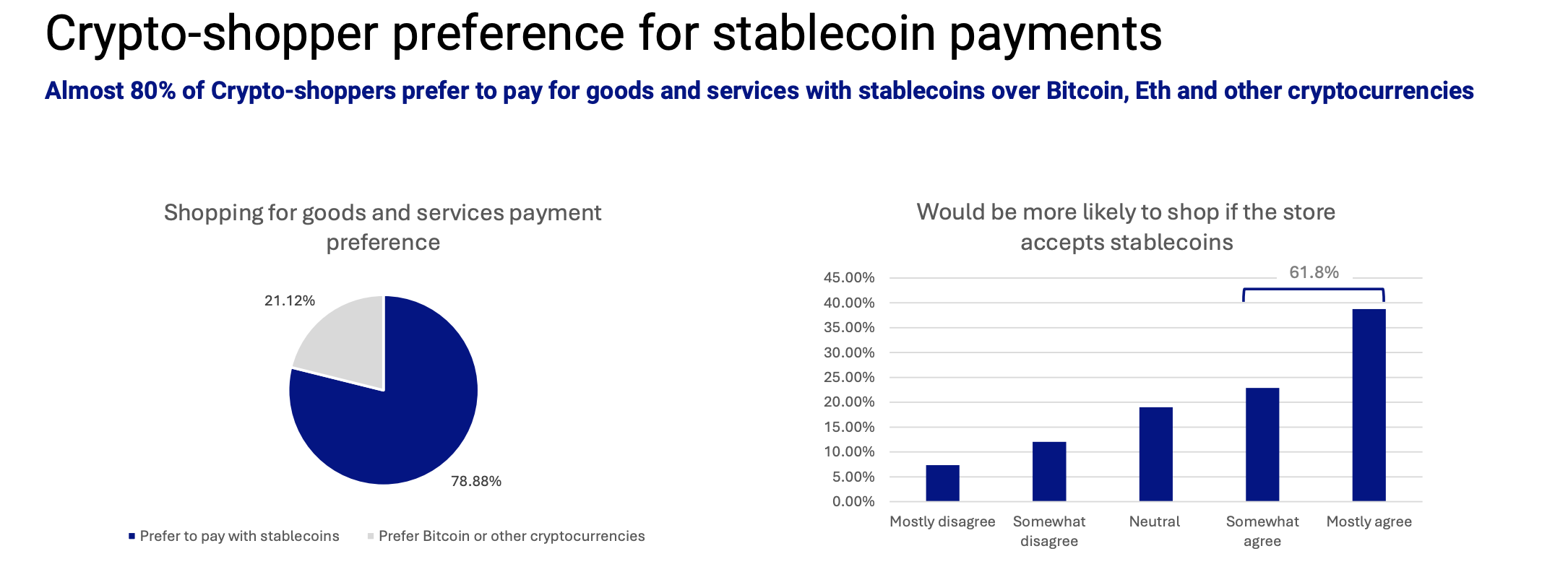 Source: Cryptorefills
While this is significant, Silenzi noted that due to transaction speeds and fees, only one-sixth of stablecoin payments occur on the Ethereum mainnet.
“The majority of stablecoin payments are fairly evenly distributed across alternative networks such as Polygon, TRON, Solana, and Avalanche, as well as Ethereum layer-2s like Optimism and Arbitrum,” Silenzi stated. “Consequently, there is currently no clear leader among stablecoin payment networks that are fast, cost-effective, and scalable.”
Challenges May Hamper Stablecoin Adoption
While it is noteworthy that stablecoin adoption may be rising due to practical payment applications, regulations and other issues could hinder this growth.
For example, although stablecoin legislation may be enacted this year in the U.S., Senator Elizabeth Warren has recently criticized the proposed stablecoin bill.
As previously reported by Cryptonews, Warren contends that establishing new regulatory frameworks for stablecoins could “amplify and entrench” the risks they pose to the American banking system.
Additionally, David Pope, Commissioner of The Wyoming Stable Token Commission, informed Cryptonews that tax regulations surrounding stablecoins remain an obstacle to adoption as well.
“The IRS categorizes all crypto (including stablecoins) as property (rather than cash),” Pope explained. “This means that whenever a U.S. person or entity utilizes a stablecoin for any purpose, it must be reported on their tax return (even though there is typically no gain or loss).”
Pope believes that if stablecoins become widely used, this will likely result in thousands of transactions needing documentation.
Alongside regulatory challenges, Djuric believes that non-crypto natives still face difficulties with Web3 concepts such as private keys, wallets, on-ramps, bridged versions of the same stablecoins, and more.
“Noble is working to address all of these challenges, but it is not an overnight process. Ultimately, we should see chain and asset abstraction as secure yet highly intuitive wallet interfaces,” she stated.
Indeed, these challenges may eventually lead to a decline in demand for stablecoins.
For instance, Paxos’ latest transparency report on PayPal USD indicated that the circulation of PYUSD in March reached $188.5 million. This represents a 39% decrease in PayPal’s stablecoin compared to the previous month.
Ways To Ensure Stablecoin Growth Moving Forward
Despite these challenges, Campbell believes that stablecoins will continue to expand as the crypto landscape evolves.
“Stablecoins will likely surpass DeFi and become a tool for real-world payments globally,” he stated.
Although adoption may progress slowly, education, along with retail demand for stablecoins, will facilitate future growth.
Notably, Tether is already taking measures to enhance stablecoin education.
On April 10, Tether announced a collaboration with Coins.ph – a well-known digital asset exchange in the Philippines – to promote financial education regarding blockchain technology, Bitcoin, and stablecoins in the region.
According to a Tether blog post, the educational initiatives being introduced will target various segments of the Filipino population. This includes finance professionals such as bankers and fintech companies, as well as overseas Filipino workers seeking efficient remittance solutions.
Pope also believes that as the general public progresses through the learning curve, retail demand for stablecoins will rise.
“This all suggests that stablecoins are gradually being adopted,” he stated. “But can anyone buy their morning coffee with them yet? Probably very few places accept a wallet transfer for that, but adoption does seem to be advancing.”
The post Payment Use Cases Fuel Increasing Stablecoin Growth appeared first on Cryptonews.
