Disclaimer: Information found on CryptoreNews is those of writers quoted. It does not represent the opinions of CryptoreNews on whether to sell, buy or hold any investments. You are advised to conduct your own research before making any investment decisions. Use provided information at your own risk.
CryptoreNews covers fintech, blockchain and Bitcoin bringing you the latest crypto news and analyses on the future of money.


Polymarket’s odds for a Russia-Ukraine ceasefire by December 31, 2026, have plummeted to 13%, down from 40% the previous day. The contract with the nearer deadline of October 31 is priced even lower, at an implied probability of 7%. Both figures are contingent on a specific resolution rule that requires more than just a diplomatic announcement.
For the Polymarket event to resolve as “Yes,” a ceasefire must take effect by 11:59 p.m. Eastern European Time on the specified date and remain continuously in force for at least 10 calendar days.
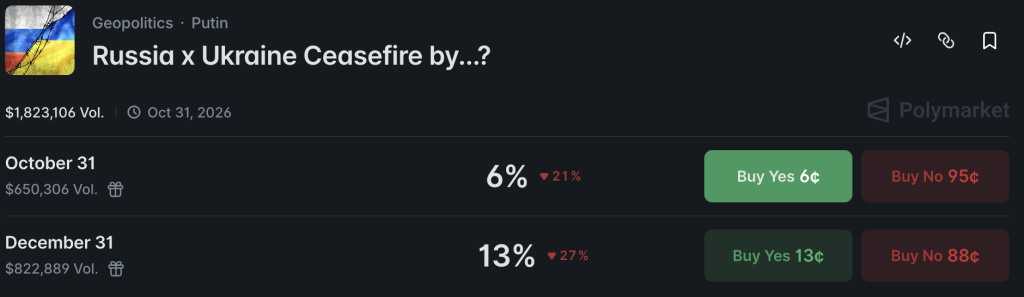
SOURCE: Polymarket
A ceasefire announced on December 30 that ends before the 10-calendar-day requirement is met would not satisfy the market’s rules. This creates a materially higher bar than a simple diplomatic announcement.
In contrast, Kalshi does not currently offer an active market for a potential Ukraine-Russia ceasefire. Instead, it focuses on whether Volodymyr Zelensky will visit Russia this year and whether he and Vladimir Putin will meet.
Check Out the Ukrainian Conflict Markets on Kalshi and Claim $25 for Free
Polymarket Ukraine Ceasefire Odds: What the 13% Price Measures
According to Ukrainian media outlet “Glavkom,” the new Trump peace plan brought by Kushner and Witkoff amounts to total surrender to Russia:
– Complete ceasefire
– Withdrawal of Ukrainian forces from Donbas and Zaporizhzhia Oblast, with possible deployment of a UN contingent there… pic.twitter.com/CQ3OZA0DLh— Megatron (@Megatron_ron) September 7, 2026


 According to Ukrainian media outlet “Glavkom,” the new Trump peace plan brought by Kushner and Witkoff amounts to total surrender to Russia:
The pricing implies that a qualifying ceasefire by year-end is unlikely, rather than simply indicating that talks or a temporary lull in fighting are improbable.
These are distinct outcomes under the market rules. A short pause, a partial agreement, or an announced truce that does not remain in effect for 10 full calendar days would not meet the condition for a “Yes” resolution.
The snapshot reports approximately $1.8 million in total volume, $327,300 in liquidity, and $621,390 in open interest. The source notes that no trader count is provided and that the dated contracts share a single event structure.
As a result, reported market depth does not necessarily indicate broad, independent participation. Prices across the October and December timeframes may reflect concentrated views or correlated positioning rather than separate assessments of each deadline.
Related Posts
The market summary identifies the European Union’s individual-sanctions rollover around September 15 as a near-term policy test regarding Western cohesion, pressure on Russia, and diplomatic flexibility.
EU individual sanctions were extended through September 15. A renewal, loosening, or visible disagreement could alter expectations for negotiations and a durable ceasefire, although the source notes that policy signals do not guarantee a ceasefire.
Earn $50 and Enter the $300K Prize Draw on EdgeX
Scenarios That Could Reprice the Contracts
The market summary suggests that a year-end ceasefire would become more plausible if autumn diplomacy produced a framework that survived the 10-day continuity test, particularly following the UN General Assembly (UNGA) period and sanctions-related signaling in September.
It identifies sustained talks, a monitored pause in attacks, or a formal settlement mechanism accepted by both sides as developments that could support such a framework.
Conversely, the summary indicates that the December deadline could lose support if negotiations stall, sanctions harden, or the war escalates into winter.
The October analysis similarly describes a fast diplomatic breakthrough around UNGA week and a shift in EU sanctions politics as factors that could be necessary to reach the earlier deadline.
The EU’s individual sanctions rollover, with listings extended through September 15, remains a policy checkpoint noted in the market summary. The UN General Assembly’s high-level week follows shortly afterward and may provide a concentrated period for diplomatic signaling or initiatives.
New participation or large position changes on the Polymarket Ukraine ceasefire odds could also move reported odds independently of real-world developments.
Because the breadth of participation cannot be verified from the available data, market prices should be read alongside its specific resolution rules, shared event structure, liquidity, and the possibility of concentrated positioning.
Make Your Prediction Count With $25 for Free on Kalshi
The post Polymarket Ukraine Ceasefire Odds Drop to 13% as Resolution Bar Remains High appeared first on Cryptonews.
