Disclaimer: Information found on CryptoreNews is those of writers quoted. It does not represent the opinions of CryptoreNews on whether to sell, buy or hold any investments. You are advised to conduct your own research before making any investment decisions. Use provided information at your own risk.
CryptoreNews covers fintech, blockchain and Bitcoin bringing you the latest crypto news and analyses on the future of money.


Matt Huang, co-founder of Paradigm, has highlighted research suggesting that the prediction market Polymarket may be overstating its reported trading volumes due to a data aggregation error that leads to double-counting across most external analytics platforms.
The research, presented by Paradigm research partner Storm Slivkoff, indicates that this issue impacts public datasets and dashboards that depend on Polymarket’s reported figures, potentially exaggerating the platform’s actual activity by around 100%.
The debate arose when Huang shared Slivkoff’s findings on X, prompting immediate backlash from Polymarket’s data team and accusations that Paradigm, an investor in competing platform Kalshi, was attempting to undermine a rival through technical nuances.
Polymarket data bug: volumes are double-counted in most public data
Interesting find in diligence from @notnotstorm https://t.co/xuQ41JUVHf— Matt Huang (@matthuang) December 8, 2025
Technical Basis of Volume Dispute
Slivkoff’s research indicates that Polymarket’s smart contracts generate separate OrderFilled events for both the maker and taker sides of each transaction, resulting in duplicate representations of the same trades.
Most analytics dashboards calculate volume by aggregating these events, effectively counting the same transaction twice.
A straightforward transaction involving YES tokens sold for $4.13 produces two OrderFilled events for that amount, leading dashboards to report $8.26 in volume instead of the actual $4.13 traded.
The complexity arises from Polymarket’s distinctive market structure, which accommodates eight different trade types, including standard swaps and split-merge operations where participants exchange USDC for opposing YES-NO positions.
While no individual event contains erroneous information, aggregating all OrderFilled events without differentiating between maker and taker representations results in systematic double-counting of notional volume and cash flow metrics.
This issue is present across both Polymarket’s CTF Exchange and NegRisk exchange contracts, which exhibit identical event emission patterns.
Slivkoff’s analysis, which involved creating a transaction simulator and reviewing contract code, shows that accurate measurement necessitates using one-sided metrics, either taker-side or maker-side volume, instead of summing redundant event streams.
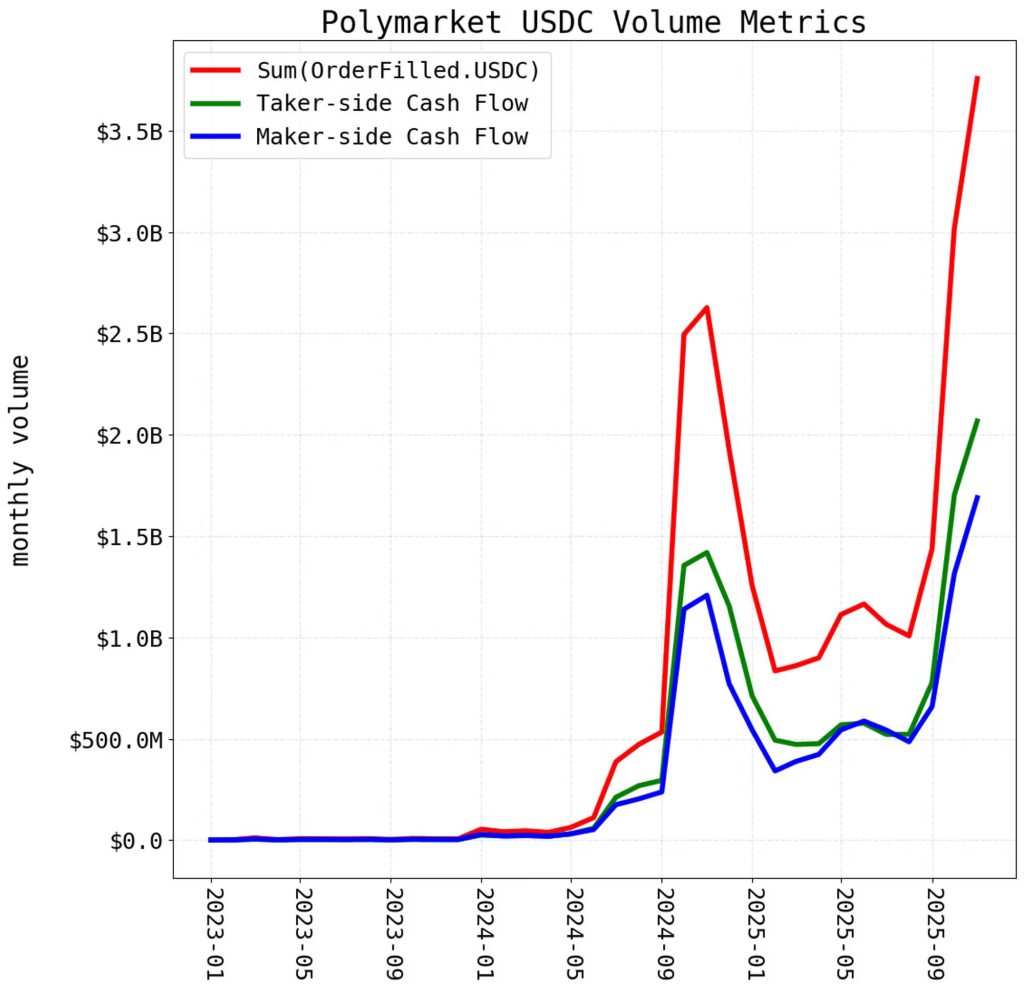 Source: Paradigm
When assessed correctly, Polymarket’s actual monthly volumes for October and November 2024 were around $1.25 billion each, roughly half of the $2.5 billion figures shown on most public dashboards prior to adjustments.
Related Posts
Industry Reaction and Competitive Dynamics
Polymarket’s Primo Data promptly contested the characterization, asserting that the platform’s official site displays notional taker volume without double-counting, consistent with industry standards utilized by Kalshi.
“This post isn’t about Polymarket’s website, it’s about the common dashboards that people use for tracking Polymarket volume,” Slivkoff clarified, stressing that the issue pertains to third-party analytics rather than Polymarket’s internal reporting.
This is not how prediction markets report volume, including your portfolio company Kalshi.
To be clear:
1. Our site does not double count volume. We show notional taker volume (same as Kalshi).
2. The primary dashboards that show both Polymarket & Kalshi show notional volume… pic.twitter.com/9Bu0zm0DS0— Primo Data (@primo_data) December 8, 2025
Major data providers, including DefiLlama, Allium Labs, and Blockworks, confirmed they are revising their Polymarket dashboards to eliminate double-counting after validating Slivkoff’s findings.
Meanwhile, some analysts defended existing methodologies, with Dragonfly data head Hildobby asserting that advanced dashboards have accounted for the distinction since 2024, although acknowledging that the methodology had not been documented until now.
The timing raised concerns, given Paradigm’s investment in Kalshi, Polymarket’s main US competitor.
Will Sheehan of Parsec Finance criticized the research as appearing “a bit like a hit piece when it’s just data being hard and Polymarket’s contracts being open/onchain,” while others questioned whether the disclosure of Paradigm’s competitive interest sufficiently addressed potential bias.
Storm defended the work as identifying genuine mistakes arising from data complexity rather than placing blame, noting that Polymarket itself is not accountable for how third parties interpret its event streams.
Beyond the immediate volume dispute, Nick Preszler of Melee Markets contended that the controversy underscores broader measurement challenges in prediction markets, where low-priced contracts can produce disproportionate notional volume compared to actual capital at risk.
“If a user buys $10 worth of contracts at .1c each, they are risking $10, but get credited for $10,000 of volume,” Preszler remarked, advocating for alternative metrics like open interest and fee revenue to offer more accurate industry comparisons.
Polymarket is building an internal trading desk to bet against customers as it relaunches in U.S. markets following CFTC regulatory clearance.#Polymarket #CFTChttps://t.co/mTAUebkNsV
— Cryptonews.com (@cryptonews) December 5, 2025
 Polymarket is building an internal trading desk to bet against customers as it relaunches in U.S. markets following CFTC regulatory clearance.#Polymarket #CFTChttps://t.co/mTAUebkNsV
The discussion arises as Polymarket prepares for its complete US relaunch following CFTC regulatory approval and seeks a valuation between $12 billion and $15 billion.
At the same time, the company is facing scrutiny over plans to create an internal market-making operation that would trade against customers, similar to controversial practices already adopted by Kalshi.
The post Polymarket Accused of Double-Counting its Trading Volume appeared first on Cryptonews.
