Disclaimer: Information found on CryptoreNews is those of writers quoted. It does not represent the opinions of CryptoreNews on whether to sell, buy or hold any investments. You are advised to conduct your own research before making any investment decisions. Use provided information at your own risk.
CryptoreNews covers fintech, blockchain and Bitcoin bringing you the latest crypto news and analyses on the future of money.


Throughout history, there have always been moments of significant economic opportunity. A singular discovery of a valuable commodity or limited resource can ignite a new wave of generational wealth.
With the advent of the Industrial Revolution came a modern perspective on asset classes for wealth enhancement. Anyone could have participated in these economic booms. However, a lack of knowledge and a general sense of inaccessibility to global financial markets kept the vast majority from investing in the world’s natural wealth.
The positive aspect is that history tends to repeat itself.
The latest economic opportunity is already here. This time, the world has blockchain technology.
Tokenizing the Industrial Revolution
Since the first industrial revolution, oil has been crucial to global economic development, fueling industries and shaping geopolitical dynamics. Today, there are numerous ways to invest in oil markets, but not necessarily across the entire value chain of the commodity. A vast ecosystem exists around black gold, encompassing extraction, processing, distribution, and consumption.
Fortunately, the rise of information and decentralization enables democratized access to how we own, trade, and value this sector. Notably, the market for tokenized real-world assets (RWAs) has exceeded $12 billion, reflecting growing investor confidence in these digital representations. This is a clear instance of the traditional economy intersecting with the digital future – or perhaps traditional money meeting the new wave of retail and institutional investors.
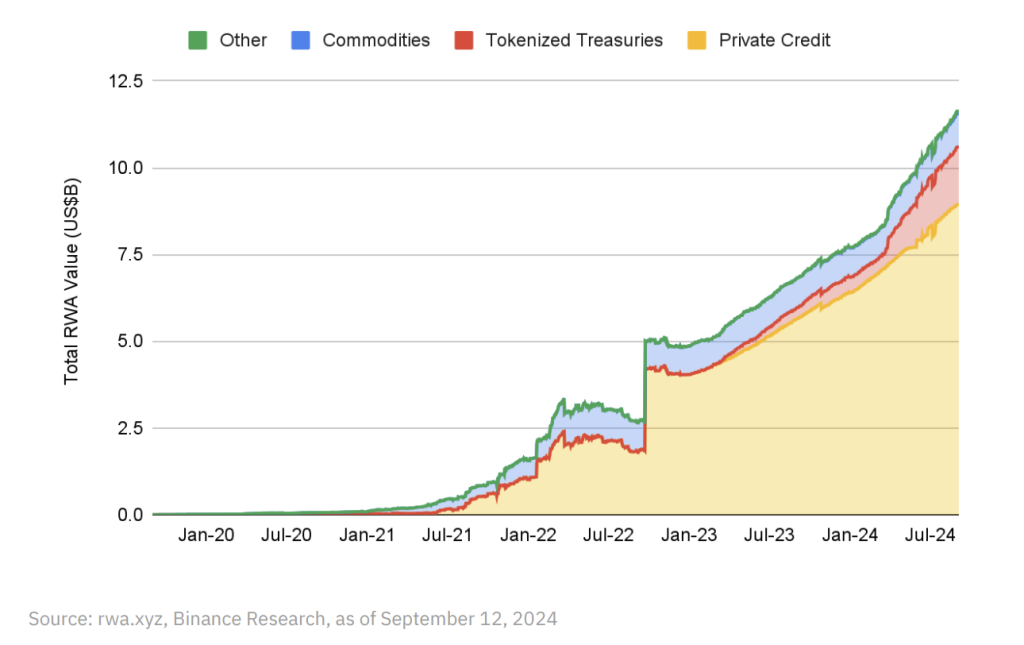 Source: Binance Research
Ownership has emerged as one of the most compelling aspects of tokenizing oil: how can one accurately claim a stake in the revenue streams of such a complex industry? This is where tokenization becomes relevant. Unlike conventional investments in oil, which may require substantial capital or intricate contracts, tokenized oil offers fractional ownership through digital tokens on a blockchain. Each token typically represents a specific, measurable quantity of oil – whether in barrels, liters, or another standardized unit – stored in certified locations or held as reserves by reputable custodians.
When an individual purchases an oil-backed token, they acquire a fractional interest in physical oil, securely recorded on a blockchain. This digital ledger provides clear, immutable proof of ownership without the need for intermediaries, facilitating a streamlined process to buy, sell, or hold oil-based assets without the necessity of handling the commodity physically. In contrast to traditional oil investments, which often demand significant capital, complex mechanisms, and insider knowledge, tokenized oil democratizes access to a market that was previously reserved for major players. Blockchain further enhances this by offering real-time asset tracking, providing investors with a transparent view of their holdings.
Moreover, smart contracts can automate essential aspects of this ownership. For instance, if the token represents oil that is leased or utilized in some manner, any returns generated can be automatically distributed back to token holders. This arrangement allows for a fluid, transparent, and more direct investment process, giving investors the opportunity to hold a valuable tangible commodity without the usual logistical and legal complexities associated with oil ownership. According to a report by PwC, blockchain technology can significantly lower operational costs in commodity trading, making tokenized oil a more efficient investment vehicle.
Related Posts
The Appeal of Tokenizing Commodities
The tokenization of commodities presents numerous advantages, making it an attractive option for traders, investors, and producers. One significant advantage is the stability derived from real-world asset backing. Traditional investors often find the cryptocurrency space daunting due to its notorious volatility—Bitcoin, for example, experienced dramatic price fluctuations, from nearly $69,000 in November 2021 to $16,000 just a year later, and is now well within reach of the coveted six-figure mark.
In contrast, oil, a commodity with a global market size of $2.7 trillion as of 2022, tends to follow more predictable supply and demand patterns. Oil-backed cryptocurrencies, by directly linking token values to oil, provide a means to engage with digital assets without the heightened risks associated with speculative currencies.
Tokenized oil also acts as a hedge against inflation and market volatility. Commodities like oil have historically been used to preserve value during inflationary periods, and inflation in many major economies has recently reached multi-decade highs. By introducing this stability into the digital asset realm, oil-backed cryptocurrencies offer an inflation-resistant investment option. Unlike traditional digital tokens that often respond to market sentiment, oil-backed tokens are anchored in physical resources, making them more stable and appealing to cautious investors.
Finally, tokenized oil connects the gap between traditional finance and digital assets. For investors wary of speculative cryptocurrencies, the tangible backing of oil offers reassurance. By merging the reliability of a physical commodity with the innovation of blockchain, oil-backed tokens attract a more diverse group of investors, including those from traditional finance sectors. This unique integration has the potential to stabilize the digital asset market, positioning tokenized oil as a middle ground between high-risk digital assets and the stability of physical commodities.
You may also like What Reforms Can We Expect from Paul Atkins at the SEC?
A New Era for Tokenized Assets
Some projections indicate that Tokenized Real-World Assets (RWAs) could unlock a $30 trillion market opportunity in the coming years. With a new administration focusing on pro-energy independence policies and a more crypto-friendly Congress anticipated to take office, there is a renewed sense of optimism within the digital asset sector. These developments are likely to foster an environment that supports RWA projects, including oil-backed cryptocurrencies, providing inflation-resistant options grounded in tangible resources within the digital economy.
The growth potential for tokenized assets is substantial. Industry leaders like McKinsey predict the RWA market could reach anywhere from $2 trillion to an impressive $4 trillion by 2030. With the current market valued at approximately $185 billion, this sector is on the brink of transformative growth as traditional and digital finance begin to align under favorable regulations.
As demand increases for secure and innovative investments, oil-backed cryptocurrencies present an exciting new frontier. By combining the stability of a tangible commodity with the transparency and accessibility of blockchain, tokenized oil could lead the way into a new era of accessible, diversified investments, providing both seasoned and novice investors with a solid foundation in the evolving crypto landscape.
Disclaimer: The views expressed in this article are those of the author and do not necessarily reflect the opinions of Cryptonews.com. This article aims to provide a broad perspective on its subject and should not be considered professional advice.
The post Opinion: Is Tokenized Oil the Next Big Thing in Investing? appeared first on Cryptonews.
