Disclaimer: Information found on CryptoreNews is those of writers quoted. It does not represent the opinions of CryptoreNews on whether to sell, buy or hold any investments. You are advised to conduct your own research before making any investment decisions. Use provided information at your own risk.
CryptoreNews covers fintech, blockchain and Bitcoin bringing you the latest crypto news and analyses on the future of money.


On March 30, 2026, Brent crude surpassed $116 a barrel, marking a 60% increase for the month, fueled by rising tensions between the US and Iran after Tehran accused Washington of planning an invasion. This situation has compounded disruptions from Houthi strikes, placing Bitcoin in the midst of the resulting institutional risk-off shift.
The surge in oil prices is not impacting crypto directly; rather, it is affecting it through three interconnected channels: a resurgence in inflation, postponed Fed rate cuts, and a geopolitical risk premium that is eroding leveraged long positions across all risk asset classes.
Bitcoin fell to weekly lows ranging from $63,000 to $65,700, with over $500 million in derivatives liquidations recorded, 84% of which originated from long positions.
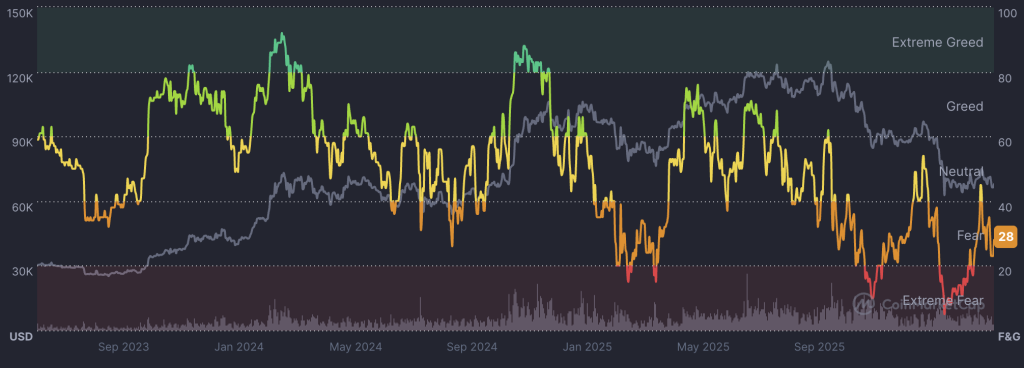 Source: CMC
The Fear & Greed Index plummeted to 28, indicating Extreme Fear, while an unprecedented $14 billion options expiry heightened the volatility.
Discover: The best crypto to diversify your portfolio with
Bitcoin Encounters Structural Deleveraging as Oil-Driven Inflation Alters the Fed’s Strategy
$63,000 is the critical threshold Bitcoin must maintain.
This level has previously limited downside during the last two macro shock events. The 200-day moving average is just below at $62,400.
A close below this average would mark the first instance since the rally began in October 2025 and could likely initiate a second wave of systematic deleveraging from quantitative funds employing momentum strategies. Resistance levels above are positioned at $67,500 and $71,000, both of which were former support areas that reversed during the selloff in February.
 Bitcoin (BTC)24h7d30d1yAll time
Related Posts
The correlation with oil is particularly significant at this moment. Binance Research indicates that the Bitcoin-WTI correlation is near zero across most market conditions.
The current 30-day rolling correlation stands at just 0.15. However, this can shift during periods of extreme disruption. The Strait of Hormuz is currently flowing at approximately 4 million barrels per day, compared to a typical 20 million. This is not merely a tail risk; it represents an active structural supply shock, which tends to create temporary spikes in correlation.
If tensions between the US and Iran ease and Hormuz flows return to normal, Brent prices could drop below $100, and the Fed may indicate a patient approach during its meeting on April 1 to 2. Bitcoin could then reclaim $67,500, while BlackRock’s IBIT builds on its $225.2 million inflow during the dip, leading institutional rotation back into accumulation mode.
If tensions continue without full escalation, Brent may stabilize between $110 and $116, and the Fed could maintain a hawkish stance through Q2. Bitcoin may fluctuate between $63,000 and $68,000 with heightened volatility, ETF flows could remain inconsistent, and mining costs for operators like Marathon Digital may increase by 15 to 25%.
“The United States of America is in serious discussions with A NEW, AND MORE REASONABLE, REGIME to end our Military Operations in Iran.” – President Donald J. Trump
pic.twitter.com/0MWL2hSNmK
— The White House (@WhiteHouse) March 30, 2026
A complete blockade of Hormuz is a scenario that market participants are keen to avoid. Oil prices above $130, 10-year Treasury yields exceeding 5%, and the Fed facing a choice between combating inflation and supporting growth could arise.
This combination could potentially drive Bitcoin down to the range of $55,000 to $57,000 in a comprehensive risk-off liquidation wave, reminiscent of February 2022 when WTI reached $115 and BTC dropped from $45,000 to $39,000 within days.
The inflation channel is an aspect that many traders are currently underestimating. Sustained oil prices above $100 not only affect sentiment but also mechanically delay rate cuts.
Bitcoin’s decline below $67,000, coupled with rising Treasury yields, has already demonstrated how directly this relationship impacts the market. BTC’s 0.9 correlation with the IGV tech index indicates it behaves like a rate-sensitive growth asset in the short term, rather than an inflation hedge.
Attention should be paid to the Fed’s meeting on April 1 to 2. Any indications of a prolonged hold could serve as a catalyst for the next downward movement. Congressional votes on Iran sanctions anticipated in mid-April carry equal significance. Further disruptions in Hormuz could send additional shocks through energy markets and directly impact institutional risk appetite.
Discover: The best pre-launch token sales
The post Oil at $116: Why This Macro Shock Could Trigger a Bitcoin Risk-Off Deleveraging appeared first on Cryptonews.
