Disclaimer: Information found on CryptoreNews is those of writers quoted. It does not represent the opinions of CryptoreNews on whether to sell, buy or hold any investments. You are advised to conduct your own research before making any investment decisions. Use provided information at your own risk.
CryptoreNews covers fintech, blockchain and Bitcoin bringing you the latest crypto news and analyses on the future of money.


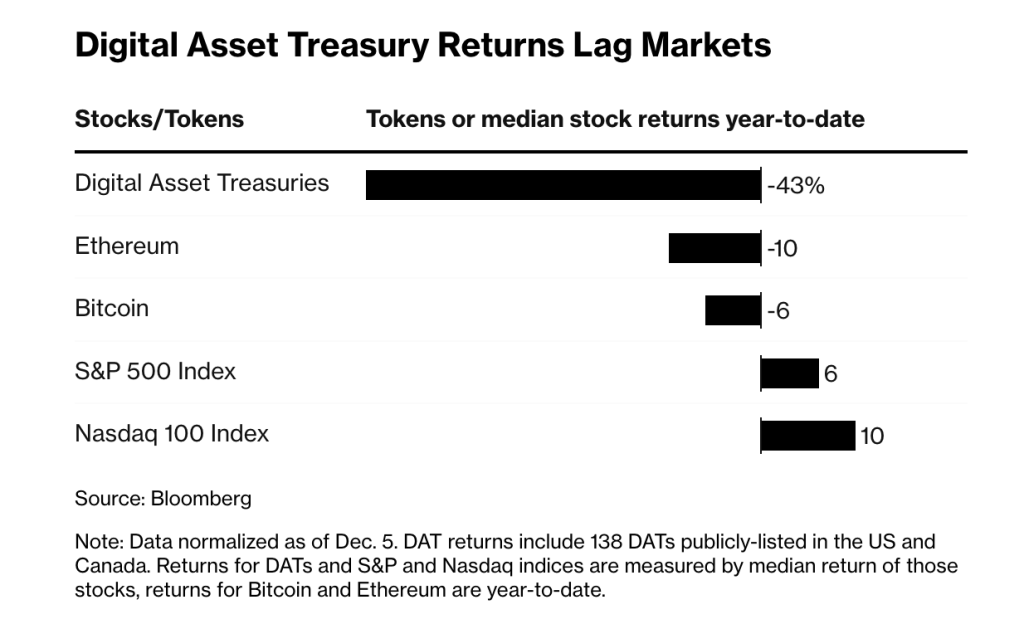
Companies that rapidly adopted Michael Saylor’s Bitcoin strategy for digital asset treasury management are currently experiencing significant declines in shareholder value, with median stock prices dropping 43% year-to-date, even as the overall market continues to rise, according to Bloomberg.
 Source: Bloomberg
In the first half of 2025, over 100 publicly listed firms transformed into cryptocurrency-holding entities, borrowing billions to acquire digital tokens while their stock prices initially surged beyond the value of the assets they obtained.
This strategy appeared to be unstoppable until the market reality imposed a severe correction.
Model’s Approach Triggers Industry-Wide Downturn
Michael Saylor of Strategy Inc. was the first to implement the tactic of converting corporate cash into Bitcoin assets, effectively turning his software firm into a publicly traded cryptocurrency treasury.
The model thrived spectacularly until mid-2025, drawing in prominent investors, including members of the Trump family.
SharpLink Gaming exemplified the excitement. The company shifted from conventional gaming operations, appointed an Ethereum co-founder as its chairman, and announced significant token acquisitions.
Sharplink Gaming added $80M in Ether to its reserves, bringing total holdings to $3.6B and securing its position as the second-largest corporate holder of ETH.#Sharplink #Ether https://t.co/ADz76OeiCn
— Cryptonews.com (@cryptonews) October 27, 2025
 Sharplink Gaming added $80M in Ether to its reserves, bringing total holdings to $3.6B and securing its position as the second-largest corporate holder of ETH.#Sharplink #Ether https://t.co/ADz76OeiCn
Its stock skyrocketed 2,600% within days before plummeting 86% from its peak, resulting in a total market capitalization that fell below the value of its Ethereum holdings, at just 0.9 times its crypto reserves.
Bloomberg’s analysis of 138 U.S. and Canadian digital asset treasuries indicates that the median share price has decreased by 43% year-to-date, significantly underperforming Bitcoin’s modest 7% drop.
In contrast, the S&P 500 increased by 6%, and the Nasdaq 100 rose by 10%.
Strategy shares have fallen 60% from their July peaks, despite having surged over 1,200% since the company began acquiring Bitcoin in August 2020.
 Source: Bloomberg
“Investors recognized that there’s limited yield from these holdings aside from merely holding onto this accumulation of funds,” B. Riley Securities analyst Fedor Shabalin stated to Bloomberg.
Debt Obligations Reveal Structural Issues
Related Posts
The core issue affecting these companies arises from their methods of financing cryptocurrency acquisitions.
Strategy and its followers issued substantial amounts of convertible bonds and preferred shares, raising over $45 billion across the sector to purchase digital tokens that do not generate cash flow.
These debt instruments come with significant interest and dividend obligations that cryptocurrency holdings cannot fulfill, resulting in a structural mismatch between liabilities requiring regular payments and assets yielding no income.
Strategy faces annual fixed obligations of around $750 million to $800 million related to preferred shares.
Firms that opted for smaller, more volatile cryptocurrencies instead of Bitcoin experienced the steepest declines.
Alt5 Sigma, supported by two Trump sons and planning to acquire over $1 billion in World Liberty Financial’s WLFI token, has seen its value drop by more than 85% from its June peak.
Strategy sought to mitigate funding issues by raising $1.44 billion in dollar reserves through stock sales, which would cover 21 months of dividend payments.
Saylor Acknowledges Possible Bitcoin Sales
The industry now confronts a pivotal moment. Strategy CEO Phong Le admitted that the company might sell Bitcoin if necessary to meet dividend obligations, particularly if the firm’s market value dips below its cryptocurrency holdings.
These remarks sent ripples through the digital asset treasury sector, given Saylor’s previous assertions that Strategy would never sell, famously quipping in February to “sell a kidney if you must, but keep the Bitcoin.”
During December’s Binance Blockchain Week, Saylor outlined the adjusted strategy, stating that “when our equity is trading above the net asset value of the Bitcoin, we just sell the equity,” but “when the equity’s trading below the value of the Bitcoin, we would either sell Bitcoin derivatives, or we would just sell the Bitcoin.“
This shift raises concerns about a potential downward spiral where forced crypto sales could depress token prices further, increasing pressure on treasury company valuations and possibly triggering additional selling.
Strategy’s monthly Bitcoin accumulation has plummeted from 134,000 BTC at the 2024 peak to just 9,100 BTC in November, with only 135 BTC added so far in December.
The company currently holds around 650,000 BTC, valued at over $56 billion, which accounts for more than 3% of Bitcoin’s total supply.
Market participants are apprehensive that leveraged traders using borrowed funds to invest in these companies could face margin calls, leading to broader market sell-offs.
Strategy has established a $1.4 billion reserve fund to manage near-term dividend payments, yet shares are still projected to decline by 38% this year despite the company’s substantial Bitcoin holdings.
The post Michael Saylor’s Bitcoin Playbook Backfires on 100+ Companies appeared first on Cryptonews.
