Disclaimer: Information found on CryptoreNews is those of writers quoted. It does not represent the opinions of CryptoreNews on whether to sell, buy or hold any investments. You are advised to conduct your own research before making any investment decisions. Use provided information at your own risk.
CryptoreNews covers fintech, blockchain and Bitcoin bringing you the latest crypto news and analyses on the future of money.

MetaMask to Introduce USD Stablecoin in Collaboration with Stripe, Governance Proposal Indicates

A governance proposal circulating within the MetaMask community outlines intentions to introduce “MetaMask USD” (mmUSD) via a collaboration with Stripe’s payment infrastructure, potentially establishing a direct rival to well-known stablecoins such as USDC and USDT.
The proposal details the development of mmUSD on the M⁰ network for decentralized issuance and settlement, with Stripe acting as the issuing partner to ensure regulatory clarity and reliable fiat backing.
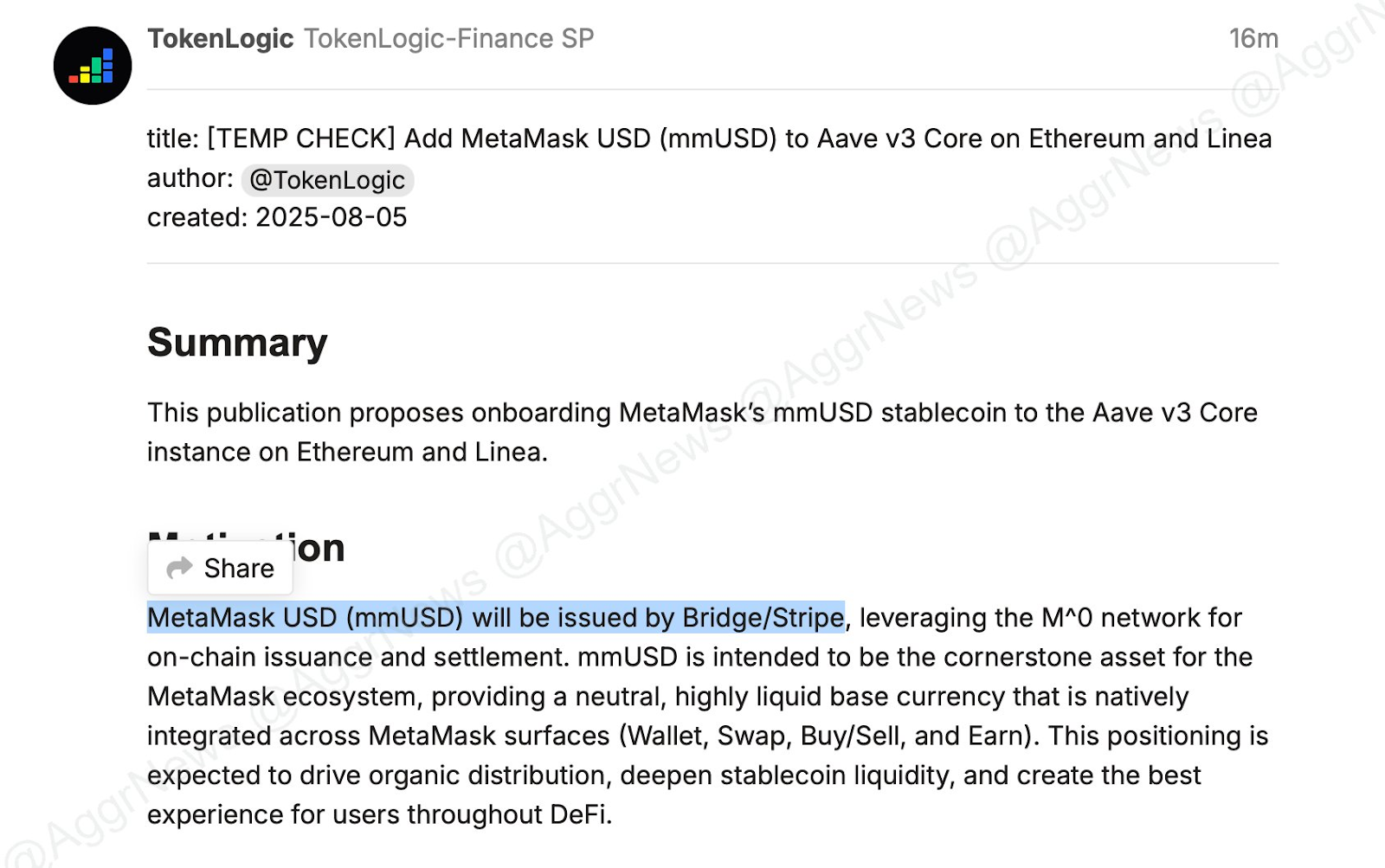 Source: Aggr News
MetaMask Utilizes 30M User Base to Compete with USDC
MetaMask caters to over 30 million monthly active users worldwide through one of the most popular non-custodial wallets in Web3.
The proposed mmUSD would serve as a foundational currency within MetaMask’s ecosystem while connecting with DeFi protocols like Aave for lending, borrowing, and yield opportunities.
This stablecoin initiative follows MetaMask’s recent card launch in collaboration with Baanx and Mastercard, allowing users to utilize crypto directly from self-custody wallets without relinquishing control to banks or exchanges.
Neither MetaMask nor Stripe has officially verified the development, leaving significant details regarding reserve models and regulatory compliance unaddressed. In fact, the initial governance post has been made private.
The proposal is in line with a broader industry trend towards stablecoins following the passage of the GENIUS Act, which established a federal regulatory framework for stablecoin issuance.
This legislation has generated interest from major corporations, including Western Union, Interactive Brokers, and Remitly, all investigating stablecoin integration for payment modernization.
Stablecoin Market Surges as GENIUS Act Sparks Corporate Interest
The stablecoin market has rapidly grown to over $250 billion in market capitalization, with Ripple CEO Brad Garlinghouse forecasting expansion to $1-2 trillion in the coming years.
The GENIUS Act, signed by President Trump in July, classifies stablecoins as payment instruments rather than investment products while providing clear regulatory guidelines.
Western Union CEO Devin McGranahan announced pilot initiatives in South America and Africa aimed at modernizing global remittance processes through stablecoins.
The company perceives stablecoins as a means to enhance cross-border transfers and optimize currency conversion in underserved regions where global remittance fees average 6.6%.
Interactive Brokers founder Thomas Peterffy has also confirmed that the firm is exploring options for launching stablecoins, potentially facilitating real-time funding for brokerage accounts.
The $110 billion market value company serves nearly 3.9 million clients and already supports crypto trading through partnerships with Paxos and Zero Hash.
Related Posts
Payments processor @remitly will soon integrate stablecoins into its global network, aiming to speed up and reduce the cost of international money transfers.#Remitly #Stablecoins https://t.co/VCG75mundR
— Cryptonews.com (@cryptonews) August 5, 2025
 Payments processor @remitly will soon integrate stablecoins into its global network, aiming to speed up and reduce the cost of international money transfers.#Remitly #Stablecoins https://t.co/VCG75mundR
Recently, Remitly initiated beta testing for its multi-currency digital wallet that supports both fiat and stablecoins, with a live rollout planned for September.
The Seattle-based fintech has added stablecoin payout options through Bridge, a Stripe-owned infrastructure provider, while incorporating USDC into its internal treasury operations.
These corporate adoptions occur as Federal Reserve Governor Christopher Waller acknowledged the importance of stablecoins, noting that 99% of stablecoin market capitalization is tied to the US dollar.
The federation believes that “stablecoins can keep the dollar the world’s reserve currency” by enhancing its accessibility globally.
Corporate Giants Navigate New Regulations While Adoption Grows
Coinbase and PayPal continue to offer stablecoin yield programs despite the GENIUS Act provisions that explicitly prohibit interest payments from stablecoin issuers.
Both companies contend that the restrictions do not apply to them as they function as intermediaries rather than direct issuers of the stablecoins they reward.
@Coinbase and @PayPal are pushing forward with stablecoin yield programs, despite new US legislation banning such incentives for issuers.#Coinbase #PayPalhttps://t.co/F4bTmQbl6J
— Cryptonews.com (@cryptonews) August 5, 2025
Coinbase CEO Brian Armstrong stated, “We are not the issuer,” while defending the company’s 4.1% APY rewards on USDC holdings.
Although Coinbase co-developed USDC with Circle, it ceased formal issuing responsibilities in 2023, with Circle now acting as the sole issuer without providing direct yield.
PayPal offers 3.7% annual returns on PYUSD holdings through both PayPal and Venmo platforms.
While PYUSD carries PayPal’s branding, technical issuance by third-party firm Paxos allows PayPal to assert exemption from GENIUS Act restrictions.
Previously, Senator Elizabeth Warren cautioned that private stablecoin launches could lead to privacy violations and systemic risks, predicting that companies would “come begging for bailout when it inevitably blows up.”
Despite such criticism, global corporations, including Amazon, Walmart, JD.com, and Alipay, continue to explore stablecoin integration.
The competitive landscape for stablecoins has intensified, with approximately 20 million addresses now engaging with stablecoins on public blockchains.
MetaMask’s proposed entry would capitalize on its extensive user base and Stripe’s compliance infrastructure to secure its position in the market.
The post MetaMask Plans USD Stablecoin Launch with Stripe Partnership, Governance Proposal Reveals appeared first on Cryptonews.
