Disclaimer: Information found on CryptoreNews is those of writers quoted. It does not represent the opinions of CryptoreNews on whether to sell, buy or hold any investments. You are advised to conduct your own research before making any investment decisions. Use provided information at your own risk.
CryptoreNews covers fintech, blockchain and Bitcoin bringing you the latest crypto news and analyses on the future of money.


Institutional investment has transformed the trading landscape for cryptocurrencies. Bitcoin and Ethereum now react to economic developments similarly to traditional financial assets. Reports concerning the CPI, inflation, and interest rates influence market prices. This evolution indicates that macroeconomic metrics have become essential for crypto traders, forming a vital part of their strategies.
This article outlines how official inflation data, central bank interest rates, and crypto-specific metrics like Bitcoin dominance can aid in forecasting market trends. The analysis is based on macroeconomic releases, crypto charts, and insights from major trading desks.
The aim is not to predict specific price movements but to provide a practical framework for understanding how wider economic trends impact cryptocurrency performance.
Inflation and Bitcoin: The Rising Influence of CPI on Crypto
Inflation began to surge significantly in early 2022. The Consumer Price Index, published by the Bureau of Labor Statistics, reached nine percent year-over-year in June. Bitcoin dropped six percent within three days of that announcement, as investors shifted away from risk assets, anticipating stricter financial conditions.
This trend persisted throughout 2023 and into 2024. When CPI figures were lower than anticipated, Bitcoin frequently experienced a rebound. For instance, in November 2022, the month-over-month figure was 0.1 percent compared to a forecast of 0.3 percent, leading Bitcoin to rise nearly four percent in just two days.
CPI for all items rises 0.1% in May; shelter up #BLSData https://t.co/dJyJeKmvth
— BLS-Labor Statistics (@BLS_gov) June 11, 2025
This consistent response implies that Bitcoin is now trading more in line with technology stocks. It does not function as a short-term inflation hedge but rather aligns with interest rate expectations. If inflation data leads the Federal Reserve to consider rate cuts, traders often shift towards cryptocurrencies. Conversely, if inflation spikes, traders tend to exit quickly.
The CPI for May 2025 indicated that price growth was slowing toward the Federal Reserve’s target. If this trend continues, investors might re-enter riskier assets. However, if energy prices or wages drive inflation above expectations, the outlook may revert to one of tightening.
Traders are likely to modify their positions in Bitcoin and Ethereum based on these economic releases, as CPI announcements now serve as catalysts for short-term price movements.
Fed Rates and Ethereum: The Dynamics of Liquidity Cycles
The Federal Reserve commenced increasing interest rates in March 2022, a cycle that extended until mid-2023, with the target range escalating to 5.25 to 5.5 percent. Each hike signaled tighter liquidity conditions. Ethereum often experienced declines in the days following these announcements, reflecting the downturn in growth-oriented equities.
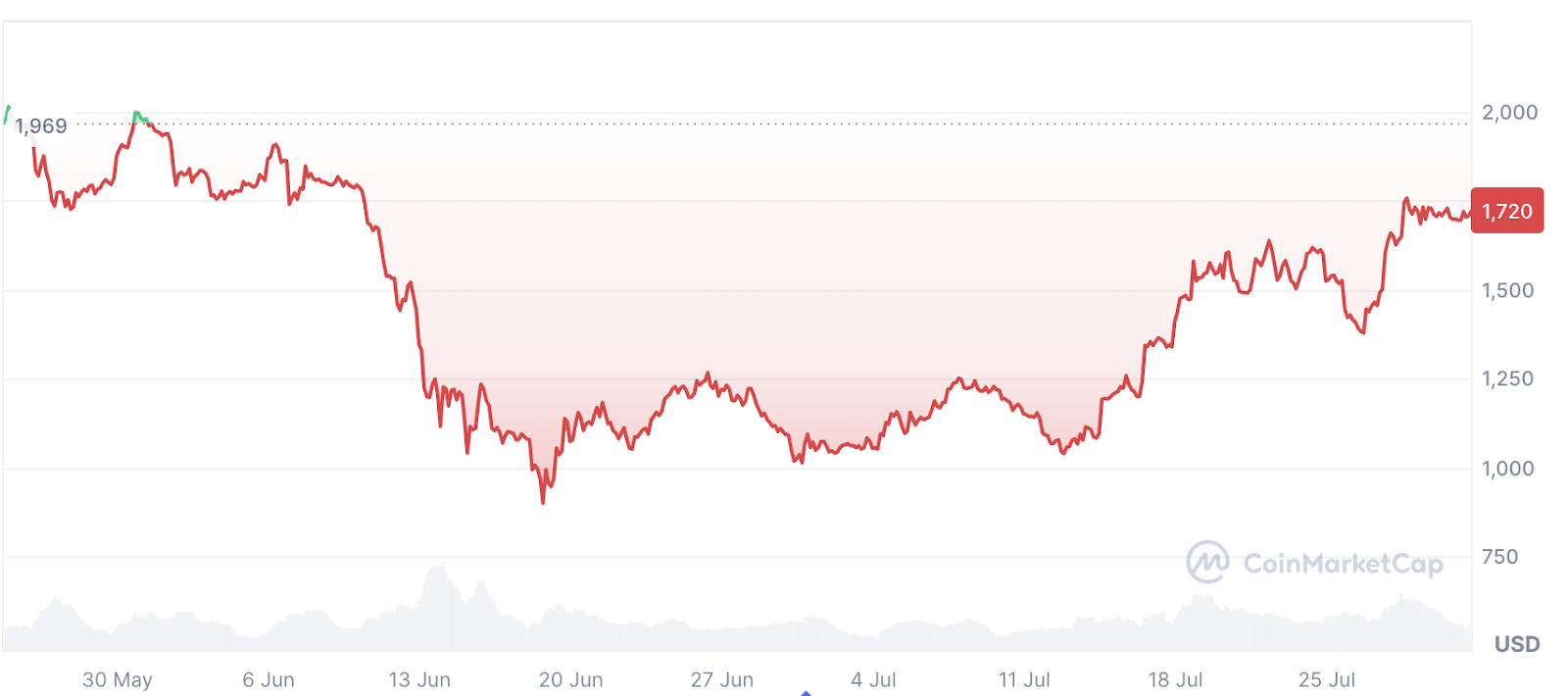
Ethereum Price 2022 (Source: CoinMarketCap)
Ethereum’s responsiveness to interest rate decisions became evident during several critical periods. Following the 75 basis point hike in June 2022, ETH plummeted by over eight percent within 48 hours. This pattern repeated in September. In contrast, when the Fed decided to pause in July 2023, ETH surged nearly five percent over the next three trading sessions.
However, there was one notable exception in March 2023. The failure of Silicon Valley Bank sparked panic in financial markets. The Fed raised rates by 25 basis points but suggested it might halt further increases soon. This shift facilitated a recovery for ETH as it rose from below $1,400 to over $1,800 in three weeks.
Related Posts
These instances illustrate Ethereum’s connection to monetary policy. Rate hikes tighten financial conditions and result in a decline in ETH. Conversely, pauses or indications of easing often lead to significant rebounds. Ethereum acts as a barometer for risk appetite in a liquidity-sensitive market.
Bitcoin Dominance: A Unique Macro Indicator for Crypto
Bitcoin dominance measures the proportion of total cryptocurrency market capitalization attributed to Bitcoin. An increase in dominance typically indicates a flight to safety. During times of macroeconomic tightening, investors reduce their holdings in smaller cryptocurrencies and transfer funds into Bitcoin. This behavior reflects broader risk-averse trends.

U.S. Interest Rate 2015-2025 (Federal Reserve Bank)
From late 2021 to 2022, Bitcoin dominance rose from below 40 percent to nearly 48 percent. This increase occurred amidst significant inflation spikes and a series of Federal Reserve rate hikes as the market retreated from speculative investments. Dominance surged again in mid-2023, just prior to the Fed signaling a pause, and subsequently fell.
This trend reinforces a familiar cycle. In the initial stages of risk-taking, Bitcoin leads the way. Once it stabilizes, capital flows into Ethereum, followed by altcoins with smaller market capitalizations. Declines in dominance often signal the beginning of these capital rotations. The index can serve as a gauge of shifting sentiment within the market.
Bitcoin dominance illustrates how cryptocurrency investors react to broader economic changes. It can act as a barometer—rising when uncertainty increases and declining when conditions favor a higher risk appetite.
Institutional Macro Predictions and the Upcoming 90 Days
Institutional analysis over the past year has increasingly correlated macro indicators with the performance of digital assets.
In an October 2024 report, Crypto.com Research stated: “While economic growth generally suggests a more favorable landscape for cryptocurrencies, the effects will differ based on other market conditions.” They highlighted that “the growing correlation between traditional markets and cryptocurrencies means that stock market performance may offer valuable insights into potential crypto trends.”
Looking forward, the next 90 days will feature several macroeconomic events that could influence cryptocurrency trajectories. The July CPI report is set for release on August 12, with consensus predicting a year-over-year increase of 2.8 percent. The next FOMC meeting is scheduled for September 17, where markets currently expect a 25 basis point cut. Additionally, the August nonfarm payroll report (to be released on September 6) and the Q2 GDP revision (on August 29) are also poised to trigger volatility.
These dates represent critical decision-making moments. A lower CPI figure could bolster expectations of Fed easing and direct capital towards risk assets. Conversely, a stronger-than-anticipated payroll figure might temper those expectations. ETF-related movements and crypto-native responses will likely depend on these signals, underscoring the notion that macro indicators now dictate the overarching crypto narrative.
Conclusion: A Strategy Informed by Macroeconomics
Macroeconomic indicators now play a significant role in influencing the direction of the cryptocurrency market. Inflation data, central bank policies, and internal metrics such as Bitcoin dominance have demonstrated clear correlations with previous price movements in both Bitcoin and Ethereum. When these indicators align, they can provide a solid framework for interpreting future trends.
While no model can capture every fluctuation, monitoring CPI announcements, FOMC actions, and market responses allows for more informed positioning. Macro data will not replace cryptocurrency-specific analysis but adds a broader context that is increasingly difficult to overlook. Maintaining awareness of an economic calendar may prove as beneficial as any technical chart.
The post Macro Meets Crypto: Predicting Prices with CPI, Fed Rates & BTC Dominance appeared first on Cryptonews.
