Disclaimer: Information found on CryptoreNews is those of writers quoted. It does not represent the opinions of CryptoreNews on whether to sell, buy or hold any investments. You are advised to conduct your own research before making any investment decisions. Use provided information at your own risk.
CryptoreNews covers fintech, blockchain and Bitcoin bringing you the latest crypto news and analyses on the future of money.


A judge in Delaware ruled on Friday that a lawsuit from shareholders claiming insider trading by Coinbase’s directors can move forward, dismissing a special committee’s suggestion to dismiss the case, even after a 10-month investigation cleared the defendants.
This ruling impacts several prominent directors, including venture capitalist Marc Andreessen and CEO Brian Armstrong, who collectively sold over $2.9 billion in shares during the company’s direct listing in April 2021.
As reported by Bloomberg Law, Judge Kathaleen St. J. McCormick permitted the lawsuit to advance due to conflicts involving one member of the committee, although she recognized that the internal investigation “paints a compelling narrative” supporting the directors’ defense.
The lawsuit, initiated in 2023 by shareholder Adam Grabski, alleges that the directors utilized confidential valuation data to evade more than $1 billion in losses by selling shares when Coinbase went public without the usual lockup restrictions.
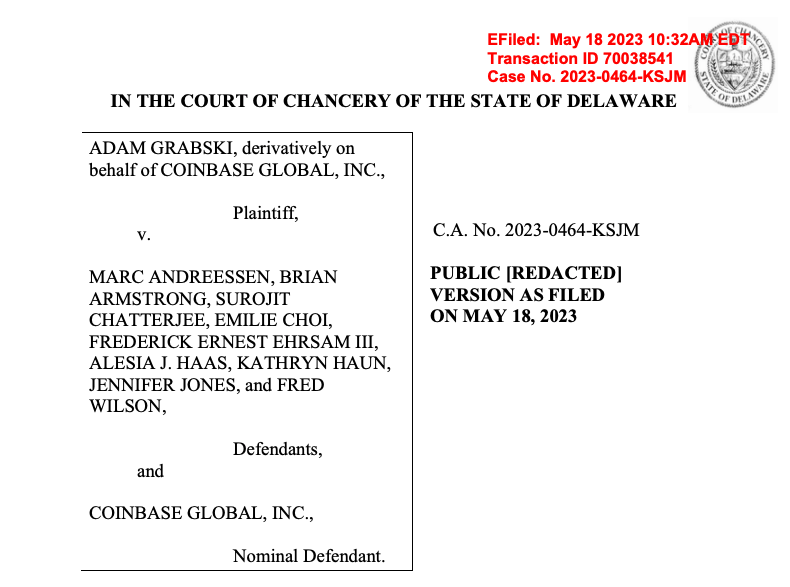 Source: Court Filing
Independence Issues Undermine Internal Review
The special litigation committee consisted of two members from the Coinbase board: Kelly Kramer, former CFO of Cisco Systems, and Gokul Rajaram, a Silicon Valley angel investor.
Neither was named as a defendant nor sold shares in the direct listing. However, McCormick pointed out significant business connections between Rajaram and Andreessen Horowitz as disqualifying conflicts of interest.
According to court documents, these connections included a 2007 investment by Andreessen in a startup co-founded by Rajaram, as well as at least 50 financing rounds in which either Rajaram or his venture firm participated with Andreessen Horowitz since 2019.
“No one—not the plaintiff and thus not the court—questions Rajaram’s good faith,” McCormick noted. “However, the close ties between him and the subject of the SLC’s investigation are enough to raise substantial disputes regarding his independence.“
Lawyers for the committee contended that the business relationships were “immaterial,” considering the total of 700 investments, and highlighted that there was no proof of collaboration in financing rounds.
“These are not close personal relationships. They are professional ones,” said Brad Sorrels, representing the committee, during an October hearing.
Direct Listing Structure Allowed Immediate Sales
The shareholder complaint focuses on Coinbase’s atypical approach to entering public markets via a direct listing instead of a conventional IPO.
 Source: Court Filing
This framework enabled existing shareholders to sell shares immediately without the lockup periods generally imposed by underwriters to prevent insider trading based on material nonpublic information.
Related Posts
Armstrong is reported to have sold $291.8 million in shares, while Andreessen Horowitz divested $118.7 million through the direct listing.
Other defendants included Chief Operating Officer Emilie Choi, who sold $224 million, and co-founder Fred Ehrsam, who sold $219.5 million.
The lawsuit claims that the directors were aware the shares were overvalued, based on an internal valuation from Andersen Tax that was significantly below market expectations when trading commenced at $381 per share.
Within five weeks of the April 14, 2021 listing, Coinbase shares fell by over 37% as the company revealed fee compression impacting retail revenues and announced a dilutive convertible note offering.
By May 18, 2021, the stock had lost more than $37 billion in value, according to the complaint.
Company Disputes Allegations Amid Delaware Criticism
“We are disappointed by the court’s ruling and remain dedicated to contesting these baseless claims in court,” Coinbase stated.
The committee’s report concluded that the defendants did not depend on confidential information, noting that Coinbase stock is “highly correlated” with Bitcoin prices, making it impossible to substantiate insider trading claims.
The committee asserted that directors “reluctantly” sold shares to ensure adequate supply for the direct listing, divesting only small portions of their holdings.
“The evidence clearly indicated that defendants, including the two largest stockholders, did not wish to sell as they were optimistic about the company,” Sorrels stated during the October hearing.
Armstrong and Andreessen Horowitz “ultimately consented to sell just over 1% of their respective shares only after the company and its banker urged them to provide the necessary supply for the direct listing to commence,” according to committee filings.
Andreessen Horowitz has openly criticized Delaware’s business courts, announcing intentions last July to reincorporate portfolio companies elsewhere due to perceived bias “against founders and their boards.”
Coinbase has revealed plans to exit Delaware and reincorporate in Texas, a move Chief Legal Officer Paul Grewal described as a strategic choice to align with the company’s long-term vision for new product development and regulatory efficiency.“Toda…https://t.co/aELNKkSwDu
— Cryptonews.com (@cryptonews) November 12, 2025
Coinbase announced its own plans for reincorporation on November 12, following similar actions by other major companies seeking to leave Delaware’s jurisdiction.
In addition to civil litigation, Coinbase faced a parallel, criminal insider trading case in 2023, when former product manager Ishan Wahi was sentenced to two years in prison for sharing confidential listing information with family members who profited from the advanced knowledge.
The post Coinbase Insider Trading Lawsuit Advances Despite $2.9B Stock Sale Defense appeared first on Cryptonews.
