Disclaimer: Information found on CryptoreNews is those of writers quoted. It does not represent the opinions of CryptoreNews on whether to sell, buy or hold any investments. You are advised to conduct your own research before making any investment decisions. Use provided information at your own risk.
CryptoreNews covers fintech, blockchain and Bitcoin bringing you the latest crypto news and analyses on the future of money.


The President of Kazakhstan, Kassym-Jomart Tokayev, has signed into law regulations regarding Banks and Banking Activities in the Republic of Kazakhstan, creating a thorough regulatory framework for digital assets.
This legislation empowers the central bank of the country to decide which cryptocurrencies can be traded on regulated exchanges.
The recent official document outlining the law includes more than five separate amendments and additions to various legislative acts related to financial market regulation, communications, and bankruptcy processes.
NEWS:
Kazakhstan establishes a regulatory framework for digital assets, licensing crypto exchanges and granting the central bank the power to approve tradable coins. pic.twitter.com/gxL7U61H0K
— CoinGecko (@coingecko) January 19, 2026
The law also establishes comprehensive regulatory frameworks for digital financial assets while imposing stricter controls on “unsecured” cryptocurrencies, such as Bitcoin and Ethereum.
Kazakhstan Launches a Three-Tier Digital Asset System
A notable advancement is the recognition and regulatory introduction of digital financial assets as a new asset category in Kazakhstan.
This new regulatory framework classifies digital financial assets into three distinct categories, each governed by different oversight protocols.
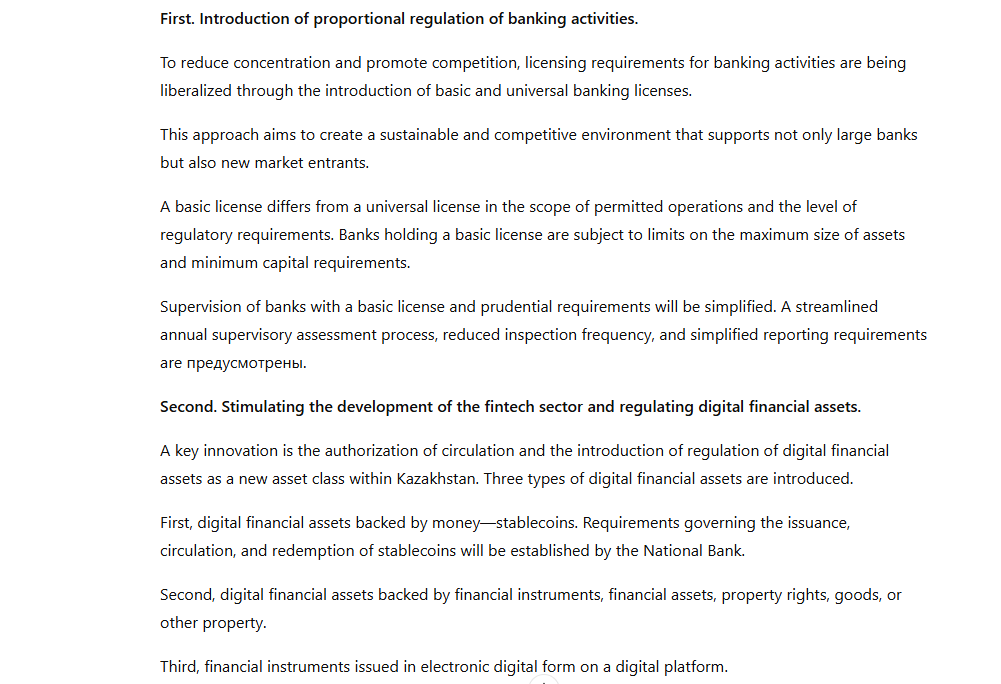 Translated from Russian. | Source Gov.kz
Stablecoins that are backed by fiat currency will be subject to the National Bank’s regulations regarding their creation, circulation, and redemption.
The second category consists of digital financial assets that are backed by financial instruments, property rights, goods, or other physical assets, while the third category includes financial instruments issued electronically on digital platforms.
Operators of digital platforms will act as newly licensed financial market entities authorized to issue these assets, adhering to traditional financial instrument requirements, including risk management procedures and investor protection measures.
Moreover, the law addresses another category of digital assets, termed “unsecured digital assets,” which refers to cryptocurrencies like Bitcoin (BTC) and Ether (ETH).
The legislation allows for the creation of cryptocurrency exchange organizations, which will be licensed and regulated by the National Bank.
To protect investors, the National Bank will create a list of approved cryptocurrencies for circulation, along with operational limits and restrictions for crypto exchanges.
For the purposes of anti-money laundering and counter-terrorism financing, crypto exchanges and participants in the digital asset market infrastructure are classified as entities subject to financial oversight.
Strict Enforcement Against Illegal Activities
Related Posts
Kazakhstan’s regulatory initiative follows months of rigorous enforcement actions against unauthorized crypto operations.
In October 2024, authorities dismantled 130 illegal crypto exchanges, seizing virtual assets valued at $16.7 million believed to be linked to money laundering activities.
Only platforms licensed by the Astana Financial Services Authority and integrated with local banks are permitted to operate legally under the Law on Digital Assets.
The crackdown extended to 81 illicit cash-out groups identified, which had a combined turnover of 24 billion KZT ($43 million) in 2024.
Kazakhstan Seizes $16.7M from Unlicensed Crypto Exchanges, Shuts Down 130 Platforms
Kazakhstan has closed 130 illegal crypto exchanges suspected of laundering criminal proceeds and confiscated virtual assets worth $16.7 million.https://t.co/WVKmsTRmf9 pic.twitter.com/aY75nl0eSJ— Cryptonews.com (@cryptonews) October 8, 2025
Kairat Bizhanov, Deputy Chairman of the Financial Monitoring Agency, highlighted ATMs as a significant vulnerability, reporting that cash withdrawals amounted to 13.2 trillion KZT ($24.1 billion), which is 1 trillion more than the previous year.
Anonymous transactions facilitated by nominee-owned bank cards allow criminals, including cyber fraudsters and drug traffickers, to operate without the identification of either the sender or recipient.
Throughout 2023 and 2024, the Financial Monitoring Agency blocked over 3,500 illegal online crypto exchanges in collaboration with the National Security Committee and the Ministry of Culture and Information.
In 2024 alone, regulators shut down 36 illegal exchangers that managed a total turnover of 60 billion tenge ($112 million), while Kazakhstan officially restricted access to Coinbase’s website for violations of digital asset regulations.
Kazakhstan Approves Crypto Banks and National Reserve Fund
Despite stringent enforcement actions, Kazakhstan is concurrently pursuing innovative digital asset initiatives.
Prime Minister Olzhas Bektenov announced intentions to establish crypto banks as part of a broader initiative to create a sustainable, regulated ecosystem.
Kazakhstan is considering the launch of crypto banks as part of its broader efforts to develop a sustainable and regulated digital asset ecosystem.#Kazakhstan #Bitcoinhttps://t.co/egghK92tqY
— Cryptonews.com (@cryptonews) April 30, 2025
 Kazakhstan is considering the launch of crypto banks as part of its broader efforts to develop a sustainable and regulated digital asset ecosystem.#Kazakhstan #Bitcoinhttps://t.co/egghK92tqY
These institutions are set to provide digital asset exchange services, secure storage options, and transaction processing via infrastructure providers, including digital asset platforms, custodians, brokers, and dealers.
Kazakhstan also aims to create a national cryptocurrency reserve fund estimated to be between $500 million and $1 billion by early 2026, according to reports from Bloomberg.
This initiative marks one of the most ambitious efforts in Central Asia to incorporate digital assets into state-managed investment portfolios, although authorities have indicated that the fund will avoid direct investment in volatile cryptocurrencies like Bitcoin and will adopt a cautious investment strategy.
The post Kazakhstan Restricts Crypto Trading to Central Bank-Approved Coins Only appeared first on Cryptonews.
