Disclaimer: Information found on CryptoreNews is those of writers quoted. It does not represent the opinions of CryptoreNews on whether to sell, buy or hold any investments. You are advised to conduct your own research before making any investment decisions. Use provided information at your own risk.
CryptoreNews covers fintech, blockchain and Bitcoin bringing you the latest crypto news and analyses on the future of money.

JPMorgan Highlights Significant Disparity in Bitcoin and Gold ETF Inflows Following Iran Conflict

The relationship between Bitcoin (BTC) and gold has broken down amid the ongoing Iran conflict, as noted in a report to investors by JPMorgan.
Typically, geopolitical unrest prompts a collective demand for safe-haven assets; however, the two commodities are presently trending in opposing directions.
This separation indicates a notable change in how investors are perceiving “digital gold” compared to traditional gold.
Rather than moving together as protective investments, investors are actively reallocating their capital, resulting in a distinct leader in the ETF sector since late February.
Discover: The best crypto to buy now
Insights from JPMorgan’s ETF Flow Data Regarding Bitcoin
Following the escalation of the conflict on February 27, JPMorgan analysts have observed a pronounced divergence in capital movements. The leading gold ETF, SPDR Gold Shares (GLD), has experienced outflows amounting to approximately 2.7% of its assets under management.
Bitcoin vs gold ETF flows diverge
@jpmorgan analysts say since the Iran war:
• Largest gold ETF GLD saw 2.7% of AUM outflows
• Largest bitcoin ETF IBIT saw 1.5% of AUM inflows
The analysts also noted signs of bitcoin volatility compressing as institutional ownership… pic.twitter.com/oLvxrT83PK— Yogita Khatri (@Yogita_Khatri5) March 12, 2026
In contrast, BlackRock’s iShares Bitcoin Trust (IBIT) has seen inflows of about 1.5% of its assets during the same period.
JPMorgan analysts, led by Managing Director Nikolaos Panigirtzoglou, pointed out in their latest communication to investors that this marks a reversal from earlier in the year when gold funds were in a stronger position.
The evidence is clear. Historically, gold has been the go-to safe investment during tensions in the Middle East, but current capital movements indicate a preference for Bitcoin exposure.
Institutional positioning generally reflects a transition away from gold in favor of spot Bitcoin ETFs, despite the greater volatility associated with cryptocurrency.
Notably, IBIT inflows since the beginning of 2024 are now approximately double the total inflows recorded by GLD, further solidifying the shift in dominance among exchange-traded products.
Related Posts
Is Bitcoin Taking Gold’s Place as the Crisis Hedge?
The divergence extends beyond surface-level flows. JPMorgan observes that while spot Bitcoin ETFs are attracting inflows, institutional derivatives markets suggest a more cautious outlook. Hedge funds seem to be decreasing their direct Bitcoin exposure even as ETF investors increase their activity.
Short interest in IBIT has risen since the onset of the conflict, whereas GLD short interest has decreased. This narrows the gap between the two, indicating that hedge funds are hedging their cryptocurrency positions while still favoring gold for defensive strategies.
BlackRock’s spot Bitcoin ETF, IBIT, is now being accepted as collateral for loans at JPMorgan.
Here we gohttps://t.co/Xif0FRby1B pic.twitter.com/aEgyZujN4T
— Joe Consorti (@JoeConsorti) June 4, 2025
 https://t.co/Xif0FRby1B pic.twitter.com/aEgyZujN4T
This results in a complex market environment. Retail investors and registered investment advisors (RIAs) are likely fueling the ETF demand, viewing Bitcoin as a risk-off asset alongside the dollar. Meanwhile, more sophisticated trading desks are hedging against downside risks as oil prices exceed $100, a macroeconomic factor that typically pressures risk assets.
Options activity supports this cautious institutional perspective. The demand for downside protection in Bitcoin has increased, contrasting with the persistent buying pressure in the spot ETF market. However, the significant scale of the rotation, moving from gold to Bitcoin, suggests that the “digital gold” narrative is proving more resilient than skeptics had expected.
Bitcoin Price Prediction: Can BTC Maintain the $70,000 Level?
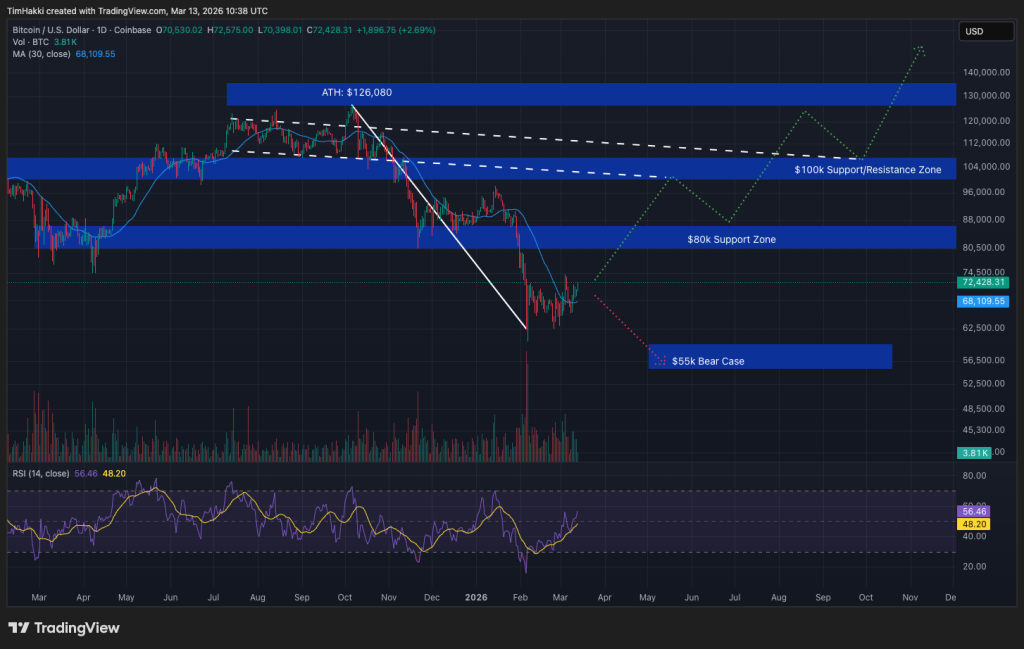
Price movements remain robust despite the mixed signals from derivatives markets. Even with inflation concerns driven by conflict dominating the news, Bitcoin is trading above $70,000, demonstrating strength where traditional assets have struggled.
 Source: TradingView
Bull Scenario: If ETF inflows continue at this 1.5% rate, Bitcoin could target the $80,000 resistance level. Surpassing that threshold would pave the way to revisit all-time highs. JPMorgan’s valuation models have previously indicated that Bitcoin is undervalued relative to gold when considering volatility-adjusted capital, suggesting potential for an upward squeeze.
Bear Scenario: If macro liquidity tightens further, support is solid at $64,000. A drop below this level would validate the increasing short interest and likely trigger a liquidation of recent leverage. Traders should closely monitor the $70,000 midpoint; losing this level would indicate that the safe-haven demand has diminished.
The next significant catalyst is not only on the charts; it lies with the Federal Reserve. Should oil prices remain elevated, inflationary pressures could compel central banks to maintain higher interest rates for an extended period, testing the resilience of both gold and Bitcoin.
Discover: The next crypto to explode
The post JPMorgan Flags Sharp Divergence Between Bitcoin and Gold ETF Flows Since Iran War appeared first on Cryptonews.
