Disclaimer: Information found on CryptoreNews is those of writers quoted. It does not represent the opinions of CryptoreNews on whether to sell, buy or hold any investments. You are advised to conduct your own research before making any investment decisions. Use provided information at your own risk.
CryptoreNews covers fintech, blockchain and Bitcoin bringing you the latest crypto news and analyses on the future of money.

Japan Reclassifies Cryptocurrency Under Securities Law – Stricter Regulations and Platform Enforcement Expected

Japan is gearing up for its most extensive reform of cryptocurrency regulation in nearly ten years, paving the way for a framework that would align digital assets more closely with conventional investment products.
This initiative follows several months of governmental discussions and a succession of regulatory proposals that have gradually emerged throughout 2024 and 2025.
Collectively, these developments indicate a significant change in the country’s approach to overseeing trading activities, exchange operations, and safeguarding investors.
FSA Advocates for Enhanced Token Disclosure to Mitigate Speculation and Risk
The most recent advancement occurred this week when the Financial Services Agency published a comprehensive report from the Financial System Council’s Working Group.
The report outlines a strategy to transition crypto regulation from the Payment Services Act, which has governed the industry since 2016, to the Financial Instruments and Exchange Act.
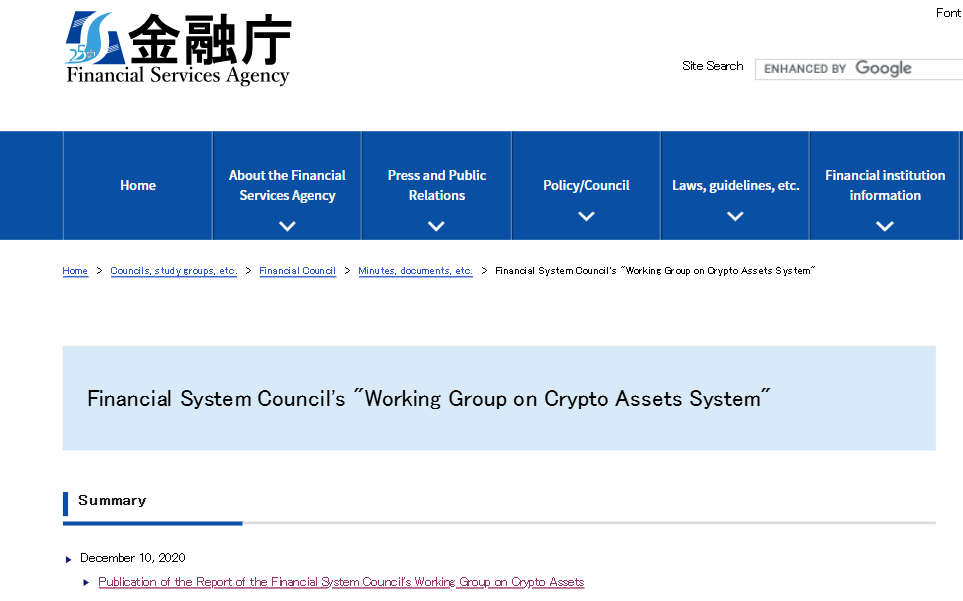 Source: Japan FSA
This modification would subject cryptocurrencies to the same legal framework applied to securities trading, disclosure requirements, and market conduct regulations. Regulators noted that this transition reflects the evolving market dynamics, highlighting that the majority of users now engage with cryptocurrencies primarily as an investment.
Government statistics indicate that over 86% of domestic users trade with the anticipation of long-term price appreciation, while deposits across registered platforms have exceeded five trillion yen.
The Working Group determined that the existing regulatory framework no longer aligns with the risks associated with a sector characterized by speculative trading, significant investor inflows, and intricate token issuance models.
By incorporating cryptocurrencies into the securities regulatory framework, authorities aim to enforce stricter disclosure obligations, particularly concerning token sales executed by exchanges.
The Financial Council has released a report from the Working Group on the Cryptocurrency Asset System. #FinancialServicesAgency
▼For more details, see below. https://t.co/oNnsy4QYO9— Financial Services Agency (@fsa_JAPAN) December 10, 2025
 The Financial Council has released a report from the Working Group on the Cryptocurrency Asset System. #FinancialServicesAgency
The report emphasizes initial exchange offerings, highlighting the necessity for pre-sale disclosures, independent code audits, and clearer information regarding project control.
Even fully decentralized assets would be subject to increased scrutiny, with exchanges required to provide users with impartial risk assessments based on verifiable information.
Related Posts
The recommendations also propose explicit insider-trading regulations concerning events such as token listings, significant system breaches, and large-scale sales by issuers.
Japan intends to categorize crypto as financial products under insider regulations, reduce profit taxes, and enhance disclosure for 105 listed assets. #Japan #CryptoRegulations https://t.co/i9qXS0DnJA
— Cryptonews.com (@cryptonews) November 17, 2025
These regulations would apply to exchange personnel, token developers, and other associated parties who may have access to undisclosed information.
This strategy parallels ongoing reforms in Europe and South Korea, where authorities have already implemented insider-trading standards for the digital asset industry.
Japan Welcomes Subsidiaries of Financial Giants Under the New Regulation
Exchanges operating in Japan would encounter standards akin to those for brokers engaged in securities transactions. They would be mandated to evaluate users’ risk tolerance prior to allowing complex or highly volatile trading.
The proposal also introduces investment caps for token offerings that have not undergone financial audits, aiming to shield retail users from abrupt selling pressure once trading commences.
Traditional financial institutions are anticipated to assume a more significant role as well. While banks and insurers will continue to be prohibited from directly operating exchanges, regulators plan to permit their subsidiaries to facilitate crypto trading through closely monitored channels.
The proposed transition coincides with a series of related policies that have emerged in recent months.
In November, the FSA suggested a registration system for custody providers and outsourced trading software companies following last year’s DMM Bitcoin breach, which revealed vulnerabilities in third-party systems.
Japan aims to mandate that crypto exchanges maintain reserves to cover customer losses, enhancing protections against hacks and operational failures. #Japan #CryptoRegulations https://t.co/g9rmxG2kbw
— Cryptonews.com (@cryptonews) November 25, 2025
 Japan aims to mandate that crypto exchanges maintain reserves to cover customer losses, enhancing protections against hacks and operational failures. #Japan #CryptoRegulations https://t.co/g9rmxG2kbw
Shortly before that, officials confirmed their support for a collaborative stablecoin pilot involving Japan’s three largest banks, which would establish a unified framework for issuing yen-backed digital tokens.
Other proposals under consideration include permitting banking groups to register as exchange operators, broadening access for retail investors, and aligning crypto management more closely with the structures used for stocks and government bonds.
Tax reform is also progressing. The government is preparing to replace the current progressive tax rate, which can reach 55%, with a flat 20% tax on crypto gains starting in 2026.
The post Japan Moves Crypto to Securities Law – Tighter Rules & Platform Crackdowns Coming appeared first on Cryptonews.
