Disclaimer: Information found on CryptoreNews is those of writers quoted. It does not represent the opinions of CryptoreNews on whether to sell, buy or hold any investments. You are advised to conduct your own research before making any investment decisions. Use provided information at your own risk.
CryptoreNews covers fintech, blockchain and Bitcoin bringing you the latest crypto news and analyses on the future of money.

Jack Dorsey’s Bitchat Gains Popularity in Madagascar as Demonstrators Abandon Government-Managed Communications

Jack Dorsey’s decentralized messaging platform Bitchat saw a significant increase in downloads in Madagascar amid violent protests related to water and electricity shortages, prompting authorities to enforce dusk-to-dawn curfews throughout the capital.
Data from Google Trends indicates that searches for “Bitchat” surged from zero to 100 in Antananarivo as demonstrators sought alternatives to government-controlled communication that resist censorship.
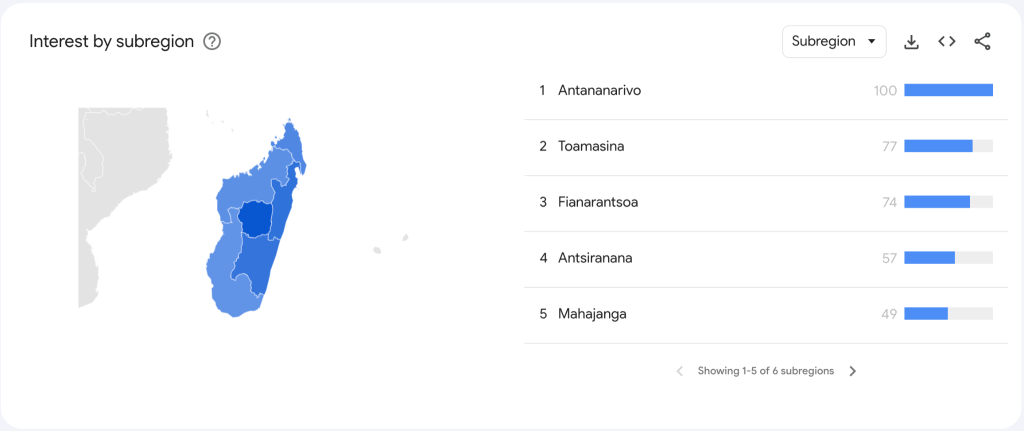 Source: Google Trends
Poverty and Infrastructure Crisis Fuel Violent Demonstrations
The peer-to-peer application functions without internet infrastructure by utilizing Bluetooth Low Energy mesh networks, enabling encrypted messages to transfer between devices within a 30-meter range.
According to Chrome-Stats, Bitchat has been downloaded 365,307 times since its launch, with over 21,000 downloads in the last day and more than 71,000 in the past week.
Protests began on Thursday as thousands of predominantly young demonstrators marched through Antananarivo, calling for the restoration of dependable water and electricity services.
Police deployed tear gas to disperse crowds that had blocked roads with burning tires and rocks, leading to looting of shopping centers, banks, and assaults on the residences of lawmakers associated with President Andry Rajoelina.
The government dismissed its energy minister and instituted curfews from 7 PM to 5 AM to restore order.
Madagascar grapples with extreme poverty, with 75% of its 30 million residents living below the World Bank’s poverty threshold, while only 6.6 million individuals have access to the internet.
bitchat downloads spiking in #madagascar pic.twitter.com/n1rBtYG4ZP
— calle (@callebtc) September 28, 2025
Mesh Networks Enable Communication During Civil Unrest
The uptake of Bitchat in Madagascar mirrors trends seen during recent protests in Nepal and Indonesia.
Nepal recorded 48,781 downloads on September 8 as youth-led protests against corruption and social media restrictions resulted in 22 fatalities and led to the resignation of Prime Minister KP Sharma Oli.
The application does not require phone numbers, email addresses, or account registration, while offering end-to-end encryption through X25519 key exchange and AES-256-GCM protocols.
Each device acts as both a client and a server, forming self-organizing networks that are resistant to centralized attacks or single points of failure.
Messages are divided into 500-byte segments, allowing transmission across multiple device hops with up to seven relay points.

The store-and-forward mechanism caches messages for offline users for up to 12 hours, ensuring delivery even when direct connections are unavailable.
Random peer IDs are generated for each session, safeguarding user privacy while removing the necessity for persistent identifiers.
Related Posts
Emergency wipe features, accessible via triple-tap commands, allow for immediate deletion of local data if devices are compromised or seized.
Dorsey introduced the beta version in July 2025, reaching TestFlight’s 10,000 user limit within hours.
The weekend initiative emphasizes disaster coordination, communication overflow during events, and fostering connections across communities during internet outages or government censorship efforts.
Western Governments Target Encrypted Communications Simultaneously
The European Union is advancing its contentious “Chat Control” regulation, which mandates messaging applications to scan every message, photo, and video prior to encryption.
Fifteen EU nations currently endorse the proposal, although it has not met the 65% population threshold required for approval.
The Child Sexual Abuse Regulation necessitates client-side scanning, where software examines content on user devices before it is sent.
Proponents argue that the measure addresses child abuse material, while opponents caution that it facilitates mass surveillance and undermines encryption, which is vital for financial privacy.
Similar pressures are present in the United States, where Telegram CEO Pavel Durov has indicated that his company refrains from developing infrastructure due to concerns regarding government surveillance.
PAVEL DUROV: THE U.S. WANTED TO CONTROL TELEGRAM BETTER
“We get too much attention from the FBI and other security agencies whenever we come to the U.S.
The last time I was in the U.S., I brought an engineer who works for Telegram.
There was an attempt by cybersecurity… pic.twitter.com/DUpz4j5TpX— Mario Nawfal (@MarioNawfal) August 24, 2024
The NSA had previously sought to influence global encryption standards to make them more vulnerable, as revealed through Edward Snowden’s disclosures.
For the EU, Germany holds a crucial vote and has yet to finalize its position ahead of the expected October 14 Council vote.
Platforms like Signal have indicated they would withdraw from the EU market rather than compromise on encryption standards.
For cryptocurrency users, the regulation poses a risk to the encryption safeguarding wallet transactions, private keys, and identity information.
Client-side scanning could theoretically extend to peer-to-peer payments, decentralized finance (DeFi) protocols, or wallet operations, thereby jeopardizing the principles of decentralization.
Crypto advocates anticipate that the proposal may drive users toward decentralized Web3 platforms, which are inherently designed for privacy.
Major technology firms, including Google and Starlink, have invested in mesh networking solutions as alternatives for decentralized infrastructure.
 Source: BitChat Explorer
Global adoption of censorship-resistant tools continues to accelerate, with Indonesia registering 12,581 Bitchat downloads during August protests concerning parliamentary allowances and police brutality, similar to the situation in Nepal.
Russia also contributed 8,749 downloads while the United States recorded 8,211 users during the same period.
The post Jack Dorsey’s Bitchat Explodes in Madagascar as Protesters Ditch Government-Controlled Comms appeared first on Cryptonews.
