Disclaimer: Information found on CryptoreNews is those of writers quoted. It does not represent the opinions of CryptoreNews on whether to sell, buy or hold any investments. You are advised to conduct your own research before making any investment decisions. Use provided information at your own risk.
CryptoreNews covers fintech, blockchain and Bitcoin bringing you the latest crypto news and analyses on the future of money.


Recent declines in the cryptocurrency market highlight the inherent volatility of digital assets; however, this has not deterred institutional interest in blockchain technology. Despite significant price fluctuations, liquidity shifts, and evolving narratives, long-term investors are channeling funds into the tokenization of real-world assets (RWAs).
According to data from the analytics platform rwa.xyz, there is currently $35.67 billion in RWAs on-chain (excluding stablecoins). The most sought-after categories remain tokenized private credit and U.S. Treasury debt.
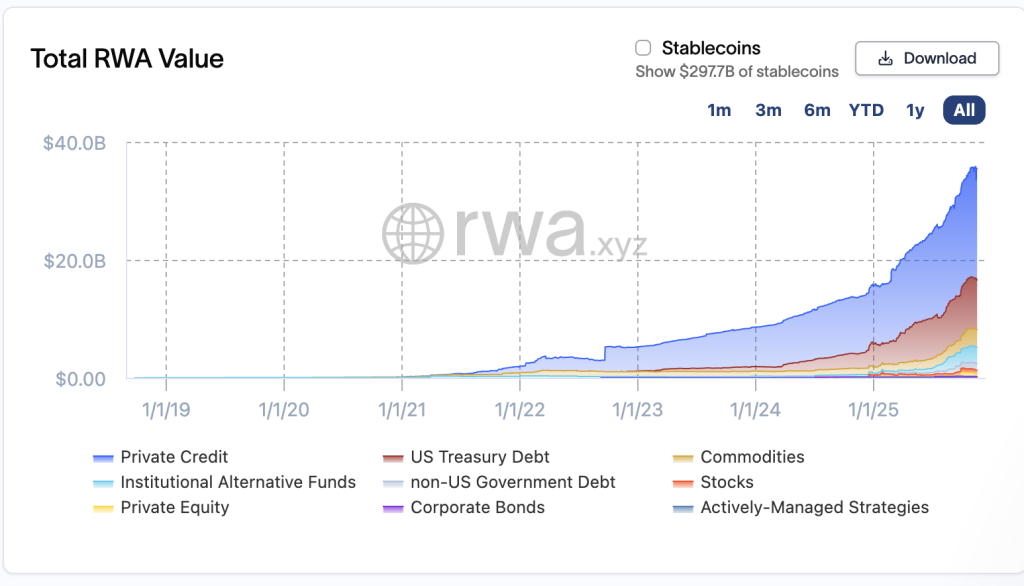 Source: rwa.xyz
A representative from BNB Chain informed Cryptonews that the total-value locked (TVL) in RWAs on the network surged from $5 million to $1 billion this year. This increase was primarily driven by USYC (Circle) and traditional finance institutions such as BlackRock (BUIDL), Franklin Templeton (BENJI), VanEck (VBILL), Qatari National Bank (QCDT), and China Merchant Bank (CMBMINT)—all of which now offer RWA products on BNB Chain.
RWAs adoption on BNB Chain is unstoppable.
USYC, @circle’s tokenized money market fund, soared past $1B in total supply, with over $900M living on BNB Chain.
As a yield-bearing collateral, USYC delivers predictable yield and settles 24/7, near-instant in USDC. It’s fully BEP-20… pic.twitter.com/y9CTlR1Zan— BNB Chain (@BNBCHAIN) November 19, 2025
The momentum continues unabated. A report from McKinsey & Company in June 2024 suggests that the global market for tokenized real-world assets could reach as much as $4 trillion by 2030.
Short-Term Volatility Doesn’t Change Long-Term Adoption Trends
Experts in the industry assert that as the global initiative to enhance financial infrastructure progresses, the turbulence in the crypto market will become less significant.
Sarah Song, head of business development at BNB Chain, observed that on-chain RWA TVL has consistently increased since 2022, a trend she believes corresponds with the growth of stablecoins and the demand for diversified, on-chain asset exposure.
“Investors can seamlessly transition between various asset types directly on-chain with a 24/7 trading and investing experience tailored to different risk appetites under varying market conditions,” Song stated.
This enables investors to directly engage with crypto-native assets, alongside T-bills and private credit, which is increasingly attractive to large institutional players seeking efficiency.
Even during periods of market cooling, the appetite for tokenized, cash-flow-backed assets remains robust, positioning RWAs as one of the most resilient growth sectors in the industry. This establishes tokenized RWAs as a primary application of blockchain technology.
Why Real-World Value Moves On-chain
Mike McCluskey, CEO of the asset tokenization suite Sologenic, likened the current RWA trend to the early days of the internet.
“What we are witnessing is the initial phases of an exponential growth trajectory of value transitioning on-chain. In the near future, every asset will possess a digital token that reflects its real-world value,” McCluskey remarked.
While tokenized government securities, such as U.S. Treasuries and T-bills, currently experience the highest demand for RWAs, new applications are expected to arise. McCluskey attributed this to more favorable regulations and clearer compliance guidelines.
This has enabled Sologenic to advance tokenized equities, making them accessible directly through crypto-native wallets. “The emerging credit-based and yield assets are becoming more feasible due to a combination of increased regulatory comfort and a broader range of necessary service providers like auditors,” he noted.
Related Posts
RWA is not a single asset class. It’s a complete capital market stack.
This chart is your allocation map:
1. The Anchor (Safety): Tokenized Treasuries (Ondo/BlackRock). 4-5% yield. This is your on-chain cash.
2. The Engine (Growth): Private Credit (Maple/Goldfinch). 8-15%… https://t.co/5A0hOgh8ma pic.twitter.com/kabI5JK9jc— Pharos Research (@PharosResearch_) November 20, 2025
Bill Barhydt, founder and CEO of the digital asset platform Abra, further informed Cryptonews that new Layer-1 (L1) protocols, such as Solana and SUI, are demonstrating that decentralized networks can scale and perform comparably to traditional monolithic transaction processing systems.
Supporting this, crypto research firm Messari reported $418.1 million in RWA value on Solana, with yield-bearing assets—led by tokenized treasuries, such as OUSG and USDY from Ondo Finance—representing the fastest-growing segment.
Other innovative RWA applications are beginning to surface. Dave Hendricks, CEO and founder of the tokenization platform Vertalo, shared with Cryptonews that one of the most revolutionary use cases Vertalo supports is “Venture Asset Treasuries” (VAT).
Unlike crypto-collateralized digital asset treasuries (DAT), Hendricks explained that VATs are backed by real-world underlying private assets that can be actively managed to appreciate in value. He added that VATs are more compelling than DATs as their potential upside is derived from what would have previously hindered issuers, specifically, Howey violations.
Regulations Improve, But Challenges Remain
Regardless of market conditions, global regulators are continuously refining frameworks surrounding tokenized assets, custody, disclosure, and stablecoin structures. This has facilitated the maturation of the RWA sector over time.
“We finally have more clarity regarding tokenized RWAs, particularly since the recent administration appointed new leadership at The Securities and Exchange Commission (SEC) and Commodity Futures Trading Commission (CFTC),” Hendricks stated.
He highlighted several policy advancements—including the Genius Act, the White House Digital Assets Working Group Report, and the anticipated passage of the Clarity Act and the Responsible Financial Innovations Act—as significant tailwinds.
While these developments are crucial, Staci Warden, CEO of the Algorand Foundation, mentioned to Cryptonews that regulatory fragmentation will continue to pose challenges for RWA expansion. According to Warden, varying regulations across the U.S., Europe, and Asia complicate the scaling of a single product globally, particularly for banks.
She added that interoperability between chains, along with existing custody, accounting, and risk systems, remains overly customized and costly. Finally, Warden noted that risk management continues to be a significant concern:
“Supervisors are rightly apprehensive about intraday liquidity, bank-run dynamics, and concentration if ‘all the collateral’ shifts onto a limited number of platforms faster than the safeguards can keep pace. Additionally, user experience and key management remain complex; until institutions are assured they can operate this safely at scale, many will remain in pilot mode rather than full production.”
The Future of RWAs Looks Bright
Despite the challenges, the ongoing investment in RWAs indicates that institutional capital is focused on genuine adoption, practical utility, and long-term structural change. This trend is expected to persist, irrespective of fluctuations in the crypto market.
“Even if regulatory guidance progresses slowly or markets take time to evolve, institutional capital is already transitioning on-chain through products like BlackRock’s BUIDL and Franklin Templeton’s funds, demonstrating that the shift is structural and currently in motion,” McCluskey remarked.
It has become evident that RWAs are no longer merely a theoretical application but are rapidly emerging as one of blockchain’s most credible avenues for mainstream adoption. As major institutions continue to connect traditional assets to digital frameworks, the sector’s long-term outlook appears stronger than ever.
The post Beyond Volatility: Why Investors Are Doubling Down on Real-World Assets appeared first on Cryptonews.
