Disclaimer: Information found on CryptoreNews is those of writers quoted. It does not represent the opinions of CryptoreNews on whether to sell, buy or hold any investments. You are advised to conduct your own research before making any investment decisions. Use provided information at your own risk.
CryptoreNews covers fintech, blockchain and Bitcoin bringing you the latest crypto news and analyses on the future of money.


Cryptocurrency possesses the potential to revolutionize global financial systems beyond conventional banking. Nevertheless, for numerous users, insufficient privacy and security measures present a significant obstacle. Individuals and organizations familiar with the strong privacy safeguards of traditional finance often regard the transparency of crypto with caution. The absence of the confidentiality and protection of digital identities they anticipate has resulted in high-net-worth individuals and businesses that utilize existing privacy frameworks being more hesitant to fully engage with on-chain financial prospects.
To attract these two particular demographics, the crypto sector must incorporate privacy as an essential feature, guaranteeing that users’ financial transactions are shielded from unwanted exposure and misuse. Numerous businesses, banks, investors, and retail consumers rely on aspects of privacy in their daily activities. Without this capability, crypto risks hindering its path toward achieving long-term mainstream acceptance.
Transactions on public blockchains are currently accessible to anyone, which exposes businesses to distinct risks:
- Economic disadvantage: In the absence of privacy, traders face the threat of being front-run or imitated, potentially resulting in lost revenue.
- Operational exposure: A lack of discretion can disclose a company’s financial activities, jeopardizing its competitive advantage.
- Criminal activity: Publicly visible wallets render users susceptible to hacking and, in certain instances, physical threats.
The decentralized characteristic of cryptocurrency should not equate to compromising security. Privacy measures can enable institutions to take advantage of transparency while safeguarding personal and operational security. Presently, traditional banking mitigates these risks through well-established privacy protocols. Incorporating privacy into crypto transactions allows high-net-worth individuals and businesses to engage without revealing sensitive information, fostering a safer environment for participation in on-chain activities.
The Appeal of Privacy for Enterprise Adoption
Companies such as Stripe and Visa are increasingly investing in the future of decentralized finance (DeFi) by utilizing stablecoins for transactions that do not require intermediaries. However, scaling this initiative necessitates addressing a crucial challenge: privacy. Traditional financial institutions function on a basis of discretion, where sensitive transaction information is concealed from public scrutiny. In the absence of privacy solutions, enterprises may be reluctant to adopt blockchain-based frameworks due to fears of data exposure, market manipulation, and security vulnerabilities.
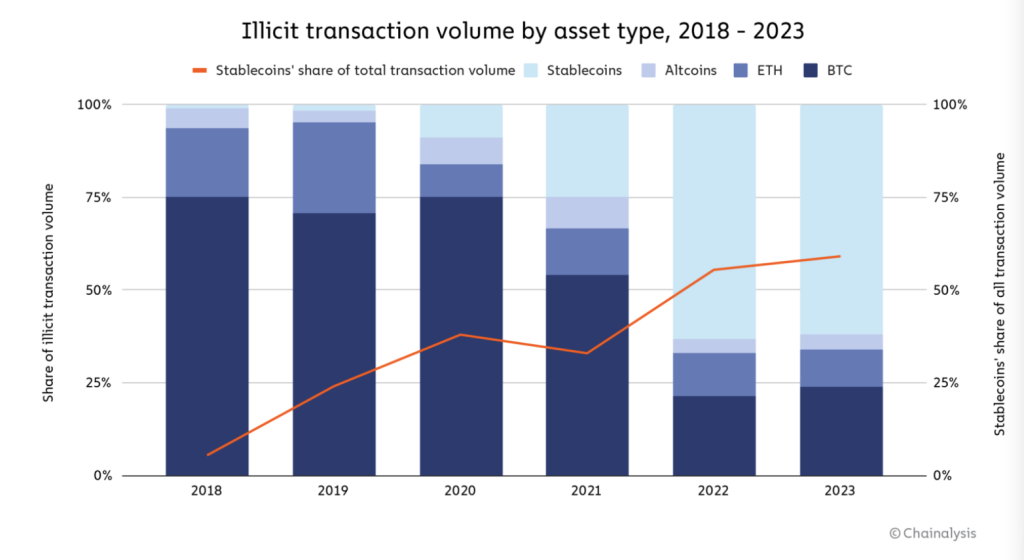 Source: 2024 Crypto Crime Trends Report by Chainalysis
To genuinely unlock the potential of intermediary-free financial systems, privacy must be integrated to safeguard institutions and high-net-worth users while preserving the decentralized and transparent essence of blockchain technology. This equilibrium will enable firms like Stripe and Visa, among others, to facilitate secure, anonymous transactions, allowing their clients and businesses to engage confidently with various DeFi protocols and the broader crypto landscape. By prioritizing privacy, these enterprises can promote the wider adoption of stablecoins and cultivate an environment conducive to the flourishing of DeFi.
Three Approaches to Privacy
Related Posts
There are three existing privacy approaches in cryptocurrency, each with distinct advantages and drawbacks:
- Centralized exchanges: Centralized exchanges provide privacy by aggregating user funds, creating a degree of transactional obscurity. However, this model is limiting, binding users to a single platform and undermining the composability that is central to DeFi. Acknowledging these constraints, even major exchanges like Coinbase and Kraken are now developing Layer 2 solutions that emphasize on-chain privacy, indicating a shift toward a more decentralized model.
- Fully homomorphic encryption (FHE): While it holds promise, fully homomorphic encryption, recently co-developed by Circle, is still constrained by current processing capabilities. FHE is computationally demanding, rendering it impractical for widespread adoption in the near future. Although theoretically robust, its complexity and performance limitations suggest it is unlikely to play a significant role in upcoming privacy solutions.
- Smart contract privacy: Smart contract privacy brings users closer to genuine on-chain privacy. Transactions remain verifiable but are obscured, maintaining both privacy and trust. This model offers considerable benefits for enterprises, enabling them to uphold confidentiality akin to Web 2 finance while enjoying the transparency and composability of DeFi.
The most feasible solution at present is smart contract privacy, as it would permit enterprises and high-net-worth users to execute private transactions while ensuring verifiability and trust. This approach is particularly beneficial for businesses, as it merges the privacy of Web 2 finance with the additional advantages of DeFi. Ultimately, smart contract privacy creates yield opportunities for both parties to earn on idle assets while keeping funds within a private Layer 2 environment.
Balancing Privacy and Compliance
Privacy in cryptocurrency is not merely an issue of concealing illicit activities; it encompasses the preservation of the right to financial discretion. Blockchain technology can incorporate compliance features directly into private transaction protocols, ensuring adherence to regulatory standards without compromising user privacy. Authorities can access transaction links for auditing purposes and restrict the use of privacy for criminal activities while still safeguarding identities.
For example, when users access their preferred platform to stake ETH, they should have the option to utilize a private wallet directly within that interface. This principle is equally applicable when generating yields, similar to traditional banking practices where deposit amounts and earnings remain confidential. The more projects and platforms that offer such options, the greater the incentive for institutions to engage with these products.
Conclusion
As cryptocurrency continues to evolve, high-net-worth individuals and enterprises utilizing existing privacy frameworks will demand strong privacy measures. In either scenario, privacy tools that comply with regulatory standards without compromising user protection would be transformative for the industry.
On-chain privacy safeguards could revolutionize the DeFi sector and encourage mainstream institutional users to enter the space with increased confidence. Privacy protections for identities, transactions, and strategies will serve as a foundational element for the expansion of Web 3, where the promises of secure, compliant, and decentralized financial opportunities become attainable for new enterprises seeking to transition from Web 2.
Disclaimer: The views expressed in this article are those of the author and do not necessarily reflect the opinions of Cryptonews.com. This article aims to provide a broad perspective on its subject and should not be construed as professional advice.
The post Lack of Privacy in Crypto Is Holding Back Institutional and Mainstream Adoption appeared first on Cryptonews.
