Disclaimer: Information found on CryptoreNews is those of writers quoted. It does not represent the opinions of CryptoreNews on whether to sell, buy or hold any investments. You are advised to conduct your own research before making any investment decisions. Use provided information at your own risk.
CryptoreNews covers fintech, blockchain and Bitcoin bringing you the latest crypto news and analyses on the future of money.


Ethereum is experiencing a quiet supply shock. While retail speculation has diminished, institutional investors have acquired nearly 11% of the circulating supply, transforming the asset into yield-generating infrastructure instead of merely a trading tool.
Key Data: Corporate treasuries and spot ETFs currently hold 10.72% of all ETH, based on information from Strategic ETH Reserve.
ETH is priced at $2,939 (-4.13%), separating from the “retail buzz” that previously influenced market cycles.
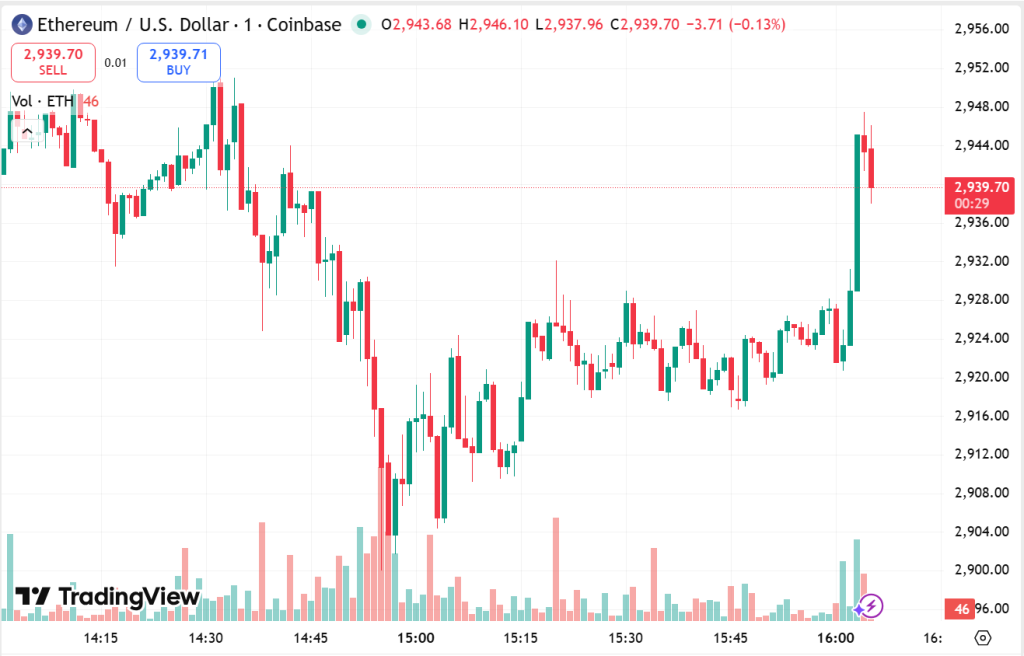 Source: TradingView
The Supply Squeeze
The reduction in liquidity is evident as Ethereum reserves on centralized exchanges have fallen to 10.5%, marking a record low and a 43% decline since July.
In contrast to earlier accumulation phases, this capital is not merely resting in whale wallets. It is being committed to staking contracts and treasury vaults.
- The Buyer: U.S. spot Ethereum ETFs have attracted around $12.4 billion in inflows year-to-date, with BlackRock’s iShares Ethereum Trust (ETHA) at the forefront.
- The Catalyst: Earlier this month, BlackRock submitted an application for a staking-enabled ETH trust, signaling a desire to harness the network’s native yield, effectively positioning ETH as a digital bond.
BREAKING:
Blackrock’s iShares has just filed for a staked Ethereum ETF.
Bullish for $ETHpic.twitter.com/7DHuXANW4R
— Ash Crypto (@AshCrypto) December 8, 2025
 Blackrock’s iShares has just filed for a staked Ethereum ETF.
Related Posts
Infrastructure, Not Speculation
The value proposition has transitioned from “ultrasound money” to settlement infrastructure.
“Current prices remain above Citi’s activity-based estimates, likely reflecting ‘buying pressure and enthusiasm around new use cases such as tokenization and stablecoins,’” noted Citi analyst Alex Saunders in a report reviewed by Reuters.
Data from RWA.xyz supports this perspective: Ethereum now secures $12.5 billion in tokenized real-world assets (RWAs). At the same time, the network processes $1.6 trillion in monthly stablecoin transactions, solidifying its position as the financial layer for digitized dollars.
The Outlook and Institutional Take
The disparity between price movements and on-chain metrics is pronounced. While NFT sales have decreased by 87% from the peaks of 2021, the structural absorption of ETH persists.
A Binance Square post suggested that ETH’s valuation may transition from a deflation narrative to an ecosystem/infrastructure narrative as stablecoin and Layer 2 usage increases. Additionally, Binance Research has highlighted that growing staking participation diminishes the supply of liquid ETH, which can heighten price sensitivity during demand surges.
Setting aside the chart for a moment, the significant development is the reclassification of ETH within institutional portfolios. It is no longer viewed as a high-beta technology investment; it is being structured as a yield-generating asset (approximately 3-4% APR).
The BlackRock staking application serves as the “green light” for risk-averse investors to seize that yield. Anticipate liquidity to remain limited on exchanges as custodians transfer assets into cold storage staking solutions, making a “supply shock” squeeze a mathematical certainty if inflows increase.
The post Institutions Corner 11% of ETH Supply as Exchange Balances Hit Record Lows appeared first on Cryptonews.
