Disclaimer: Information found on CryptoreNews is those of writers quoted. It does not represent the opinions of CryptoreNews on whether to sell, buy or hold any investments. You are advised to conduct your own research before making any investment decisions. Use provided information at your own risk.
CryptoreNews covers fintech, blockchain and Bitcoin bringing you the latest crypto news and analyses on the future of money.

India Advances Tokenization Legislation to Make Billion-Dollar Real Estate Accessible to Middle Class — Will It Succeed?

This week, India’s Parliament engaged in discussions regarding the integration of asset tokenization into the nation’s formal legal framework, as legislators considered whether digital fractional ownership could enhance wealth accessibility while ensuring capital remains within the country.
During a session in the Rajya Sabha on Tuesday, Member of Parliament Raghav Chadha called on the government to present a specific Tokenization Bill that would enable assets like real estate, infrastructure projects, and intellectual property to be segmented into digital units and acquired in smaller fractions.
Why does India require a 𝗧𝗼𝗸𝗲𝗻𝗶𝘀𝗮𝘁𝗶𝗼𝗻 𝗕𝗶𝗹𝗹?
I elaborated on this in Parliament today. pic.twitter.com/Ucw395cWpg— Raghav Chadha (@raghav_chadha) December 16, 2025
Chadha positioned the initiative as a means of financial inclusion, drawing a comparison to India’s Unified Payments Interface, which revolutionized everyday transactions by reducing barriers for millions of users.
Can Tokenization Unlock Wealth for India’s Middle Class, or Is Regulation Holding It Back?
Chadha informed lawmakers that the middle class in India is predominantly confined to savings accounts, fixed deposits, and mutual funds, with minimal exposure to assets that generally yield higher long-term returns.
He contended that tokenization could enable average investors to acquire small shares in office buildings, highways, and other capital-intensive ventures, while also offering quicker liquidity without the need for brokers or complicated paperwork.
He advocated for tailored legislation and a regulatory sandbox that would permit the testing of new models under oversight, rather than being compelled to conform to existing and often unsuitable regulations.
With a population estimated at approximately 1.46 billion and a median age below 30, the nation has experienced significant declines in extreme poverty, which is now approximated at around 1% based on the $2.15-per-day standard.
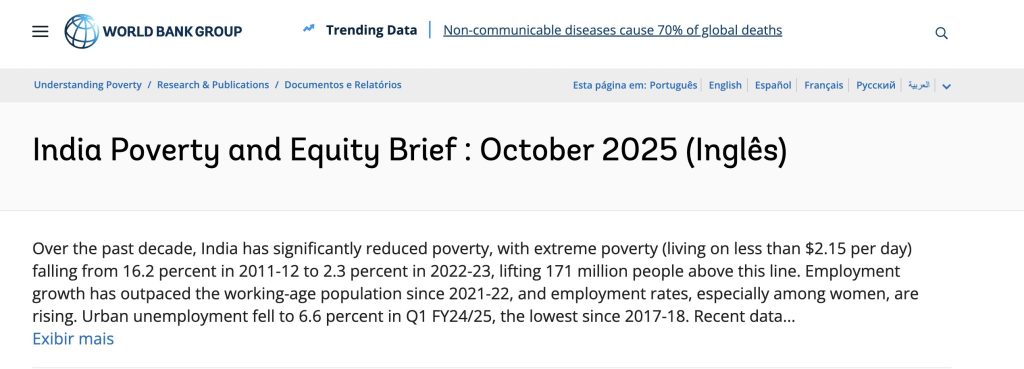 Source: World Bank Group
However, broader poverty metrics still reveal substantial disparities, with over a quarter of the population classified as falling below the lower-middle-income poverty threshold.
A limited fraction of household wealth is actively invested in financial markets, restricting opportunities for diversification into assets such as carbon credits, infrastructure, or commercial real estate.
Early Tokenization Efforts Emerge as Regulators Urge Caution
Proponents of tokenization argue that fractional ownership could reduce minimum investment requirements and channel portions of this idle capital into more productive avenues.
Related Posts
Opponents highlight that the pool of individuals capable of participating meaningfully remains limited by income levels and varying degrees of financial literacy.
India has already initiated early experiments in this domain. In GIFT City, platforms like Tokeny and Terazo have been developing regulated tokenized real estate frameworks, typically utilizing special purpose vehicles and public blockchains such as Polygon.
These initiatives function under current securities and virtual digital asset regulations, rather than a comprehensive tokenization statute.
The Reserve Bank of India and the Securities and Exchange Board of India have permitted limited pilot programs but have emphasized caution, particularly concerning investor protection and settlement risks.
State-Level Momentum Grows, Yet India Falls Behind on Asset Tokenization
State governments have also contributed to the momentum. In November, Maharashtra Chief Minister Devendra Fadnavis announced that the state was developing a framework that could unlock an estimated ₹50 trillion in dormant capital by digitizing asset transfers, especially in Mumbai’s real estate sector.
This announcement followed disclosures from the RBI indicating that its wholesale central bank digital currency pilots for financial instruments had enhanced settlement efficiency, furthering interest in blockchain-based infrastructure.
Despite this activity, India still lags behind countries that have progressed more rapidly in asset tokenization.
Jurisdictions such as the UAE, Singapore, Germany, Hong Kong, and the United States have established clearer legal frameworks that permit regulated platforms to offer fractional ownership to retail investors.
The SEC has granted a significant approval to the Depository Trust and Clearing Corporation’s (DTCC) initiative in blockchain-based markets. #SEC #Cryptohttps://t.co/LOvN1BzjZ1
— Cryptonews.com (@cryptonews) December 12, 2025
 The SEC has granted a significant approval to the Depository Trust and Clearing Corporation’s (DTCC) initiative in blockchain-based markets. #SEC #Cryptohttps://t.co/LOvN1BzjZ1
In Dubai, for instance, property tokenization pilots have lowered entry costs from millions of dirhams to a few thousand, while Singapore’s Project Guardian has concentrated on institutional-grade frameworks that can later be scaled for public use.
Dubai’s real estate sector is experiencing an influx of new investors due to its recent tokenization initiative.#Dubai #Tokenizationhttps://t.co/HwG1ztgavq
— Cryptonews.com (@cryptonews) July 17, 2025
Indian policymakers have been cautious about rapid advancements, citing intricate land titles, fragmented state regulations, and concerns regarding data privacy.
The outcome is that tokenization remains limited in scope, even as grassroots crypto adoption is notably high.
The post India Pushes Tokenization Bill to Open Billion-Dollar Real Estate to Middle Class — Will It Pass? appeared first on Cryptonews.
