Disclaimer: Information found on CryptoreNews is those of writers quoted. It does not represent the opinions of CryptoreNews on whether to sell, buy or hold any investments. You are advised to conduct your own research before making any investment decisions. Use provided information at your own risk.
CryptoreNews covers fintech, blockchain and Bitcoin bringing you the latest crypto news and analyses on the future of money.


On Thursday, the International Monetary Fund published a new global evaluation of the stablecoin sector, cautioning that disparate regulatory frameworks among nations are now establishing structural “roadblocks” that jeopardize financial stability, diminish oversight, and hinder the advancement of cross-border payments.
In its document titled “Understanding Stablecoins,” the IMF examined how leading economies, such as the United States, the United Kingdom, the European Union, and Japan, regulate stablecoins and discovered that national strategies remain significantly inconsistent.
Stablecoins possess the capability to transform cross-border payments and capital flows. They present opportunities, but also introduce new risks—financial integrity, regulatory oversight, consumer protection, capital flow management, monetary sovereignty, and more. Learn more:… pic.twitter.com/cOlZKuqLDF
— IMF (@IMFNews) December 4, 2025
While certain nations classify stablecoins as securities, others regulate them as payment instruments, allow only bank-issued tokens, or leave substantial portions of the market without regulation.
IMF Warns: Stablecoins Are Advancing Faster Than Regulatory Oversight
The IMF indicated that this regulatory patchwork enables stablecoins to traverse borders more swiftly than oversight can keep pace.
Issuers can function from lightly regulated regions while catering to users in more stringent markets, restricting authorities’ capacity to supervise reserves, redemptions, liquidity management, and anti-money laundering measures.
The organization cautioned that this situation fosters regulatory arbitrage and undermines global supervision.
The report also highlighted technical fragmentation. Stablecoins increasingly operate across various blockchains and exchanges that are not always compatible.
According to the IMF, this lack of coordination elevates transaction costs, impedes market development, and establishes obstacles to efficient global payments.
Variations in national regulatory treatment further complicate cross-border usage and settlement.
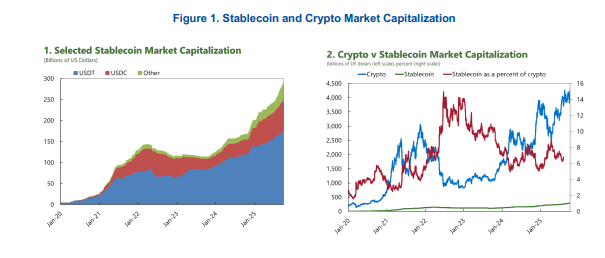 Source: IMF
Stablecoins continue to be predominantly represented by U.S. dollar-denominated tokens. The IMF reported that the global stablecoin market now exceeds $300 billion. Tether’s USDT and Circle’s USDC constitute the majority of that supply. Approximately 40% of USDC’s reserves are maintained in short-term U.S. treasuries, while around 75% of USDT’s reserves are in short-term treasuries, with an additional 5% held in Bitcoin.
The concentration of reserves in government debt markets directly connects stablecoins to traditional financial systems.
Related Posts
The extensive use of foreign-currency stablecoins can undermine domestic monetary control, reduce demand for local currency, and hasten digital dollarization. Stablecoins also facilitate the circumvention of capital controls through unhosted wallets and offshore platforms.
Beyond monetary issues, the fund pointed to broader financial stability concerns. Large-scale redemptions could necessitate rapid sales of Treasury bills and repo assets, potentially disrupting short-term funding markets that are essential for monetary policy transmission.
The IMF also observed that the growing interconnection among stablecoin issuers, banks, custodians, crypto exchanges, and funds heightens the risk of contagion spreading from digital markets to the broader financial system.
IMF Advocates for Unified Stablecoin Regulation as Cross-Border Risks Escalate
To mitigate these risks, the IMF introduced new global policy recommendations aimed at reducing fragmentation. It advocated for harmonized definitions of stablecoins, consistent regulations for reserve assets, and shared cross-border monitoring frameworks.
The fund asserted that issuers should adhere to the principle of “same activity, same risk, same regulation,” irrespective of whether the issuer is a bank, fintech company, or crypto platform.
The IMF also stated that stablecoins should be backed solely by high-quality liquid assets such as short-term government securities, with strict limitations on risky holdings. Issuers must ensure full one-to-one redemption at par, on demand, at all times.
Robust international coordination on anti-money laundering enforcement, licensing, and supervision of large global stablecoin arrangements was also included in the new guidance.
The IMF’s warning arrives as regulatory scrutiny intensifies globally. In Europe, the European Central Bank recently cautioned that stablecoins, despite their limited presence in the euro area, now pose spillover risks due to their increasing connections to U.S. Treasury markets.
The ECB warns that stablecoins are growing fast, now topping $280B, with rising spillover risks as USDT and USDC dominate 90% of the market. #Stablecoins #ECBhttps://t.co/ef16HZzqYL
— Cryptonews.com (@cryptonews) November 24, 2025
 The ECB warns that stablecoins are growing fast, now topping $280B, with rising spillover risks as USDT and USDC dominate 90% of the market. #Stablecoins #ECBhttps://t.co/ef16HZzqYL
The European Systemic Risk Board has also urged for immediate safeguards against cross-border stablecoin structures operating under the EU’s MiCA framework.
In China, the central bank has labeled stablecoins as a threat to financial stability and monetary sovereignty, while the Bank of England and Basel regulators are reevaluating how banks should allocate capital against stablecoin exposure as usage grows.
The IMF concluded that without consistent global regulation, stablecoins could evade national safeguards, destabilize vulnerable economies, and transmit financial shocks across borders at high speed.
The post IMF Warns: Fragmented Stablecoin Rules Create “Roadblocks” – New Guidelines Released appeared first on Cryptonews.
