Disclaimer: Information found on CryptoreNews is those of writers quoted. It does not represent the opinions of CryptoreNews on whether to sell, buy or hold any investments. You are advised to conduct your own research before making any investment decisions. Use provided information at your own risk.
CryptoreNews covers fintech, blockchain and Bitcoin bringing you the latest crypto news and analyses on the future of money.


Industries that rely heavily on infrastructure are experiencing significant changes to adapt to the demand for digital advancements. Emerging technologies such as artificial intelligence (AI), blockchain, and the Internet of Things (IoT) are being integrated into sectors that have remained stagnant for years.
These infrastructure-dependent sectors are also transitioning towards decentralized frameworks. Consequently, decentralized physical infrastructure, or DePINs, are rapidly gaining popularity.
A recent report from Moody’s Ratings, titled “How DePINs could build the future of physical infrastructure one token at a time,” indicates that the DePIN market could potentially reach $3.3 trillion by 2030. The findings reveal that this market was valued at $2.2 trillion the previous year.
DePIN continues to grow
With fundraising volume up 296% year over year, the total market cap grew 400% to $20 billion.
It’s Time for a #DePIN Sector Update— Messari | Road to #Mainnet2024
(@MessariCrypto) August 7, 2024


 (@MessariCrypto) August 7, 2024
DePIN For The Auto Industry Explained
Although the idea behind DePIN may appear intricate, multi-billion dollar industries, such as the automotive field, are starting to showcase the transformative potential of these models.
Initial applications illustrate how vehicle owners can possess and utilize their data while receiving rewards for sharing personal information.
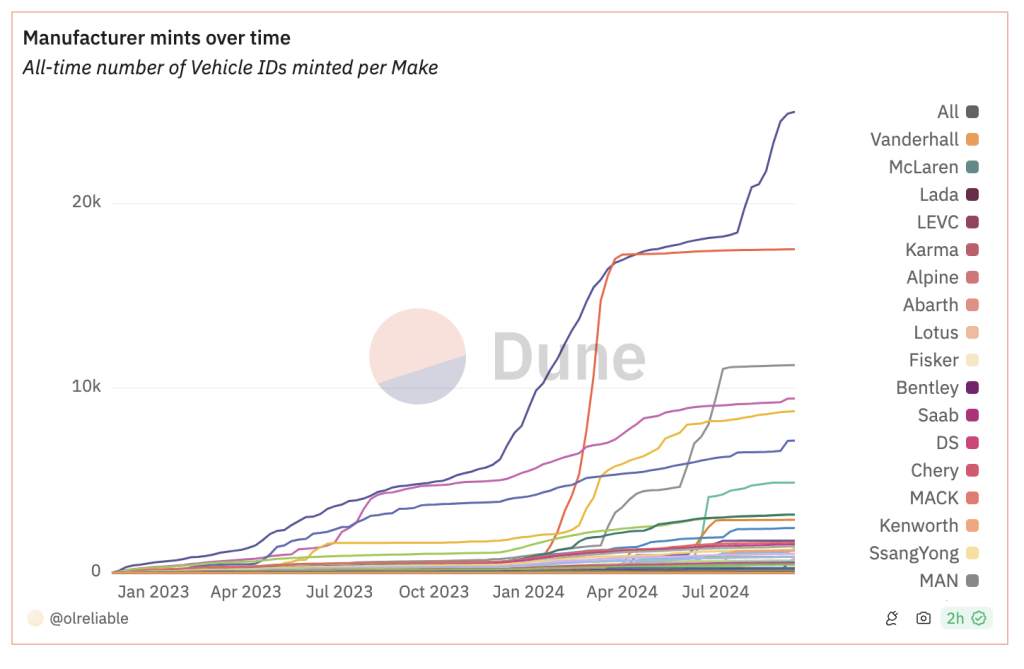
For instance, Dimo is a DePIN network designed to enhance the car ownership experience. Rob Solomon, Co-Founder of Dimo, informed Cryptonews that Dimo aims to make every vehicle globally smart and programmable by placing cars on-chain.
“Dimo operates by assigning an on-chain identity to vehicles,” Solomon stated. “Users mint their vehicle on-chain to create a digital twin of the car. We then link the digital car to the Dimo platform through a vehicle ID.”
 Source: Dimo
Solomon clarified that the data produced from a user’s vehicle is recorded off-chain. This encompasses speed, location, and other information accumulated over time.
Users can opt to share that data with Dimo, earning tokens as a reward.
“The Dimo token is active, and anyone who connects their car automatically earns Dimo tokens weekly as a standard reward,” Solomon explained. “Users also have the option to share their data to receive additional rewards that are deposited directly into the Dimo wallet.”
As per the Dimo protocol dashboard, 112,311 vehicles are linked to Dimo, with over 36,000 vehicle ID holders.
User Data Streamlines The Auto Industry
While drivers can generate passive income by linking their cars to Dimo, the data produced can optimize traditional processes within the automotive sector.
Solomon believes that Dimo will facilitate new types of applications that companies can develop over time.
For example, he noted that car insurance firms could collaborate with Dimo to access data from the platform.
“Insurance providers are unable to obtain crucial data from drivers and their vehicles, so they are seeking a better method to connect with users. They view Dimo as a solution,” he remarked.
Another application Solomon anticipates will soon be feasible is having vehicles connect directly to parking facilities.
“Once a vehicle enters a garage, payment will already be processed, and the car will know precisely where to park,” he pointed out.
Car Data Helps With Mapping Accuracy
Another noteworthy automotive DePIN application is being facilitated by a street-level mapping initiative known as Hivemapper Network.
Ariel Seidman, Co-founder of Hivemapper Network and CEO of the Bee Maps brand, shared with Cryptonews that Hivemapper contributors can assist in creating digital maps by gathering high-quality, street-level imagery using dashcams connected to their vehicles.
“Conventional mapping solutions often face challenges in keeping data up to date, particularly in rapidly evolving urban areas or less accessible locations,” Seidman stated. “Hivemapper’s decentralized model allows for real-time updates and guarantees that map data is both current and reflective of actual conditions.”
Hivemapper aims to address the issue of digital mapping precision. Recent data indicates that drivers utilizing Google Maps across 56 trips, covering 18 miles in 32 minutes, found that driving time accuracy was 23% and journey length accuracy was 38% correct.
It was also observed that each month, over a billion individuals use Google Maps to locate destinations and determine optimal routes.
Related Posts
“By enabling individuals and fleets to contribute to the map, Hivemapper ensures more comprehensive coverage that can meet the diverse needs of users across a region,” Seidman noted.
This is particularly crucial as the demand for real-time, accurate map data is increasing, driven by the rise of autonomous vehicles, advanced logistics, and emerging technologies that rely on precise geospatial information.
Although Hivemapper is adopting a novel approach to mapping systems, the network already boasts 10 million miles of map coverage.
According to Seidman, Hivemapper has achieved coverage five times faster than Google Street View.
It took 10 years for Google Street View to map its first 10 million unique miles of roads. https://t.co/pqhk13MIfV
Our incredible Hivemapper community reached that milestone a few hours ago. It took 1 year, 10 months, and 16 days.
There’s a better way to map our world. It’s here. pic.twitter.com/isYPUHIOLB— Hivemapper (@Hivemapper) September 19, 2024
“The network currently provides unique coverage for over 26% of the world’s roads, with the strongest coverage in North America, Europe, South Korea, and Japan,” he stated.
Users Are Incentivized To Share Data
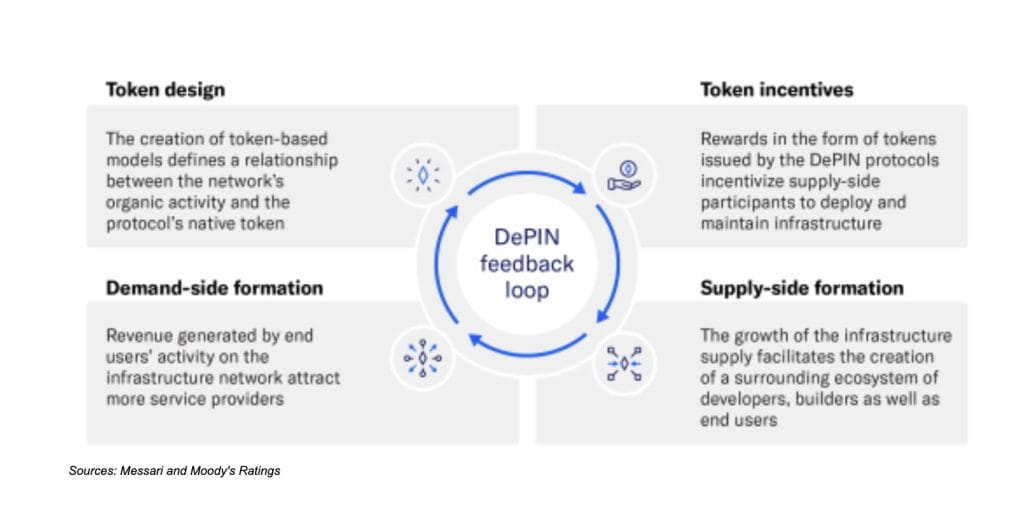
Seidman added that map contributors receive a digital token called “HONEY,” which can be exchanged for map data.
“This model enables the economic advantages of the global mapping network to be distributed among those who contribute to the map,” he explained.
Similar to other DePIN models, the Hivemapper Network is designed to be fully decentralized. Seidman believes this ensures that the Hivemapper Network remains equitable and accessible.
 Source: Moody’s Ratings Report
“Together with engaged community members, the Hivemapper Foundation will assist in maintaining the decentralized mapping network and support an open-source ecosystem, including the release of source code and materials for hardware and software projects,” he remarked.
Challenges With Current DePIN Models
While DePINs may represent a significant use case for blockchain, several challenges persist that could impede its widespread adoption across various sectors.
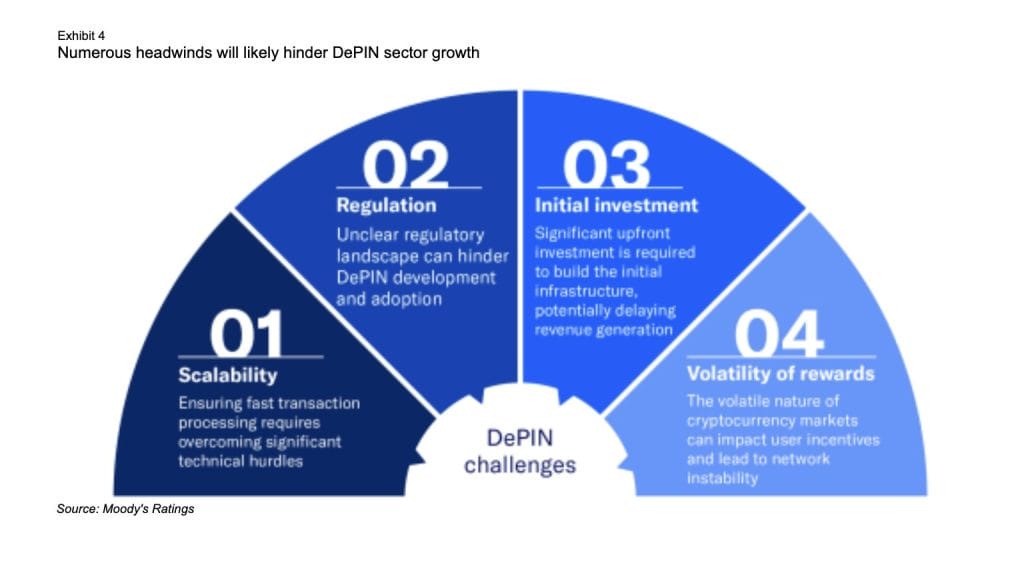
According to Moody’s Ratings report on DePIN, regulatory compliance is one of these challenges.
“Companies in infrastructure-heavy sectors operate under strict regulations that govern essential operations, such as spectrum use, infrastructure deployment, and data protection, which vary significantly across jurisdictions,” the report stated. “A decentralized infrastructure model would need to navigate these complex landscapes to ensure compliance while still maintaining maximum operational flexibility and scalability.”
 Source: Moody’s Ratings Report
Unfortunately, the development of DePIN regulations is likely to take time. Josh Benaron, Founder and CEO of the layer-1 data chain Irys, informed Cryptonews that traditional physical infrastructure stakeholders regard DePIN with skepticism and distrust.
“This is due to its decentralized nature,” Benaron stated. “There is also no established method to implement DePIN with existing infrastructures, making it challenging for physical infrastructure companies to adopt this technology.”
Benaron elaborated that the DePIN sector must create a seamless approach to enhance interoperability while developing tools to improve transparency and efficiency that serve all types of users to eliminate these adoption hurdles.
Moreover, Moody’s Ratings report highlighted that scalability and sustainability remain vital concerns.
“Establishing and sustaining decentralized physical infrastructure in sectors like telecommunications, especially in remote or underserved regions, will likely necessitate significant financial investments and technical expertise,” the report noted.
Ensuring reliable connectivity and service dependability across decentralized networks further complicates infrastructure management.
DePIN Models Will Advance
Despite these challenges, Benaron pointed out that in the past year, DePIN protocols have experienced rapid growth across all major blockchains.
“With the rising demand for data privacy and security in our daily lives, there is an increasing need for decentralized data solutions,” he stated. “Ongoing blockchain innovations are anticipated to yield more efficient and scalable DePIN projects that will enhance real-world usability and attract further investments in this sector.”
In light of this, Benaron believes that DePIN applications will extend beyond the cryptocurrency industry, influencing significant transportation, telecommunications, and AI companies.
The post How DePIN Models Are Transforming The Automotive Industry appeared first on Cryptonews.
