Disclaimer: Information found on CryptoreNews is those of writers quoted. It does not represent the opinions of CryptoreNews on whether to sell, buy or hold any investments. You are advised to conduct your own research before making any investment decisions. Use provided information at your own risk.
CryptoreNews covers fintech, blockchain and Bitcoin bringing you the latest crypto news and analyses on the future of money.

Geopolitical Turmoil Involving Crypto, Iran Conflict, and Oil Prices May Postpone the Cryptocurrency Market Surge

Cryptocurrencies are facing pressure as tensions surrounding Iran escalate, prompting traders to consider the alarming possibility of disruptions in the Strait of Hormuz.
A closure of this critical passage would lead to a surge in oil prices. An increase in oil prices would subsequently drive inflation higher, placing the Federal Reserve in a difficult position and necessitating prolonged higher interest rates.
Cryptocurrencies are not exempt from these developments. Although there has been some speculative purchasing linked to headlines about capital flight in the region, the overall macroeconomic landscape remains challenging. Bitcoin is increasingly aligning with traditional risk assets rather than separating from them.
Rather than functioning as digital gold, the market appears to be treating liquidity as the true safe haven. In the event of a significant energy crisis, the immediate response is typically not a shift towards cryptocurrencies but rather a broad-based reduction of risk.
Key Takeaways:
- Bitcoin volatility has surged as traders hedge against a possible Strait of Hormuz closure that could impact one-fifth of global oil supplies.
- Rising Oil Price levels exceeding $90 per barrel would likely keep inflation elevated, potentially removing the prospect of a Fed rate cut in Q2.
- While Capital Flight into USDT provides localized support, global risk-off trends are dominating market dynamics and limiting upward momentum.
Bitcoin Crypto Volatility Spikes as Iran War Jitters Trigger $128M Liquidations
The initial response of the crypto market to the Iran conflict was marked by turmoil rather than clarity. Data from CoinGlass indicates that over $128 million in liquidations occurred within just four hours following reports of the IRGC’s “Operation True Promise 4,” with nearly 80% of these being long positions. Leverage traders were positioned incorrectly and faced rapid losses.
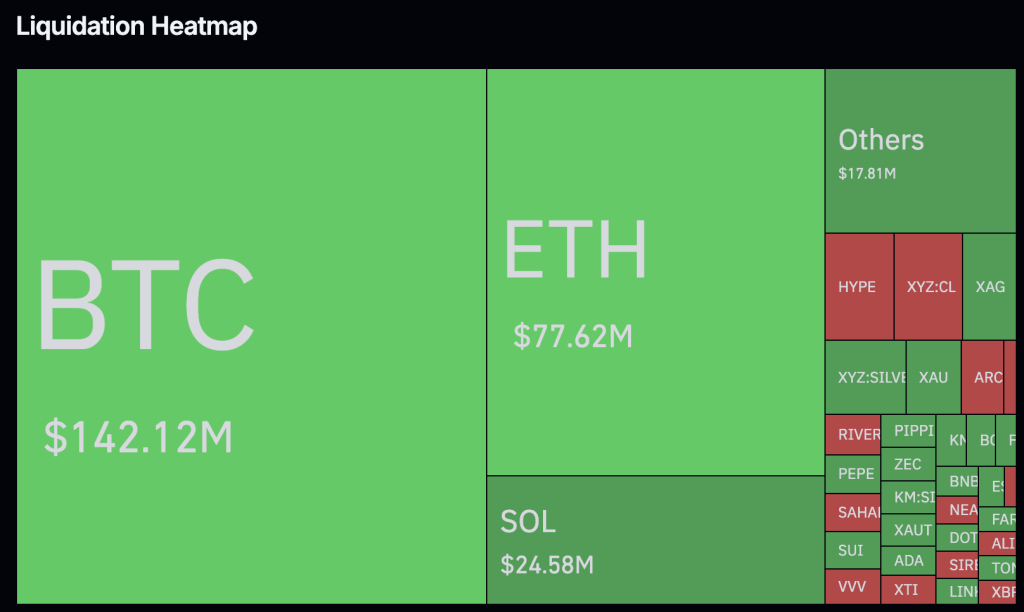 Source: Coinglass
Bitcoin initially fell to around $63,000 in response to the news but then rebounded as further information emerged. However, this recovery appears mechanical rather than driven by confidence. Open Interest has significantly decreased, indicating that trading desks are reducing risk rather than actively purchasing on dips.
Related Posts
This behavior is indicative of classic panic. Sell first, reassess later.
Equities are displaying a similar trend. The S&P 500 has experienced outflows, and Bitcoin’s correlation with technology stocks remains strong during periods of stress. Regardless of the narrative surrounding digital gold, in such moments, BTC behaves like a high-beta risk asset rather than a safe haven.
Oil Price Surge Threatens to Derail Fed Pivot Plans
The primary threat to cryptocurrencies may not stem from news headlines but rather from oil prices. Should the Strait of Hormuz be disrupted, up to 21 million barrels per day could be impacted, representing approximately 20% of global supply. Historically, even minor disruptions lead to immediate price increases.
If crude oil prices remain above $100, inflation is likely to rise swiftly. This scenario would constrain the Federal Reserve, delaying rate cuts, maintaining tight liquidity, and adversely affecting cryptocurrencies in a prolonged high-rate environment.
 Source: BTCUSD / TradingView
Some analysts are once again proposing extreme downside scenarios. While most institutional desks still regard $58,000 to $60,000 as Bitcoin’s critical support range, this level is heavily contingent on the Fed not adopting a more hawkish stance.
There is a counteracting force: capital flight. Demand for stablecoins in certain parts of the Middle East has surged as local currencies fluctuate. Bitcoin and USDT serve as escape routes. However, retail flows from crisis-affected regions seldom compensate for substantial institutional outflows driven by macroeconomic tightening.
Altcoins are already exhibiting signs of strain. In the absence of new liquidity, Ethereum and the wider sector are struggling to maintain upward momentum. If yields on the U.S. 10-year approach 5% due to energy-driven inflation, risk assets are likely to remain constrained.
Discover: The best new crypto in the world
The post Crypto, Iran War, and Oil Price: Geopolitical Shock Could Delay the Crypto Bull Run appeared first on Cryptonews.
