Disclaimer: Information found on CryptoreNews is those of writers quoted. It does not represent the opinions of CryptoreNews on whether to sell, buy or hold any investments. You are advised to conduct your own research before making any investment decisions. Use provided information at your own risk.
CryptoreNews covers fintech, blockchain and Bitcoin bringing you the latest crypto news and analyses on the future of money.


France has made a significant move that may alter the monetary landscape of Europe. Legislators in the National Assembly have passed a resolution that rejects the European Central Bank’s (ECB) proposed digital euro while supporting Bitcoin and euro-denominated stablecoins as viable alternatives.
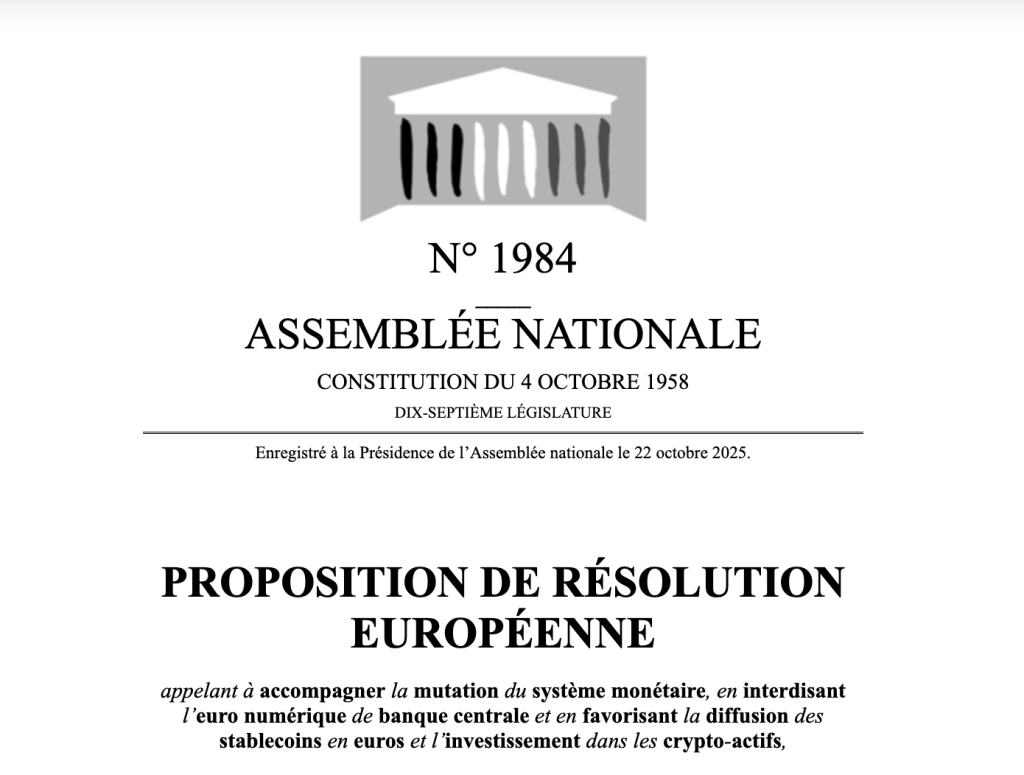
The initiative, presented on October 22, 2025, by Éric Ciotti and members of the Union of the Right for the Republic (UDR), urges the French government to dismiss the European Commission’s draft regulation for a digital euro.
 Source: French National Assembly
Instead, it advocates for euro-based stablecoins and increased national investment in crypto-assets.
Is France’s Bitcoin Reserve Plan a Defense of Freedom or a Rebellion Against Europe?
The document, titled “Proposal for a European Resolution Calling for Support for the Transformation of the Monetary System,” contends that central bank digital currencies (CBDCs) threaten privacy and economic freedom.
Ciotti characterized the action as a measure to safeguard “fundamental individual rights” and uphold monetary sovereignty in a progressively digital economy.
French legislators cautioned that a centrally controlled network would enable authorities to monitor and potentially freeze citizens’ assets.
The explanatory memorandum likened the ECB’s initiative to China’s digital yuan, indicating that similar centralized control could “pose a major threat to fundamental individual freedoms.”
The ECB is currently in the preparatory phase of the digital euro, which commenced in November 2023 and is anticipated to conclude by the end of 2025. The currency could be launched around 2029, according to ECB Executive Board member Piero Cipollone.
A digital euro could launch in 2029, says ECB board member Piero Cipollone, citing growing momentum and progress in member-state talks.#digitaleuro #ECBhttps://t.co/yn43I38DdH
— Cryptonews.com (@cryptonews) September 24, 2025
 A digital euro could launch in 2029, says ECB board member Piero Cipollone, citing growing momentum and progress in member-state talks.#digitaleuro #ECBhttps://t.co/yn43I38DdH
Lawmakers also expressed concerns that implementing a digital euro could destabilize Europe’s banking system by allowing users to transfer deposits directly to the ECB, potentially leading to a “bank run” and centralizing financial authority within a single entity.
The resolution asserted that “such a concentration of power would be detrimental to economic freedom” and emphasized that it is “not the role of the ECB to function as a commercial bank.”
Instead, the French proposal outlines a comprehensive pro-crypto agenda focused on three primary areas: establishing a national Bitcoin reserve, promoting euro-denominated stablecoins, and fostering the growth of the domestic crypto industry.
Under this plan, France would create a public administrative entity to oversee a strategic Bitcoin reserve equivalent to 2% of the total Bitcoin supply, approximately 420,000 BTC, to be accumulated over a period of seven to eight years.
This initiative aims to establish a “national digital gold” reserve to diversify France’s foreign exchange reserves and enhance financial sovereignty.
The proposal also introduces the potential for tax payments to be made in Bitcoin, pending constitutional approval.
France Calls on Europe to Break Dependence on U.S. Dollar Stablecoins
Related Posts
In addition to Bitcoin, the motion aims to promote the use of euro-denominated stablecoins as an alternative to U.S. dollar-backed tokens that currently dominate global markets.
The document criticizes the ECB’s restrictive approach to euro stablecoins and calls on the European Commission to amend the Markets in Crypto-Assets (MiCA) regulation to facilitate the issuance of stablecoins by European banks and companies.
Referencing data from the International Monetary Fund, the report highlights that 91% of global stablecoin capitalization, approximately $210 billion out of $230 billion, is denominated in U.S. dollars, primarily through Tether (USDT) and Circle’s USD Coin (USDC).
 Source: CoinGecko
In contrast, the leading euro stablecoin has a market capitalization of only $259 million. The proposal argues that this disparity renders Europe excessively reliant on U.S. firms and advocates for policies that would enable euro-backed stablecoins to compete on a global scale.
François Villeroy de Galhau, the governor of France’s central bank, has previously cautioned that Europe’s reluctance could exacerbate its dependence on non-European digital currencies.
France has urged the European Union to give ESMA direct authority over major cryptocurrency firms operating across the bloc.#ESMA #EUhttps://t.co/V98VhQzUDi
— Cryptonews.com (@cryptonews) October 9, 2025
 France has urged the European Union to give ESMA direct authority over major cryptocurrency firms operating across the bloc.#ESMA #EUhttps://t.co/V98VhQzUDi
During a speech at the Paris Fintech Forum earlier this month, he stated that European banks should concentrate on developing euro-denominated stablecoins rather than depending solely on dollar-based products.
The UDR’s resolution also suggests relaxing Basel prudential regulations, which currently categorize certain crypto-backed loans as high-risk with capital requirements of up to 1,250%.
Lawmakers contend that this makes such loans unattractive for banks and advocate for a “targeted deviation” from the Basel standard to promote crypto-collateralized lending.
France Strengthens Its Crypto Framework Ahead of MiCA Implementation in 2026
The proposal emerges at a crucial moment for France’s crypto sector. The country’s financial regulator, the Autorité des Marchés Financiers (AMF), has recently authorized BPCE’s subsidiary, Hexarq, to provide crypto custody and trading services, marking the entry of another significant banking institution into the market.
France has also sanctioned the Lightning Stock Exchange (Lise), its first fully tokenized equity platform operating under the EU’s Distributed Ledger Technology (DLT) Pilot Regime, reflecting a growing national interest in blockchain-based financial systems.
France just approved Lise Exchange, a tokenized stock exchange that aims to redefine how IPOs work for SMEs.#France #IPO #LiseExchangehttps://t.co/56RhlDLw3A
— Cryptonews.com (@cryptonews) October 16, 2025
Simultaneously, French regulators have been increasing scrutiny of crypto exchanges.
The prudential supervision authority, ACPR, has conducted anti-money laundering inspections on numerous firms, including Binance and Coinhouse, as part of preparations for the full implementation of the MiCA framework across the European Union by 2026.

Meanwhile, Europe’s crypto market continues to grow rapidly. Data from Chainalysis indicates that France processed $180 billion in crypto transactions between July 2024 and June 2025, positioning it among the region’s most active markets, following Germany and the United Kingdom.
The post France Stuns Europe: Lawmakers Adopt Bitcoin and Ban Digital Euro appeared first on Cryptonews.
