Disclaimer: Information found on CryptoreNews is those of writers quoted. It does not represent the opinions of CryptoreNews on whether to sell, buy or hold any investments. You are advised to conduct your own research before making any investment decisions. Use provided information at your own risk.
CryptoreNews covers fintech, blockchain and Bitcoin bringing you the latest crypto news and analyses on the future of money.

France Moves Forward with Tax Initiative Aimed at Crypto as “Unproductive Wealth” – Will It Secure Senate Approval?

France has taken a significant step towards imposing taxes on cryptocurrency assets as part of a comprehensive overhaul of its wealth tax framework, following the approval of a contentious amendment that categorizes digital assets as “unproductive wealth.”
This initiative, put forth by centrist MP Jean-Paul Mattei from the Les Démocrates group, was endorsed on October 31 with a close vote of 163–150 in the National Assembly during deliberations on the 2026 draft finance bill.
However, the proposal still requires approval from the Senate and must navigate the remaining stages of the legislative process before it can be enacted into law.
Is France’s Crypto Tax a Drive for Productivity or a Burden for Holders?
The amendment aims to replace France’s current Impôt sur la Fortune Immobilière (IFI), the real estate wealth tax, with a more expansive Impôt sur la Fortune Improductive (IFI 2.0), or “tax on unproductive wealth.”
This reform would broaden the range of taxable assets beyond real estate to encompass various items considered economically “inactive” or “non-productive.”
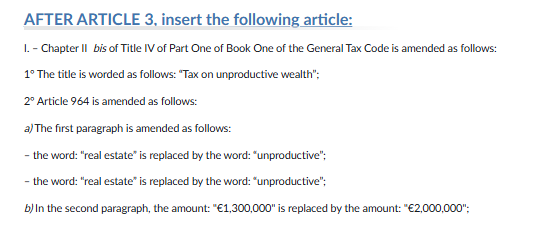 Source: France National Assembly
Included in this category are luxury items such as yachts, private jets, jewelry, collectible art, and, for the first time, digital currencies like Bitcoin and other cryptocurrencies.
The amendment raises the tax threshold from €1.3 million to €2 million and substitutes the existing progressive rates (0.5% to 1.5%) with a flat rate of 1% on the net assets exceeding that threshold.
The proposal indicates that the reform seeks to promote investment in assets that actively contribute to economic growth while discouraging the accumulation of wealth in assets classified as “unproductive.”
“Gold, coins, classic cars, yachts, and works of art are currently excluded from the tax base, yet they represent forms of wealth that do not generate jobs or innovation,” Mattei noted in his summary. “This reform addresses that inconsistency.”
The measure would also impact taxpayers holding cryptocurrencies that have increased in value but remain unsold, raising concerns about the potential taxation of unrealized gains.
Critics within France’s crypto sector argue that the measure disproportionately affects savers and investors who view crypto as a means of preserving value rather than for speculative purposes.
Crypto as ‘Unproductive Wealth’? France’s Tax Reform Ignites Discussion.
Éric Larchevêque, co-founder of Ledger, cautioned that the proposal “penalizes all savers who aim to secure their financial future through gold and Bitcoin.”
Related Posts
He further stated that the political implication is evident: “Crypto is regarded as an unproductive reserve, not beneficial to the real economy.”
Après le rejet de la taxe Zucman, je pensais qu’on allait enfin pouvoir passer à autre chose et revenir à nos vrais sujets positifs de contribution économique au pays.
Mais voila que l’amendement de l’IFI sur la richesse “improductive” a été voté hier soir.
Seront désormais…— Eric Larchevêque (@EricLarch) November 1, 2025
Larchevêque also expressed concern that numerous crypto holders might be compelled to liquidate portions of their portfolios to meet the new tax obligations, especially if their assets are illiquid or subject to volatility.
The close vote highlighted significant divisions within the French political arena. The amendment received backing from an unexpected coalition of Socialist, centrist MoDem, and far-right Rassemblement National (RN) MPs.
Conversely, the government and its Renaissance allies opposed the measure, labeling it as “uncertain in scope and revenue.”
Economists are split regarding the potential fiscal implications. Some Socialist MPs estimate that the reform could yield up to €2 billion in additional annual revenue, while others, including France’s Ministry of Public Accounts, foresee total receipts ranging from €1 billion to €3 billion, or possibly less if affluent households adjust their asset structures to evade the tax.
Proponents contend that the reform would redirect capital into “productive” sectors such as business investment, innovation, and green infrastructure.
Opponents caution that it risks penalizing savers, investors, and collectors while introducing administrative challenges in assessing the value of diverse assets like digital currencies and art.
Crypto Taxation Already a Contentious Issue
The framework for crypto taxation in France has been a longstanding topic of contention. Under current regulations, individuals incur a 30% flat tax on realized crypto capital gains, meaning tax is applicable only when assets are exchanged for euros or goods. Crypto-to-crypto transactions and holding (HODLing) are not subject to taxation.
The existing IFI generated €2.2 billion in 2024 from approximately 186,000 households, about half of the €4.2 billion previously produced by the former ISF in 2017, according to data from France’s tax administration (DGFiP).
 Source: impots.gouv.fr
If implemented, the new “unproductive wealth” tax would establish a fundamentally different principle: taxing unrealized gains on crypto holdings annually, even when investors have not sold their assets.
Critics argue that this could set a troubling precedent for taxing “paper profits.”
The post France Advances Tax Proposal Targeting Crypto as “Unproductive Wealth” – Will it Pass the Senate Vote? appeared first on Cryptonews.
