Disclaimer: Information found on CryptoreNews is those of writers quoted. It does not represent the opinions of CryptoreNews on whether to sell, buy or hold any investments. You are advised to conduct your own research before making any investment decisions. Use provided information at your own risk.
CryptoreNews covers fintech, blockchain and Bitcoin bringing you the latest crypto news and analyses on the future of money.



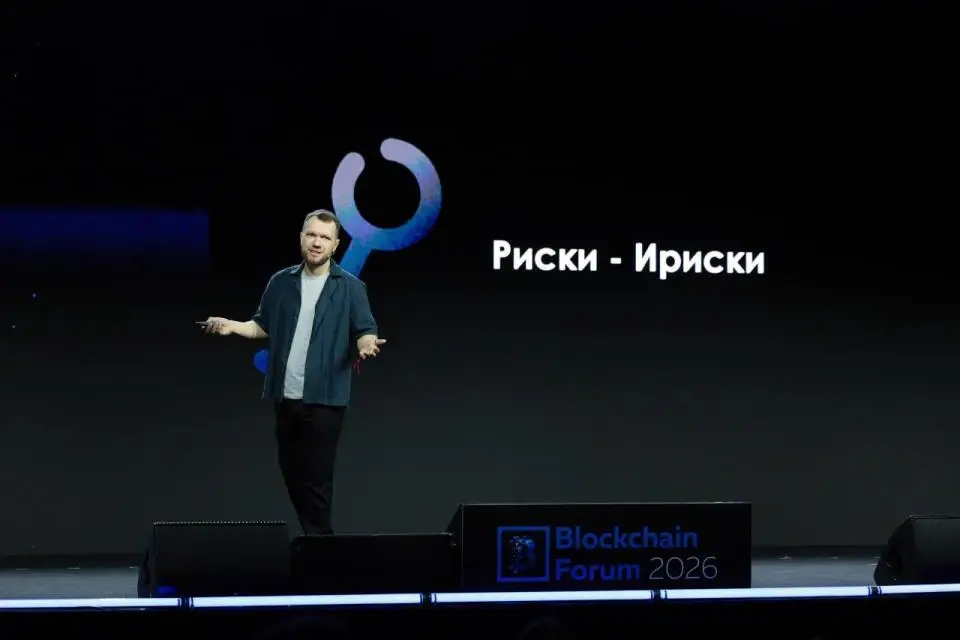
Ivan Tikhonov spoke at the Blockchain Forum 2026 in Moscow, where he discussed private stablecoins. According to the founder of Bits.media, the demand for privacy tools continues to increase, despite the overall trend of integrating cryptocurrencies with the traditional financial system, and private stablecoins may emerge as a new market direction.
Currently, the majority of market participants are primarily focused on prices: when to buy, when to sell, and where to secure profits. Bitcoin was created after the 2008 crisis as an alternative to Wall Street and the traditional financial system; however, the crypto market is increasingly influenced by the behavior of stock markets. Any developments in the stock markets quickly impact the value of digital assets.
A few years ago, cryptocurrency advocates claimed that banks would become obsolete, and government institutions would be replaced by smart contracts and decentralized services. Now, however, a significant portion of the market is anticipating the integration of banks with cryptocurrencies, the launch of ETFs, and investments from pension funds into Bitcoin and other cryptocurrencies. The widespread interest in the industry often revolves not around the ideas of financial independence but rather around meme coins, quick profits, and speculative trading.
Nevertheless, the underlying needs that led to the creation of cryptocurrencies have not disappeared. Bitcoin was designed as a tool for financial transactions without intermediaries and censorship; however, today, most users store their assets on exchanges and custodial services, often verifying addresses through AML providers before transferring funds.
Related Posts
Why Privacy is Becoming Essential
The transparency of blockchains means that anyone can view transaction histories, approximate asset volumes, counterparties, and a user’s financial activities. This creates vulnerabilities: transparency weakens negotiating positions, poses risks for businesses, and makes holders of large sums targets for fraudsters.
The risks extend beyond phishing and social engineering. The crypto industry is increasingly experiencing kidnappings, extortions, and attacks on investors. Such incidents have been recorded not only in countries with high crime rates but also in the USA, France, and the UAE. In France, a tax service employee was detained for leaking confidential information to a criminal group, and last year, a co-founder of Ledger was kidnapped along with his spouse.
Privacy in Public Networks
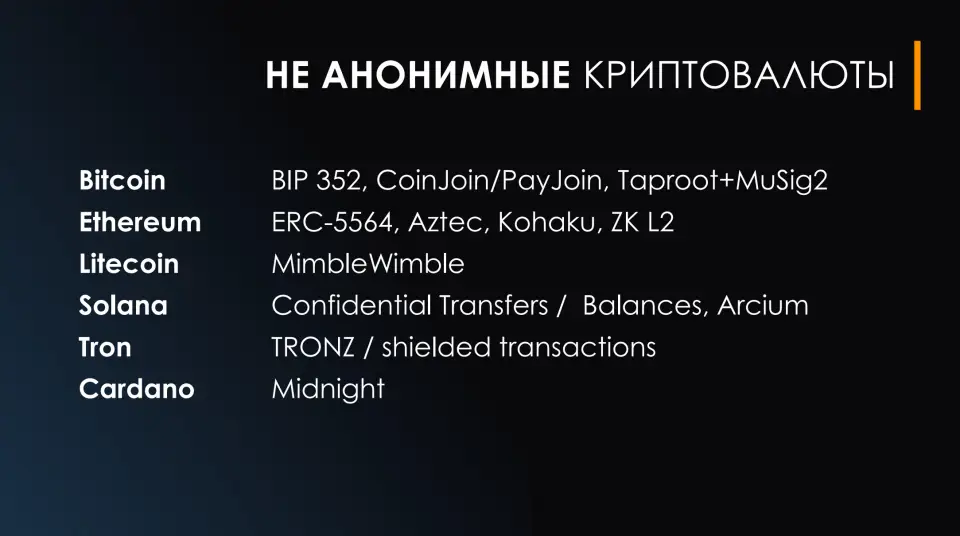
For these reasons, even the largest blockchains are gradually implementing additional privacy mechanisms. Bitcoin utilizes BIP 352, CoinJoin, PayJoin, and the combination of Taproot with MuSig2. In Ethereum, developments include ERC-5564, Aztec, Kohaku, and ZK L2. Litecoin employs MimbleWimble, Solana features Confidential Transfers and Arcium, and Tron has the TRONZ privacy protocol based on Zk-SNARK, while the Cardano ecosystem is advancing the Midnight project.
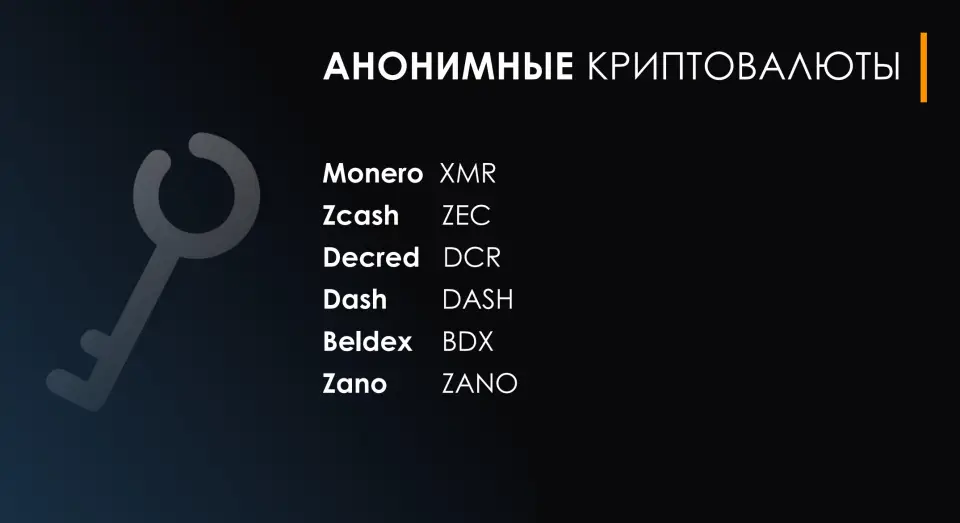
Concurrently, there are blockchains where privacy is built into the core architecture. These include Monero, Zcash, Dash, Beldex, and Zano. Monero employs ring signatures, while Zcash uses zero-knowledge proofs.
Confidential Stablecoins — The Next Trend
One of the challenges facing private cryptocurrencies is their high volatility. This is why the market has gradually moved towards the concept of stablecoins. There are three main types of such assets: fiat-backed, crypto-backed, and algorithmic. For private solutions, crypto-backed and algorithmic models are considered the most suitable.
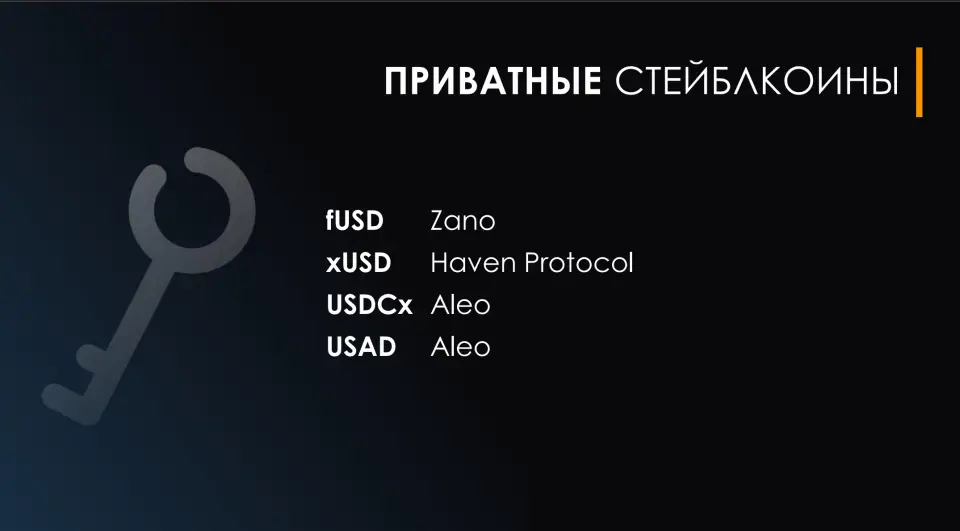
The market for these instruments is still in its formative stages. Among existing projects, fUSD based on Zano, xUSD from Haven Protocol, and USDCx and USAD on Aleo can be highlighted. Notably, xUSD is not listed on CoinMarketCap, while the market capitalization of fUSD is approximately $10 million.
Interest in such solutions may increase in light of sanctions, restrictions, mutual blockades, and the demand for financial sovereignty. For instance, within the Zano ecosystem, it is already possible to issue private tokens similar to Ethereum, but with a higher level of confidentiality.
Why Regulators Will Resist
The primary risk for confidential assets is related to regulation. Regulators find it more challenging to work with tools that limit access to transaction information, which is why they often seek to prohibit such solutions. However, a similar approach has already been applied to cryptocurrencies in general: projects simply relocated their operations to other jurisdictions, where they created jobs, paid taxes, and developed infrastructure.
Moreover, private assets do not necessarily imply a complete departure from legal requirements. There are already mechanisms for selective disclosure of information for such tools — for example, transaction disclosure keys. Analysts estimate that the share of illegal operations involving cryptocurrencies typically does not exceed 0.5%.
Technologies have previously faced attempts at prohibition — from the printing press to the telegraph. However, such restrictions have never resulted in anything but technological lag for countries that tried to isolate themselves from new tools and approaches.
“True freedom has never been a mass product,” — this statement emerged as one of the key conclusions of the presentation. Privacy in the digital economy is gradually evolving from a fundamental right into a distinct privilege that requires technical knowledge and specialized tools.