Disclaimer: Information found on CryptoreNews is those of writers quoted. It does not represent the opinions of CryptoreNews on whether to sell, buy or hold any investments. You are advised to conduct your own research before making any investment decisions. Use provided information at your own risk.
CryptoreNews covers fintech, blockchain and Bitcoin bringing you the latest crypto news and analyses on the future of money.

Former SEC Attorney Supports Ripple’s Position on CLARITY Act — Claims Speculation Is Not Securities Law

A previous attorney from the Securities and Exchange Commission has openly supported Ripple’s assertion that mere speculation should not suffice to invoke securities regulation.
The remarks, made as part of the SEC’s current Crypto Task Force consultation, bolster a rising policy argument that delineates more clearly between investment contracts and the assets that might be traded in association with them.
This submission was authored by Teresa Goody Guillén, a former SEC lawyer, and was published on Monday on the commission’s website as public feedback.
Her response addressed a letter from Ripple dated January 9, which cautioned against regulatory frameworks that categorize a crypto asset as a security solely because purchasers anticipate an increase in its price.
Ripple Asserts Speculation Alone Shouldn’t Invoke Securities Regulations
Guillén concurred with Ripple’s fundamental concern, stating that methodologies that depend on a “passive economic interest” risk conflating market speculation with legally enforceable investment rights.
In her correspondence, Guillén clarified that her own academic research on the structure of the digital asset market was referenced by Ripple not as an endorsement of such conflation, but as part of a broader dialogue on how economic factors ought to be evaluated.
She stressed that no single factor, including speculative intent, should be conclusive when applying securities laws to digital assets.
Instead, she contended, those factors should be assessed on a sliding scale rooted in legal responsibilities and historical regulatory practices.
Ripple’s initial submission to the SEC’s Crypto Task Force coincided with Congress’s consideration of the CLARITY Act.
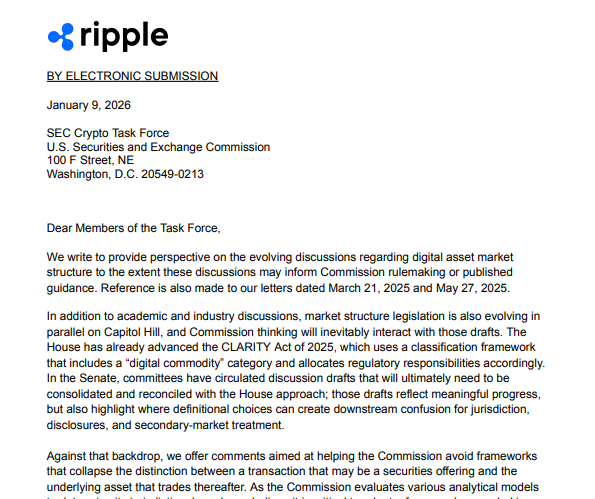 Source: sec.gov
At the heart of Ripple’s argument lies the differentiation between an asset and the transaction through which it may have been exchanged.
The company asserts that once an issuer’s enforceable commitments have been met or have lapsed, the asset itself should not continue to be subject to securities regulation indefinitely.
To treat it otherwise, the company argued, would blur the distinction between a contract and a commodity-like asset, extending regulatory authority beyond its intended boundaries.
Related Posts
Ripple also opposed regulatory strategies that heavily rely on the “efforts of others” aspect of the Howey test.
The company stated that concentrating solely on buyers’ expectations of others’ efforts neglects critical components of an investment contract, such as a common enterprise and enforceable profit rights.
It noted that price speculation alone does not classify an asset as a security unless it involves a legal claim on an issuer.
Regulators Consider New Asset Category as Crypto Policy Discussion Expands
Guillén’s submission aligns with this perspective while not fully endorsing any specific legislative proposal.
Separately, she published a discussion draft for a proposed Digital Markets Restructure Act of 2026, which has yet to be adopted by the SEC or the CFTC.
The draft introduces a new classification termed “Digital Value Instruments” for assets that do not neatly fit into current securities or commodities frameworks and suggests a risk-based division of regulatory oversight among agencies.
The comments were part of a larger wave of submissions made in late January, as industry stakeholders, policy organizations, and former regulators expressed their views on market integrity, tokenization, and cross-border regulation.
Numerous contributors cautioned against broad exemptions for decentralized trading platforms.
In contrast, others urged Congress and regulators to maintain essential investor protections without compelling digital assets into disclosure frameworks designed for traditional equities.
The policy discussion is taking place as legislative momentum has slowed in the Senate.
This week, a winter storm in Washington postponed the Senate Agriculture Committee’s initial markup vote on digital asset market structure legislation, further complicating an already uncertain timeline.
The Banking Committee’s parallel initiative on the CLARITY Act has also been delayed, leaving the Agriculture Committee’s bill as the most immediate vehicle for reform, despite evident partisan divisions.
The post Ex-SEC Lawyer Backs Ripple’s CLARITY Act Stance — Says Speculation Isn’t Securities Law appeared first on Cryptonews.
